

Introduction
Language is an important part of education, communication, and everyday life. Students use language to understand lessons, write assignments, answer examination questions, communicate with teachers, and express their ideas. Strong language skills can therefore make many aspects of learning easier.
One simple way to develop language skills is through regular reading.
When people read books, articles, stories, newspapers, academic materials, and other written resources, they encounter words and expressions in meaningful contexts. They can see how vocabulary is used, how sentences are constructed, and how ideas are organized.
Reading does not instantly transform someone’s vocabulary. Instead, improvement usually happens gradually through repeated exposure, attention, and practice.
The type of material also matters. A student reading a science textbook will encounter different vocabulary from someone reading a novel. Academic articles may introduce technical terminology, while fiction may provide exposure to descriptive language and dialogue.
This article explains how reading can support vocabulary and language development and provides practical strategies for making reading more effective.
Why Vocabulary Matters
Vocabulary is the collection of words a person understands and uses.
A strong vocabulary can help students understand complex information and express their ideas more precisely.
For example, knowing several words with related meanings allows a writer to select the word that best communicates a particular idea.
Vocabulary is especially important in academic settings because textbooks and research materials often use subject-specific terminology.
Developing vocabulary can therefore support both reading comprehension and communication.
1. Reading Introduces New Words
One of the most direct ways reading supports vocabulary development is by exposing readers to unfamiliar words.
A reader may encounter a word they have never seen before. The surrounding sentence often provides clues about its meaning.
For example, an unfamiliar word may be followed by an explanation, example, comparison, or description that helps the reader understand it.
The more varied material a person reads, the more opportunities they have to encounter new vocabulary.
2. Context Helps Explain Meaning
A dictionary provides a definition, but context can show how a word actually works in a sentence.
Suppose a reader encounters an unfamiliar word in a paragraph. Instead of immediately skipping it, they can look at the surrounding sentences.
Ask:
- What is the topic?
- Is the word describing an action, object, or quality?
- Are there examples nearby?
- Does the sentence provide a contrast?
- Can the general meaning be guessed?
These clues can help readers develop the ability to understand unfamiliar vocabulary independently.
3. Reading Improves Comprehension
Vocabulary and comprehension are closely connected.
If a reader understands the words used in a text, it becomes easier to understand the author’s overall message.
Conversely, unfamiliar vocabulary can make a difficult text even harder to follow.
Regular reading exposes students to vocabulary repeatedly, helping them become more comfortable with different types of written material.
4. Reading Introduces Different Writing Styles
Different types of books use language in different ways.
A novel may use descriptive language and dialogue.
A science textbook may use technical terminology.
A research paper may use formal academic language.
A biography may combine factual information with narrative writing.
Reading different formats allows learners to observe how language changes according to purpose and audience.
5. Reading Supports Better Writing
Reading can influence writing because readers are constantly exposed to examples of written communication.
By reading well-structured material, students can observe:
- How paragraphs are organized.
- How introductions work.
- How arguments are developed.
- How examples are presented.
- How conclusions summarize ideas.
This does not mean copying another author’s writing. Instead, readers can learn from the way information is organized and then develop their own style.
6. Reading Helps With Sentence Structure
Language development involves more than individual words.
Readers also learn how words work together to form sentences.
Regular exposure to different sentence structures can help students recognize:
- Simple sentences.
- Compound sentences.
- Complex sentences.
- Questions.
- Explanations.
- Comparisons.
This awareness can support clearer writing and communication.
7. Reading Builds Academic Vocabulary
Academic subjects often contain specialized vocabulary.
For example, computer science students may encounter terms related to programming, algorithms, databases, and networks.
Science students may encounter technical terms that are uncommon in everyday conversation.
Regular reading within a subject helps students become familiar with this vocabulary.
When preparing for examinations, understanding subject-specific terms can also make textbooks and questions easier to interpret.
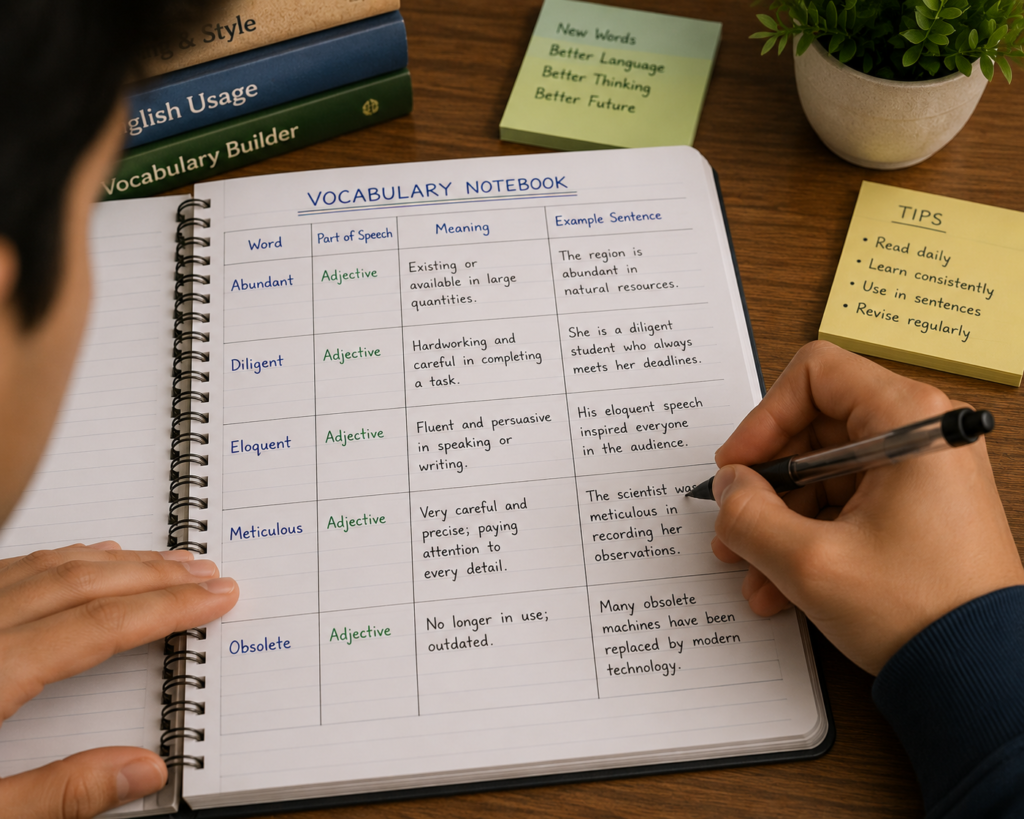
8. Keep a Vocabulary Notebook
A vocabulary notebook is a simple way to make reading more active.
When you encounter a useful unfamiliar word, record:
Word: The new vocabulary item.
Meaning: A simple explanation.
Example: A sentence showing how it is used.
Related Words: Synonyms or connected terms when useful.
For example:
Word: Analyze
Meaning: To examine something carefully.
Example: Students analyze information before reaching a conclusion.
Reviewing the notebook regularly can reinforce what you have learned.
9. Learn Words in Context
Memorizing a long list of isolated words is not always effective.
It can be more useful to learn vocabulary within sentences and paragraphs.
For example, instead of memorizing a definition alone, read several examples showing how the word is used.
This helps you understand not only what the word means but also when it is appropriate to use it.
10. Use a Dictionary When Necessary
Context can help you guess the meaning of an unfamiliar word, but sometimes a dictionary is still necessary.
If the word is important to understanding the paragraph, check its definition.
You can also look for:
- Pronunciation.
- Part of speech.
- Example sentences.
- Related words.
- Different meanings.
The goal is not to stop reading every time you see an unfamiliar word. Use a dictionary when the word is important or repeatedly appears.
11. Read Different Genres
Reading only one type of material limits the range of vocabulary you encounter.
Try exploring different genres, such as:
- Fiction.
- Biography.
- History.
- Science.
- Technology.
- Essays.
- News articles.
- Educational resources.
- Research publications.
Each category introduces different vocabulary and writing styles.
12. Read at the Right Difficulty Level
Material that is far beyond your current reading ability can become frustrating.
At the same time, reading only very easy material may provide limited opportunities for growth.
A useful approach is to choose resources that are understandable but contain some unfamiliar vocabulary.
As your skills improve, you can gradually move toward more challenging material.
13. Read Aloud Sometimes
Reading aloud can provide additional language practice.
It allows readers to hear sentence structures, pronunciation, rhythm, and phrasing.
For students learning a second language, reading aloud can be particularly useful as part of broader language practice.
However, reading silently is also valuable, especially for longer academic materials.
Using both approaches can provide variety.
14. Discuss What You Read
Language develops through communication as well as reading.
After reading a chapter or article, try explaining the main idea to someone else.
You can discuss:
- What happened.
- What you learned.
- Which ideas were important.
- Which words were unfamiliar.
- Whether you agreed with the author’s argument.
Explaining information in your own words helps connect reading with active language use.
15. Write After Reading
Writing a short summary after reading can reinforce vocabulary.
For example, after completing an article, write three to five sentences explaining its main ideas.
Try using some of the new vocabulary you encountered, but make sure you understand the words before using them.
This creates a useful cycle:
Read → Understand → Record → Use → Review
How Digital Libraries Can Support Language Development
Digital libraries can provide access to a wide range of written resources.
Depending on their collections, readers may find:
- eBooks.
- Academic articles.
- Research papers.
- Literature.
- Reference materials.
- Educational documents.
Digital search tools can also help users find resources by subject, author, or keyword.
Students can use these resources to encounter vocabulary related to their subjects while also developing general reading skills.
As always, digital resources should be accessed and used according to applicable copyright, licensing, and platform rules.

Common Vocabulary-Learning Mistakes
Trying to Memorize Too Many Words
Learning a small number of useful words thoroughly is often more practical than trying to memorize a huge list.
Ignoring Context
Knowing a definition is not enough. Understanding how a word is used is also important.
Never Reviewing New Words
Without review, newly learned vocabulary can easily be forgotten.
Using Words Without Understanding Them
Do not use a complicated word simply because it sounds impressive. Make sure you understand its meaning and usage.
Reading Only One Type of Material
Different genres expose you to different vocabulary and writing styles.
A Simple Reading and Vocabulary Routine
You can use the following routine several times a week:
Step 1: Choose a Suitable Article or Book
Select something that interests you and is appropriate for your reading level.
Step 2: Read Without Constant Interruption
Try to understand the overall meaning before stopping for every unfamiliar word.
Step 3: Identify Useful Vocabulary
Select a few important or interesting words.
Step 4: Check Their Meanings
Use a reliable dictionary when necessary.
Step 5: Write Example Sentences
Create your own sentences to practice using the words.
Step 6: Review Later
Return to your vocabulary list after a few days.
Step 7: Use the Words Naturally
Try incorporating appropriate vocabulary into your writing and communication.
Conclusion
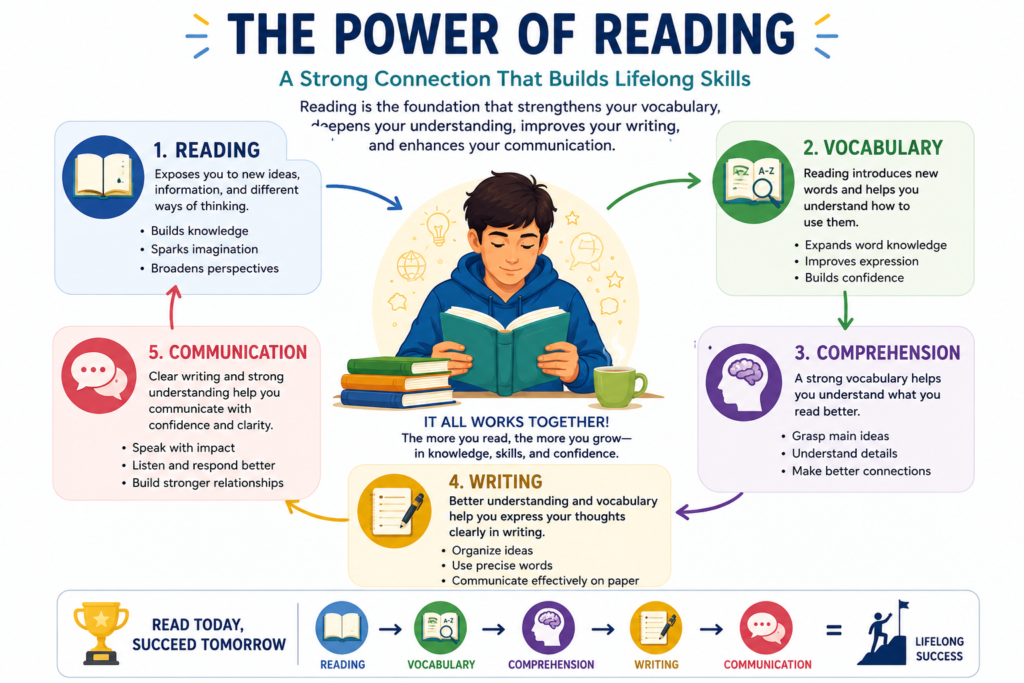
Reading is a practical and accessible way to support vocabulary and language development. Every book, article, and educational resource provides opportunities to encounter new words, sentence structures, ideas, and styles of communication.
The greatest benefits come from reading actively rather than simply moving from one page to the next. Paying attention to useful vocabulary, checking important unfamiliar words, taking notes, writing summaries, and reviewing new terms can make reading more effective.
Students can also benefit from reading materials connected to their academic subjects. This helps them become familiar with subject-specific vocabulary while strengthening their general language skills.
Digital libraries provide another useful source of reading material by making many types of resources easier to discover and access, depending on their collections and usage policies.
Vocabulary growth is a gradual process. There is no need to memorize hundreds of words in a single day. Consistent reading, thoughtful practice, and regular review can steadily expand your language abilities.
By making reading a regular part of your routine, you can build vocabulary while also improving comprehension, writing, communication, and confidence in using language.
Frequently Asked Questions
1. How does reading improve vocabulary?
Reading exposes you to new words in meaningful contexts and gives you repeated opportunities to see how those words are used.
2. Should I look up every unfamiliar word?
Not necessarily. Try using context to understand the general meaning first. Check a dictionary when the word is important or appears repeatedly.
3. Is reading fiction useful for vocabulary?
Yes. Fiction can expose readers to descriptive language, dialogue, expressions, and a wide variety of vocabulary.
4. Is academic reading useful for language development?
Yes. Academic books and articles can introduce subject-specific terminology and formal writing styles.
5. How can I remember new vocabulary?
Keep a vocabulary notebook, write example sentences, review words regularly, and use them appropriately in your own writing.
6. Does reading improve writing skills?
Regular reading exposes readers to different sentence structures, paragraph organization, vocabulary, and writing styles, which can support better writing.
7. Should I read aloud to improve language skills?
Reading aloud can provide practice with pronunciation, sentence rhythm, and phrasing. It can be combined with silent reading for a balanced routine.
8. Can digital libraries help improve vocabulary?
Yes. Digital libraries can provide access to many types of books and educational materials that expose readers to new vocabulary and writing styles.