
Introduction
A book review is more than a simple statement about whether you liked or disliked a book. A good review gives readers useful information about the book while also explaining the reviewer’s evaluation of its content, structure, ideas, characters, writing style, or overall purpose.
Students may be asked to write book reviews as part of an English, literature, history, or research assignment. Writing a review can also be a useful personal reading activity because it encourages readers to think carefully about what they have read.
A strong book review should answer several important questions:
- What is the book about?
- Who wrote it?
- What are its main ideas?
- What makes it interesting or useful?
- What are its strengths?
- Are there weaknesses?
- Who might benefit from reading it?
The best reviews do not simply retell the entire story. Instead, they provide enough background to help the reader understand the book and then offer a thoughtful evaluation.
This guide explains how students and general readers can write an organized, informative, and engaging book review.
What Is a Book Review?
A book review is a written evaluation of a book.
It usually contains:
- Basic information about the book.
- A brief summary.
- Discussion of important ideas or features.
- Evaluation of strengths and weaknesses.
- The reviewer’s overall opinion.
- A recommendation or conclusion.
A review should give readers an idea of what they can expect from the book without revealing unnecessary details.
For fiction, this may involve discussing characters, setting, themes, and writing style.
For nonfiction, the review may focus on the author’s arguments, organization, evidence, and usefulness.
Why Are Book Reviews Important?
Book reviews can help both readers and writers.
For readers, a review can provide an overview before they decide whether a book is suitable for them.
For students, writing a review develops several skills:
- Reading comprehension.
- Critical thinking.
- Writing.
- Analysis.
- Summarization.
- Communication.
- Evaluation.
Writing a review also encourages readers to move beyond simply finishing a book. They have to think about what the author was trying to communicate and how successfully the book achieved its purpose.
1. Read the Book Carefully
The first step in writing a good review is to read the book carefully.
Do not start writing the review based only on the book’s description or a short summary.
While reading, pay attention to:
- Main ideas.
- Important events.
- Characters.
- Themes.
- Arguments.
- Writing style.
- Examples.
- Evidence.
- Your own reactions.
Keep brief notes if necessary.
2. Record the Basic Book Information
Before writing, collect the essential details.
These may include:
- Book title.
- Author.
- Publisher.
- Publication year.
- Edition, if relevant.
- Genre.
- Number of pages, if relevant.
For example:
Book: [Title]
Author: [Author Name]
Genre: [Genre]
Publisher: [Publisher]
Published: [Year]
This information gives readers useful context.
3. Understand the Purpose of the Book
Ask yourself:
Why did the author write this book?
The purpose may be to:
- Tell a story.
- Explain an idea.
- Present research.
- Educate readers.
- Entertain.
- Explore a social issue.
- Share personal experiences.
Understanding the purpose makes it easier to evaluate whether the author achieved the intended goal.
4. Identify the Main Idea
Every book has one or more central ideas.
For nonfiction, the main idea may be an argument or subject the author explores.
For fiction, the central idea may be connected to themes such as:
- Friendship.
- Family.
- Courage.
- Identity.
- Responsibility.
- Change.
- Conflict.
Try to describe the main idea in your own words.
5. Write a Brief Summary
A book review usually includes a summary, but the summary should remain focused.
Explain:
- What the book is about.
- The main subject or storyline.
- Important themes or ideas.
- The general direction of the book.
Avoid summarizing every chapter.
The purpose is to give readers enough context to understand your evaluation.
6. Avoid Major Spoilers
If you are reviewing fiction, be careful about revealing major plot developments.
A review should help potential readers understand the book without taking away the experience of discovering the story themselves.
Instead of explaining every major event, discuss the overall storyline and themes.
If an important plot detail must be mentioned for analysis, provide an appropriate spoiler warning.
7. Analyze the Characters in Fiction
For novels and other fictional works, characters are often an important part of the review.
Consider:
Main Characters
Who are the central characters?
Development
Do they change throughout the story?
Relationships
How do their relationships affect the story?
Motivation
What motivates their decisions?
Believability
Do their actions make sense within the story?
You do not need to discuss every character. Focus on the characters most important to the book.
8. Examine the Setting
The setting includes the time and place where a story occurs.
Ask:
- Where does the story take place?
- When does it happen?
- Does the setting influence the characters?
- Does it contribute to the atmosphere?
- Is the setting described effectively?
A strong setting can make a fictional world more believable and meaningful.
9. Discuss the Themes
Themes are important ideas explored throughout a book.
For example, a novel might explore:
- Friendship.
- Family.
- Justice.
- Education.
- Freedom.
- Responsibility.
- Personal growth.
Do not simply list themes. Explain how the author develops them.

10. Evaluate the Writing Style
The author’s writing style can strongly influence the reading experience.
Consider whether the writing is:
- Clear.
- Descriptive.
- Formal.
- Conversational.
- Simple.
- Detailed.
- Fast-paced.
- Slow-paced.
For fiction, you might also discuss dialogue, descriptions, and storytelling techniques.
For nonfiction, consider whether the author explains complicated ideas clearly.
11. Review the Structure of the Book
Think about how the book is organized.
For nonfiction, consider:
- Are chapters logically arranged?
- Does each section contribute to the main topic?
- Are ideas introduced in a useful order?
- Are examples provided at appropriate points?
For fiction, consider:
- Is the story well paced?
- Does the sequence of events make sense?
- Are different parts connected effectively?
Structure can affect how easy a book is to understand.
12. Evaluate the Evidence in Nonfiction
For nonfiction books, evidence is often an important part of the review.
Ask:
- Does the author provide supporting evidence?
- Are examples relevant?
- Are sources identified?
- Are arguments explained clearly?
- Does the evidence support the author’s conclusions?
A book presenting factual or academic information should be evaluated carefully rather than accepted simply because it is published.
13. Discuss the Strengths
Every review should identify what the book does well.
Possible strengths include:
- Strong characters.
- Interesting ideas.
- Clear explanations.
- Useful examples.
- Effective organization.
- Engaging storytelling.
- Well-developed themes.
- Strong research.
Choose specific strengths rather than simply saying:
“The book was excellent.”
Explain why it was effective.
14. Discuss the Weaknesses Fairly
A good review does not have to praise everything.
You can identify areas that could be improved.
For example:
- Some sections may be repetitive.
- Certain explanations may be too brief.
- The pacing may become slow.
- Some arguments may need stronger evidence.
- A topic may not be explored deeply enough.
Criticism should be respectful and supported by examples.
The purpose is to evaluate the book, not attack the author.
15. Give Your Personal Evaluation
After analyzing the book, explain your overall opinion.
Instead of writing:
“I liked it.”
write something more informative:
“The book provides a clear introduction to the subject and uses practical examples that make the main ideas easier to understand.”
Your opinion becomes more useful when you explain the reasons behind it.
16. Consider the Intended Audience
Ask:
Who would benefit from reading this book?
It might be suitable for:
- School students.
- University students.
- Beginners.
- Researchers.
- Fiction readers.
- History enthusiasts.
- General readers.
Mentioning the intended audience helps readers decide whether the book is appropriate for them.
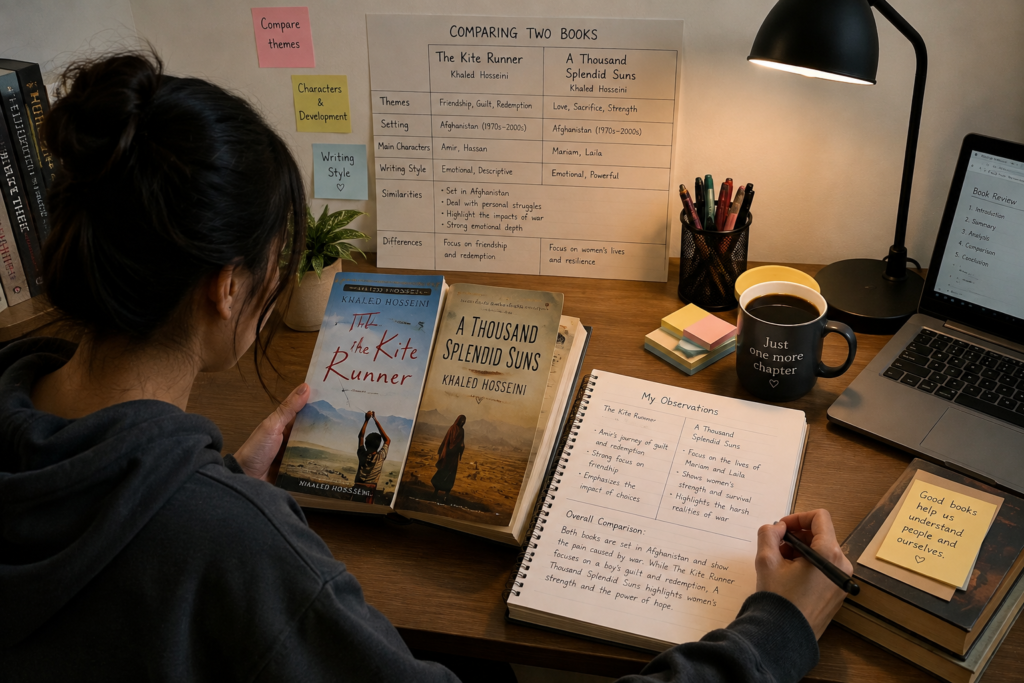
17. Compare the Book With Similar Works
A comparison can sometimes strengthen a review.
You might discuss whether the book:
- Provides a different perspective.
- Explains the topic more simply.
- Offers more detailed evidence.
- Uses a different writing style.
- Approaches a familiar subject in a new way.
However, comparison is optional. The main focus should remain on the book being reviewed.
18. Write an Effective Introduction
The introduction should immediately tell readers what book you are reviewing.
Include:
- Title.
- Author.
- Genre or subject.
- General purpose.
- Your overall impression.
For example:
“[Book Title] by [Author] explores [main topic]. The book combines [feature] with [feature] and provides readers with a useful perspective on [subject].”
Keep the introduction focused.
19. Organize the Main Body
A simple structure can make the review easier to read.
Paragraph 1
Introduce the book.
Paragraph 2
Provide a brief summary.
Paragraph 3
Discuss important ideas, themes, or arguments.
Paragraph 4
Analyze writing style, characters, evidence, or organization.
Paragraph 5
Discuss strengths and weaknesses.
Paragraph 6
Give your overall evaluation.
This structure can be adapted depending on the book.
20. Finish With a Strong Conclusion
The conclusion should summarize your overall evaluation.
Mention:
- Your final opinion.
- The book’s main strengths.
- Any important limitations.
- Who might enjoy or benefit from it.
Avoid introducing a completely new argument in the final paragraph.
A Simple Book Review Structure
Students can remember this structure:
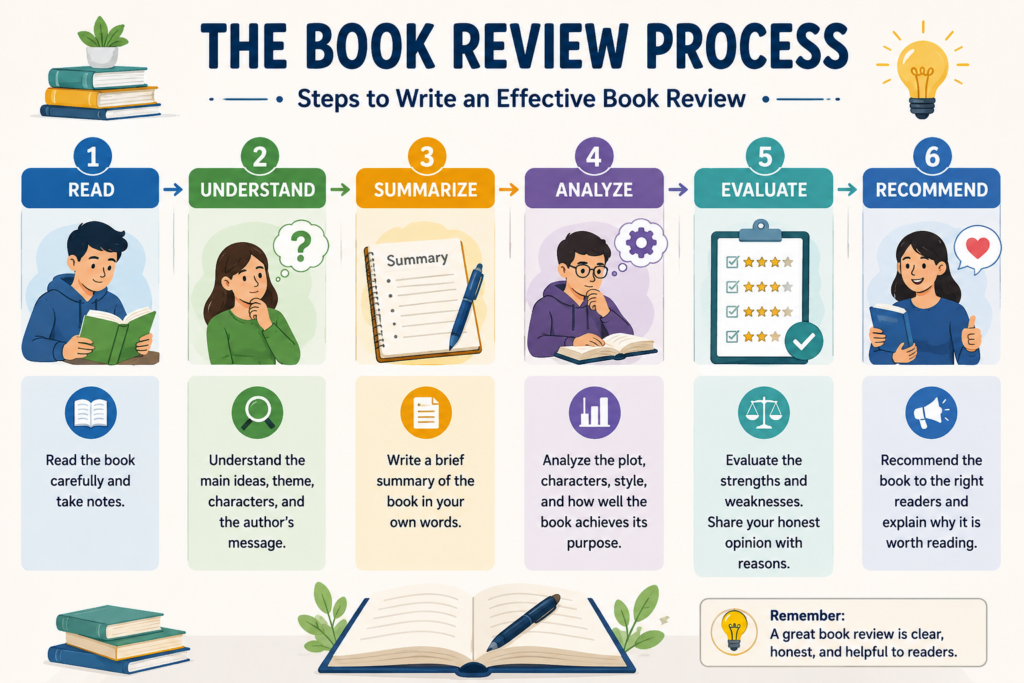
Introduction → Summary → Analysis → Strengths → Weaknesses → Evaluation → Recommendation
This provides a logical flow and prevents the review from becoming only a summary.
Example of a Balanced Review
Instead of:
“This is the best book ever. Everyone should read it.”
A stronger review might say:
“The book presents its central ideas clearly and provides useful examples for beginners. Some sections could be more detailed, but the straightforward organization makes the book accessible to students who are new to the subject.”
The second version is more useful because it explains both strengths and limitations.
Common Book Review Mistakes
Writing Only a Summary
A review should evaluate the book, not simply retell it.
Giving an Opinion Without Reasons
Explain why you reached your conclusion.
Including Too Many Spoilers
Protect the reading experience.
Ignoring the Author’s Purpose
Evaluation should consider what the book was trying to achieve.
Being Too Negative
Criticism should be fair and supported.
Being Too Positive
A useful review should remain honest rather than praising everything.
Forgetting Basic Information
Always identify the title and author clearly.
Tips for Writing a Better Book Review
Take Notes While Reading
Record important ideas instead of trying to remember everything later.
Use Specific Examples
Examples make your evaluation more convincing.
Be Fair
Recognize both strengths and weaknesses.
Use Clear Language
Avoid unnecessary complicated words.
Keep Your Review Organized
Use paragraphs and headings where appropriate.
Proofread Before Publishing
Check grammar, spelling, punctuation, and names.
Avoid Unnecessary Spoilers
Give readers useful information without revealing major developments.
Book Reviews and Digital Libraries
Digital libraries can also support book reviewing.
Students may discover books through digital library collections and examine publication information before reading.
Depending on the platform, they may also be able to search within digital books for specific terms or topics.
When reviewing a digital book, students should treat it in the same thoughtful way as a printed book:
Read → Understand → Analyze → Evaluate → Write
The format may be digital, but critical reading remains essential.
Why Writing Book Reviews Improves Reading Skills
Writing a review can make reading more active.
Instead of simply asking:
“Did I enjoy this book?”
students begin asking:
- What is the author’s main idea?
- Why did the author write this?
- How effectively are the ideas presented?
- What evidence supports the arguments?
- How do the characters develop?
- What themes are explored?
- What could be improved?
These questions encourage deeper reading and critical thinking.
Conclusion
Writing a good book review requires more than giving a simple opinion. A strong review combines a brief summary with thoughtful analysis and fair evaluation.
Students should begin by reading the book carefully and recording important observations. They can then introduce the book, explain its main ideas, discuss relevant features, identify strengths and weaknesses, and provide an overall evaluation.
The best reviews are specific, balanced, and useful to readers. They explain why a book succeeds or falls short rather than simply saying whether the reviewer liked it.
Book reviewing can also strengthen important academic skills, including reading comprehension, critical thinking, analysis, and writing.
Whether you are reviewing a novel, textbook, biography, research book, or another type of publication, the basic principle remains the same: read carefully, think critically, write clearly, and support your evaluation with meaningful observations.
Frequently Asked Questions
1. What is a book review?
A book review is a written evaluation that summarizes and analyzes a book while giving an overall opinion about its quality and usefulness.
2. What should a book review include?
It should generally include basic book information, a brief summary, analysis, strengths, weaknesses, an overall evaluation, and sometimes a recommendation.
3. How long should a book review be?
The appropriate length depends on the assignment. A short school review may require only a few paragraphs, while a detailed review can be much longer.
4. Should I summarize the entire book?
No. A review should provide enough information to explain the book without retelling every event or chapter.
5. Should a book review include spoilers?
Avoid major spoilers unless they are necessary for your analysis and clearly identified.
6. Can I criticize a book in a review?
Yes. A review can discuss weaknesses, but criticism should be fair, respectful, and supported by specific observations.
7. Should I give my personal opinion?
Yes. A review normally includes an overall evaluation, but your opinion is more useful when you explain the reasons behind it.
8. What is the difference between a book summary and a book review?
A summary mainly explains what a book contains. A review goes further by analyzing and evaluating the book.