
Introduction
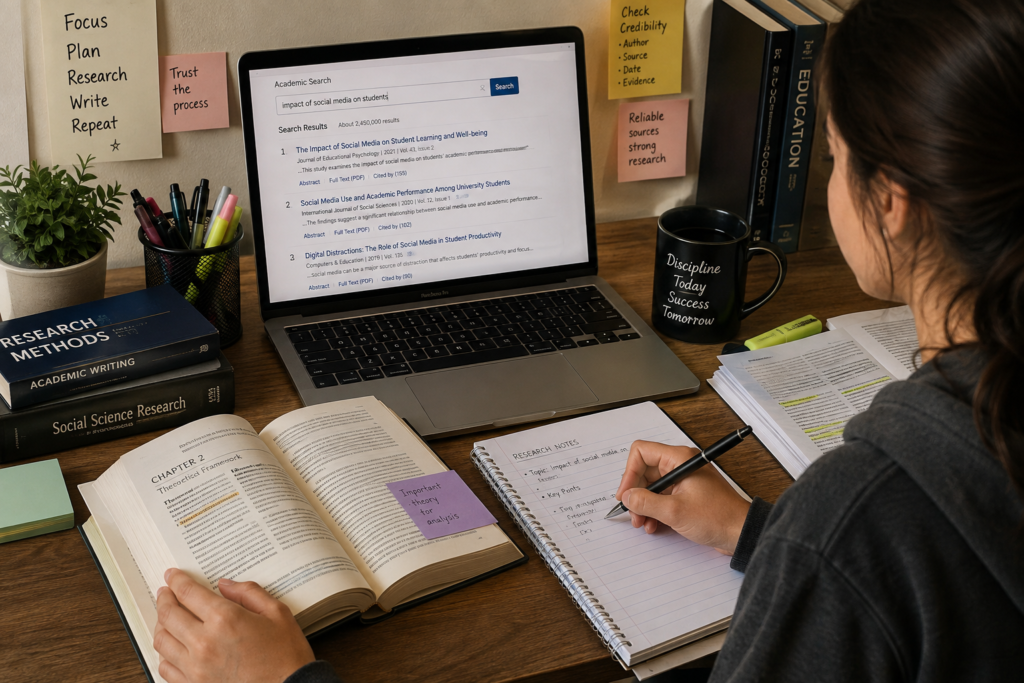
Research is an important part of student learning. Whether a student is preparing an assignment, writing a report, creating a presentation, or working on a research project, the quality of the information used can affect the quality of the final work.
The internet has made research faster and more convenient, but it has also created a new challenge: not all information available online is reliable.
A search can produce thousands of results within seconds. Some sources may contain accurate information supported by evidence, while others may contain opinions, outdated information, incomplete explanations, or unsupported claims.
For this reason, students need to learn how to identify reliable sources before using information in academic work.
Finding a reliable source does not mean choosing a website simply because it looks professional. Students should examine the author, publisher, date, evidence, references, purpose, and relevance of the information.
This article explains practical methods students can use to find and evaluate reliable sources for academic research.
What Is a Reliable Source?
A reliable source is a source that provides information that can reasonably be trusted for the purpose of your research.
A reliable source generally has identifiable authorship, appropriate evidence, clear publication information, and information that can be checked or supported.
Examples can include:
- Academic books.
- Peer-reviewed research articles.
- University publications.
- Government publications.
- Library resources.
- Reputable educational organizations.
- Established reference works.
The most suitable source depends on the research topic.
Why Reliable Sources Matter
Using unreliable information can create several problems.
For example, a student may:
- Include incorrect facts.
- Reach an unsupported conclusion.
- Misrepresent a topic.
- Lose marks on an assignment.
- Spread misinformation.
- Have difficulty defending their research.
Reliable sources provide a stronger foundation for academic writing.
Good research is not simply about finding information. It is about finding useful information that can be supported and evaluated.
1. Start With a Clear Research Question
Before searching for sources, understand what you are trying to find.
For example, instead of searching:
“Reading”
create a more specific question:
“How can regular reading support students’ learning?”
A clear question helps you choose relevant sources.
It also prevents you from collecting information that sounds interesting but does not actually support your research topic.
2. Use Specific Search Keywords
Search engines work better when your keywords describe exactly what you need.
Instead of:
“students”
try:
“effective reading habits for students”
Instead of:
“digital library”
try:
“benefits of digital libraries for academic research”
You can experiment with different keyword combinations until you find relevant results.
3. Look for Academic and Educational Sources
When conducting academic research, prioritize sources designed for education or research.
Useful places to search may include:
- University websites.
- Digital libraries.
- Academic databases.
- Educational institutions.
- Research organizations.
- Government websites.
- Reputable publishers.
These sources are not automatically correct simply because of their affiliation, but they can provide valuable starting points for academic research.
4. Check the Author
One of the first things to examine is authorship.
Ask:
- Who wrote the information?
- What is the author’s background?
- Are qualifications or affiliations provided?
- Does the author have relevant knowledge of the subject?
An identifiable author gives readers more information about where the content came from.
For academic work, the author’s expertise can be particularly important.
5. Check the Publisher or Organization
Look at who published the information.
A source published by a university, research institution, government department, academic publisher, or established educational organization may provide stronger evidence than an anonymous page.
However, always evaluate the actual content rather than relying only on the organization’s name.
6. Check the Publication Date
The date of publication matters because information changes over time.
For example, a source about:
- Current technology.
- Educational policies.
- Software.
- Scientific developments.
- Current statistics.
may need to be relatively recent.
On the other hand, an older book may still be extremely useful when researching history or the development of an idea.
The important question is:
Is this source current enough for my particular topic?
7. Look for References and Evidence
A strong academic source often explains where its information comes from.
Look for:
- Citations.
- References.
- Research data.
- Studies.
- Bibliographies.
- Links to original publications.
A claim without supporting evidence should be examined carefully.
If a source says something surprising, try to find another credible source that supports or challenges the claim.
8. Compare Information From Multiple Sources
One source should not always be treated as the final answer.
Compare important information across several suitable sources.
For example, if you are researching the benefits of reading, you might compare information from:
- An academic article.
- A university resource.
- A library book.
- A research publication.
If several independent sources support the same point, you have stronger grounds for including it.
If sources disagree, investigate why.
9. Understand the Purpose of the Source
Ask why the source was created.
It could be intended to:
- Educate.
- Inform.
- Entertain.
- Persuade.
- Sell a product.
- Promote an organization.
- Express an opinion.
A promotional page may contain useful information, but students should recognize that its purpose may influence how information is presented.
10. Recognize Opinion-Based Content
Not every piece of writing is intended to provide objective information.
Blogs, opinion articles, personal essays, and discussion forums may express individual viewpoints.
Such sources can sometimes be useful when your research involves opinions or public perspectives, but they should not automatically be treated as academic evidence.
Look for the difference between:
“Research indicates…”
and
“I believe…”
They represent different types of statements.
11. Use Digital Libraries
Digital libraries can be especially useful for academic research because they organize collections of books, articles, journals, documents, and other educational materials.
Depending on the collection, students may be able to search by:
- Title.
- Author.
- Subject.
- Keyword.
- Publication.
- Date.
Digital libraries can save time because they provide a structured environment for finding research materials.
Students should always use legitimate library services and respect copyright and access conditions.

12. Check the Original Source
Sometimes an article refers to a study or report.
Instead of relying only on the article’s summary, try to locate the original publication when practical.
For example:
Article → Research study → Original findings
Reading the original source can provide more context and reduce the risk of misunderstanding what the research actually says.
13. Be Careful With Search Snippets
Search engines often show a short preview of a webpage.
A snippet may contain only part of a sentence or paragraph.
Do not use the snippet as your evidence.
Open the original page and read the relevant section in context.
This helps prevent misunderstanding.
14. Check for Outdated Statistics
Statistics can change.
Suppose an old article says that a particular percentage of students use a certain technology.
That number may no longer represent current usage.
When using statistics, check:
- The year.
- The organization that collected the data.
- The sample or population.
- The original report, when available.
This is especially important for research involving current trends.
15. Be Careful With AI-Generated Content
AI tools can produce useful explanations, but students should not automatically treat AI-generated text as an authoritative academic source.
AI-generated information can contain errors, incomplete explanations, or unsupported claims.
When research requires evidence, students should verify important information through appropriate primary or authoritative sources.
AI can be used as a learning aid, but it should not replace source evaluation.
16. Check Whether the Information Is Relevant
A source can be reliable but still be unsuitable for your particular research question.
For example, a highly credible book about twentieth-century history may not be relevant to an assignment about modern digital education.
Ask:
Does this source actually help answer my research question?
Relevance is just as important as reliability.
17. Use Primary and Secondary Sources Appropriately
A primary source provides original material or direct evidence.
Examples may include:
- Original research.
- Interviews.
- Historical documents.
- Official records.
- Survey results.
A secondary source discusses, analyzes, or explains information from other sources.
Examples include:
- Textbooks.
- Review articles.
- Research summaries.
- Educational explanations.
Both can be useful, depending on the assignment.
18. Keep a Source Record
As you research, record information about every useful source.
A simple table can help:
| Source | Author | Date | Main Idea | Used? |
|---|---|---|---|---|
| Academic article | Author name | Year | Research finding | Yes |
| E-book | Author name | Year | Background information | Yes |
| Website | Organization | Year | Definition | Maybe |
Keeping this information organized makes writing much easier later.
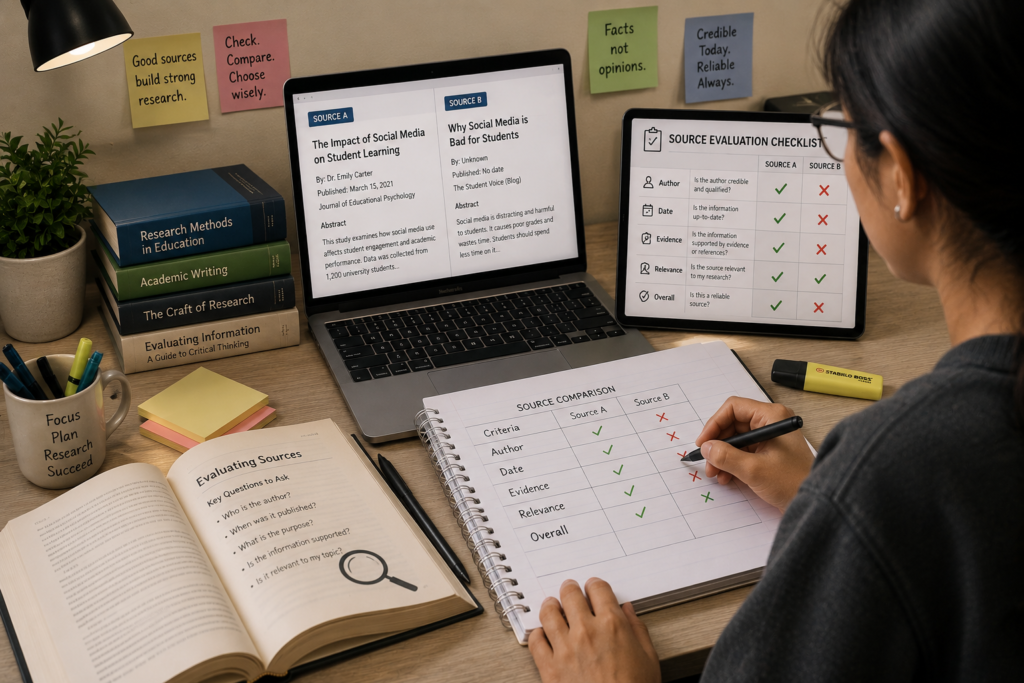
19. Use a Source Evaluation Checklist
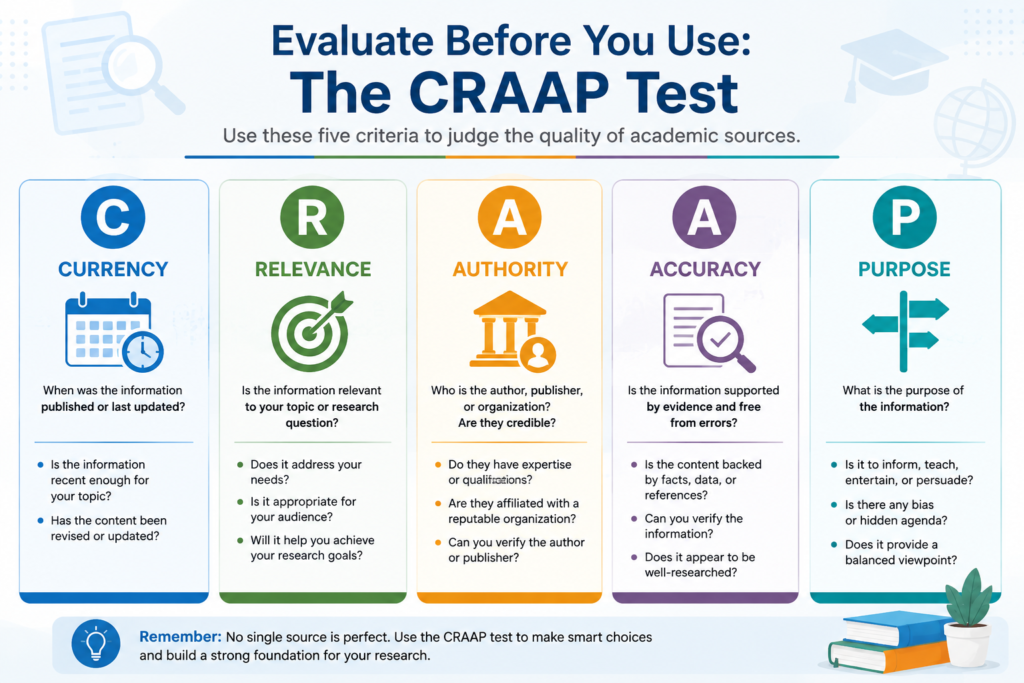
Before using a source, ask:
Authority
Who created it?
Accuracy
Is the information supported?
Currency
Is the information recent enough?
Relevance
Does it answer your research question?
Purpose
Why was it published?
Evidence
Are references or supporting sources provided?
If a source performs well across these areas, it may be more suitable for your research.
20. Don’t Trust a Source Just Because It Looks Professional
A website can have attractive graphics, modern design, and impressive language while still containing weak information.
Visual appearance is not proof of accuracy.
Always examine the actual content and supporting evidence.
This is an important research habit because students may encounter misleading information presented in a professional-looking format.
Example: Evaluating an Online Source
Imagine you find an article about the benefits of reading.
Before using it, ask:
Who wrote it?
Is an author identified?
When was it published?
Is the date appropriate?
Where was it published?
Is the publisher identifiable?
What evidence is provided?
Are studies or references mentioned?
Does it answer my research question?
If the answers are satisfactory, the source may be useful.
If the page has no author, no date, no references, and makes several unsupported claims, you should look for stronger sources.
Common Mistakes Students Make
Using the First Result
The first search result is not automatically the best source.
Relying on One Website
Important information should often be compared with other sources.
Ignoring the Author
Knowing who produced the information helps you evaluate it.
Forgetting the Date
Older information may not be suitable for current topics.
Copying Without Checking
Students should understand and verify information before using it.
Using Unsourced Statistics
Statistics should be connected to a credible source whenever possible.
Confusing Popular Content With Academic Evidence
A page can be popular without being academically reliable.
How to Build a Strong Research Collection
A strong collection of sources does not need to be enormous.
For a student assignment, focus on finding sources that cover different needs.
For example:
Background Source
Provides basic information about the topic.
Academic Source
Provides research or scholarly discussion.
Reference Source
Provides definitions, dates, or established facts.
Supporting Source
Provides examples, statistics, or additional evidence.
Together, these sources can create a stronger foundation for an assignment.
Responsible Use of Online Information
Students should remember that information found online belongs to its creators or publishers.
Responsible research includes:
- Giving credit to sources.
- Following copyright rules.
- Using quotations appropriately.
- Paraphrasing honestly.
- Keeping accurate references.
- Avoiding plagiarism.
Research becomes more valuable when it is conducted honestly.
Conclusion
Finding reliable sources is one of the most important academic research skills students can develop.
The internet provides an enormous amount of information, but students must learn to separate useful evidence from unsupported claims.
A good researcher checks the author, publisher, publication date, evidence, references, purpose, and relevance of a source. Comparing information across several suitable sources can provide additional confidence and help reveal different perspectives.
Digital libraries, academic publications, university resources, government information, and reputable educational organizations can all provide valuable research material.
At the same time, students should not judge a source simply by its appearance or search-engine ranking. Professional design does not guarantee accuracy, and popularity does not necessarily mean academic reliability.
The best approach is simple: search carefully, evaluate critically, organize your sources, and verify important information before using it.
These habits can help students produce stronger assignments and become more confident independent researchers.
Frequently Asked Questions
1. What makes a source reliable?
A reliable source generally has identifiable authorship, appropriate evidence, clear publication information, and content that can be checked or supported.
2. Are university websites reliable sources?
University websites can provide valuable academic and educational information, but students should still evaluate the specific page and its purpose.
3. Are digital libraries useful for academic research?
Yes. Digital libraries can provide organized access to books, articles, research publications, and other educational materials.
4. How can I check whether an online article is reliable?
Check the author, publisher, publication date, references, evidence, purpose, and relevance to your research question.
5. Should students use multiple sources?
Comparing multiple suitable sources can help students verify information and understand different perspectives.
6. Can AI-generated information be used as an academic source?
Students should verify AI-generated information through appropriate authoritative sources rather than treating AI output itself as proof.
7. What is the difference between a primary and secondary source?
A primary source provides original evidence or material, while a secondary source analyzes, explains, or summarizes information from other sources.
8. Why is the publication date important?
Some information changes over time. The date helps students determine whether a source is current enough for their particular research topic.