
Introduction
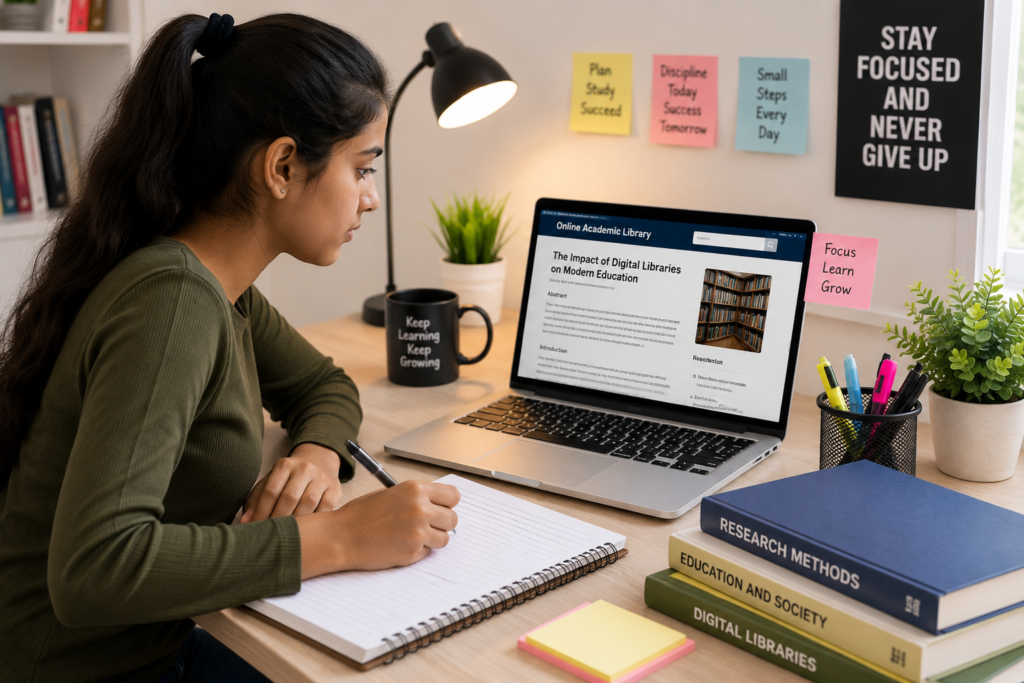
The internet has changed the way students find information. Instead of depending entirely on a single textbook or visiting a physical library every time they need information, students can now access digital books, academic articles, educational websites, research papers, reference materials, and other learning resources from a computer or mobile device.
However, having access to a large amount of information does not automatically make research easy.
One of the biggest challenges students face is deciding which information is useful and which sources can be trusted. A quick search may produce thousands of results, but some may be outdated, incomplete, inaccurate, or unsuitable for academic work.
Effective online research is therefore a skill.
Students need to know how to create a research question, choose appropriate keywords, find suitable sources, evaluate information, take organized notes, and use sources responsibly.
This guide explains a practical research process that students can use for assignments, projects, presentations, and independent study.
What Is Online Research?
Online research is the process of finding, examining, and using information through internet-based resources.
Students may use:
- Digital libraries.
- E-books.
- Academic journals.
- Research papers.
- Educational websites.
- Online encyclopedias.
- Government publications.
- Institutional websites.
- Digital archives.
Online research can save time, but students still need to think critically about the information they find.
The goal is not to collect the largest number of websites. The goal is to find relevant, reliable, and useful information.
Why Is Online Research Important for Students?
Research skills are useful throughout education.
Students may need to research information for:
- Homework.
- Assignments.
- Science projects.
- Presentations.
- Essays.
- Reports.
- Academic papers.
- Examination preparation.
Learning how to research effectively also helps students become more independent learners.
Instead of waiting for someone to provide every answer, students can learn how to find and evaluate information themselves.
1. Understand Your Research Topic
Before searching online, make sure you understand what you are being asked to research.
Suppose an assignment asks:
“Explain the effects of digital technology on education.”
The topic is broad.
You can divide it into smaller questions:
- How is technology used in classrooms?
- What are the benefits?
- What are the challenges?
- How does technology affect independent learning?
- What examples can support the discussion?
Breaking a broad topic into smaller questions makes research easier.
2. Create a Research Question
A good research question gives direction to your work.
Instead of searching:
“Technology”
try:
“How does digital technology support student learning?”
A specific question helps you decide which information is relevant.
As you research, you may also modify the question when you discover new information.
3. Choose the Right Keywords
Search engines work more effectively when you use specific keywords.
For example, instead of searching:
“books”
you could search:
“benefits of digital books for students”
Other useful keywords might include:
- Academic research.
- Digital learning.
- Student reading habits.
- Online education resources.
- Digital library research.
Try different combinations if the first search does not provide useful results.
4. Use Reliable Search Results
Search results can contain many different types of websites.
A student should look for sources such as:
- Universities.
- Libraries.
- Educational institutions.
- Government organizations.
- Established academic publishers.
- Recognized research organizations.
This does not mean every page from these organizations is automatically perfect, but institutional sources can often provide useful starting points.
5. Use Digital Libraries
Digital libraries can be valuable research tools.
They may provide access to:
- E-books.
- Academic articles.
- Reference materials.
- Historical documents.
- Research publications.
- Educational resources.
Instead of relying only on general search results, students can explore appropriate digital library collections for their topic.
When using a digital library, check the information about the publication and follow its access and copyright conditions.
6. Evaluate the Author
Before using information from a source, check who created it.
Ask:
Who is the author?
What qualifications or experience do they have?
Are they associated with a recognized institution?
Have they provided references?
The answers can help you decide how useful the source may be.
7. Check the Publication Date
Information can become outdated.
For subjects such as technology, science, education policy, and current events, publication dates can be particularly important.
An older source may still be valuable for historical information, but a recent topic may require newer research.
Always consider whether the date is appropriate for your research question.
8. Check the Evidence
Reliable academic information should be supported by evidence where appropriate.
Look for:
- References.
- Citations.
- Data.
- Research findings.
- Examples.
- Links to original sources.
Be cautious with claims that provide no supporting information, especially when the claim is presented as an important fact.
9. Compare Multiple Sources
Do not automatically accept the first source you find.
Compare information from several suitable sources.
For example, if you are researching reading habits, you might consult:
- An educational institution.
- A research article.
- A digital library book.
- A reputable educational resource.
Comparing sources can help you identify consistent information and notice differences that require further investigation.
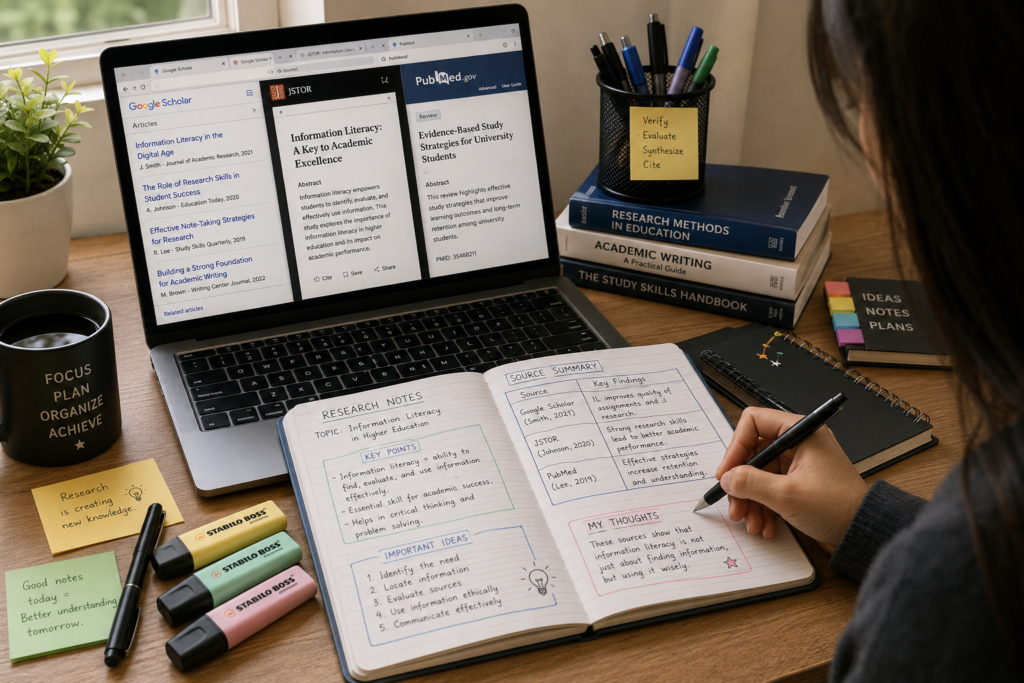
10. Take Research Notes
Good notes are essential.
Do not copy entire pages into your notebook.
Instead, record:
- Main idea.
- Important facts.
- Useful quotations when permitted.
- Source name.
- Author.
- Publication date.
- Page or section information.
- Your own explanation.
Keeping source information alongside your notes makes it easier to return to the original material later.
11. Organize Your Sources
Create a simple source list.
For example:
| Source | Topic | Useful Information |
|---|---|---|
| E-book | Digital learning | Learning benefits |
| Academic article | Student research | Research methods |
| Educational website | Online learning | Practical examples |
Organization becomes especially important when an assignment requires several sources.
12. Distinguish Facts From Opinions
Not every statement online is a fact.
Some pages contain:
- Personal opinions.
- Reviews.
- Arguments.
- Interpretations.
- Advertising claims.
Students should identify what type of information they are reading.
A personal opinion can sometimes be useful when discussing perspectives, but it should not automatically be presented as an established fact.
13. Avoid Copying and Plagiarism
Easy access to information can create a temptation to copy.
Students should not submit someone else’s writing as their own.
A better process is:
Read → Understand → Take Notes → Write in Your Own Words → Cite the Source
If you use an exact quotation, follow the required citation rules and quotation guidelines for your assignment.
Academic honesty is an important part of responsible research.
14. Use Search Filters
Many search engines and research databases provide filters.
Depending on the platform, you may be able to narrow results by:
- Date.
- Language.
- Document type.
- Subject.
- Publication.
- Academic source.
Using filters can reduce irrelevant results and make research more efficient.
15. Keep Track of Useful Sources
Do not assume you will remember where you found information.
Save or record the source details while researching.
For each useful source, record:
- Title.
- Author.
- Website or publication.
- Date.
- Relevant page or section.
- Access information when required.
This can save considerable time when preparing the final assignment.
16. Check Information Before Using It
Before including an important fact, ask whether it can be verified.
If two reliable sources provide different information, investigate further rather than choosing one randomly.
Look for the original study, official publication, or authoritative source when possible.
This habit helps students develop stronger research skills.
17. Don’t Collect Too Many Sources
More sources do not always mean better research.
If you collect dozens of articles but read only the first few lines of each, you may not understand your topic properly.
A smaller collection of relevant, reliable sources can be more useful than a huge collection of unrelated material.
Focus on quality and relevance.
18. Read Beyond Search Snippets
Search results often display short descriptions.
These snippets can help you decide whether a page may be relevant, but they are not a substitute for reading the source itself.
Open the source and examine the actual information.
Pay attention to:
- Context.
- Evidence.
- References.
- Author information.
- Publication details.
19. Use Research to Build Understanding
Research should not simply be a process of collecting sentences.
After gathering information, ask:
What does this information mean?
How does it answer my research question?
How does it connect with other sources?
What conclusion can I reasonably draw?
These questions turn research into learning.
20. Review Your Research Before Writing
Before starting the final assignment, review your notes.
Identify:
- The strongest sources.
- The main ideas.
- Supporting evidence.
- Differences between sources.
- Important examples.
- Information that still needs verification.
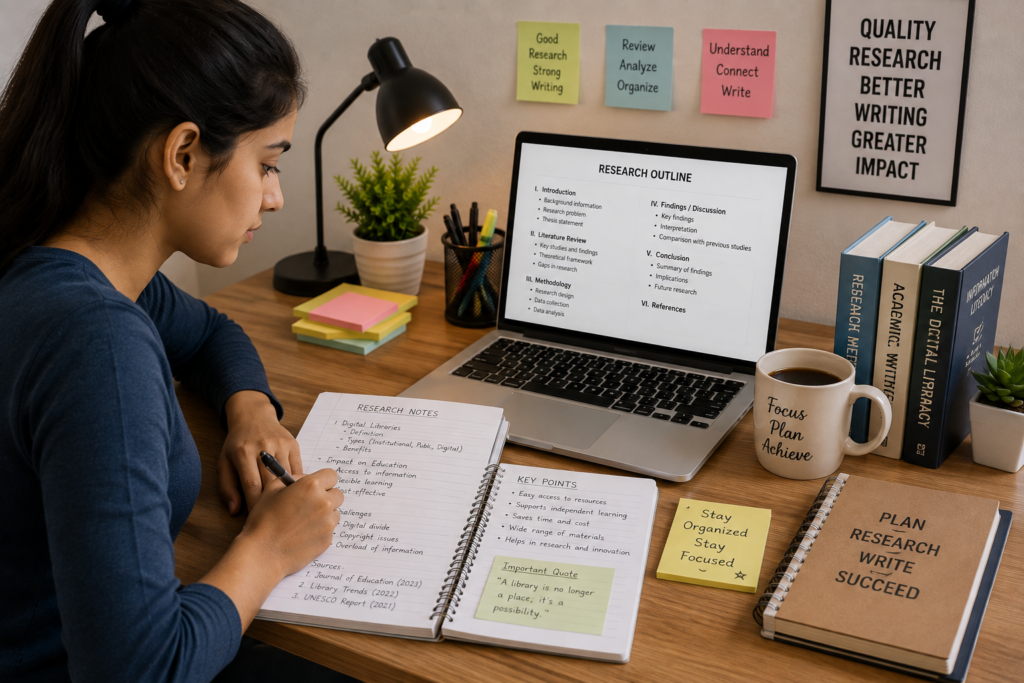
Then create a simple outline.
For example:
Introduction
Explain the topic.
Main Point 1
Present the first major idea.
Main Point 2
Provide evidence and examples.
Main Point 3
Discuss another perspective.
Conclusion
Summarize the findings.
A Simple Online Research Process
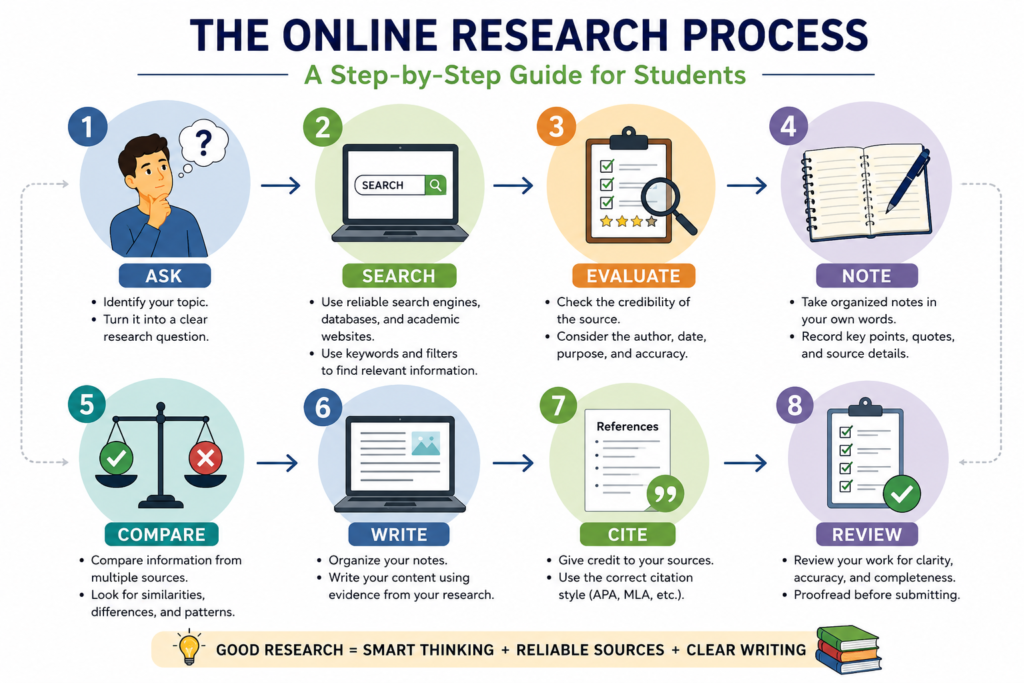
Students can remember the research process using these steps:
Step 1: Ask
Create a clear research question.
Step 2: Search
Use specific keywords.
Step 3: Select
Choose relevant sources.
Step 4: Evaluate
Check reliability, author, date, evidence, and purpose.
Step 5: Read
Understand the information carefully.
Step 6: Note
Record important ideas and source details.
Step 7: Compare
Check information against other suitable sources.
Step 8: Write
Present your findings in your own words.
Step 9: Cite
Give appropriate credit to sources.
Step 10: Review
Check your work before submission.
Common Online Research Mistakes
Using the First Search Result
The first result is not necessarily the most reliable source.
Searching With Very Broad Keywords
Broad searches can produce too much irrelevant information.
Copying Text Directly
Copying can lead to plagiarism and does not demonstrate understanding.
Ignoring Publication Dates
Old information may not be suitable for some topics.
Using Unverified Claims
Information without evidence should be treated carefully.
Forgetting Source Details
Losing track of sources makes citation and verification more difficult.
Using Too Many Resources
Too many sources can create unnecessary confusion.
How Digital Libraries and Online Research Work Together
Digital libraries can complement general online research.
A search engine can help students discover possible sources, while digital libraries can provide access to organized collections of books, articles, and other publications.
Using both can create a stronger research process.
For example:
Search engine → Find relevant topic → Digital library → Locate reliable resources → Read → Take notes → Compare → Write
Students should always use resources legally and follow the rules of the library or platform.
Benefits of Developing Online Research Skills
Strong research skills can help students:
- Find information more efficiently.
- Identify reliable sources.
- Understand topics more deeply.
- Complete assignments more effectively.
- Develop critical thinking.
- Avoid plagiarism.
- Organize academic information.
- Become independent learners.
These skills can remain useful long after a particular assignment has been completed.
Conclusion
Online research has become an important part of modern education. Students can access an enormous amount of information through digital libraries, e-books, academic articles, educational websites, and other online resources.
However, effective research requires more than typing a question into a search engine.
Students need to define their topic, choose useful keywords, evaluate sources, compare information, take organized notes, and keep track of where their information comes from.
Most importantly, research should be used to develop understanding rather than simply collect information.
When students learn to question sources, verify important facts, recognize opinions, and organize evidence, they become stronger researchers and more independent learners.
A good research process takes practice, but the skills developed through that process can benefit students throughout their academic journey.
Frequently Asked Questions
1. What is online research?
Online research is the process of finding, evaluating, organizing, and using information from internet-based resources.
2. What are good sources for student research?
Digital libraries, academic publications, universities, educational institutions, government resources, and reputable research organizations can provide useful sources.
3. How can students know whether an online source is reliable?
Check the author, publisher, publication date, evidence, references, and purpose of the source.
4. How many sources should a student use?
There is no universal number. Students should use enough relevant and reliable sources to support the requirements of their particular assignment.
5. Why should students compare sources?
Comparing sources can help students verify information and understand different perspectives.
6. Is copying information from a website acceptable?
Students should not present another person’s writing as their own. Information should be understood, appropriately paraphrased or quoted, and cited according to the assignment requirements.
7. Are digital libraries useful for research?
Yes. Depending on their collections, digital libraries can provide access to books, academic articles, reference materials, and research publications.
8. What is the most important online research skill?
Critical evaluation is one of the most important skills because students need to determine whether information is relevant and trustworthy.