
Introduction
Books have always been an important source of knowledge, education, entertainment, and personal development. For centuries, readers have relied on printed books, but advances in technology have introduced another popular option: the e-book.
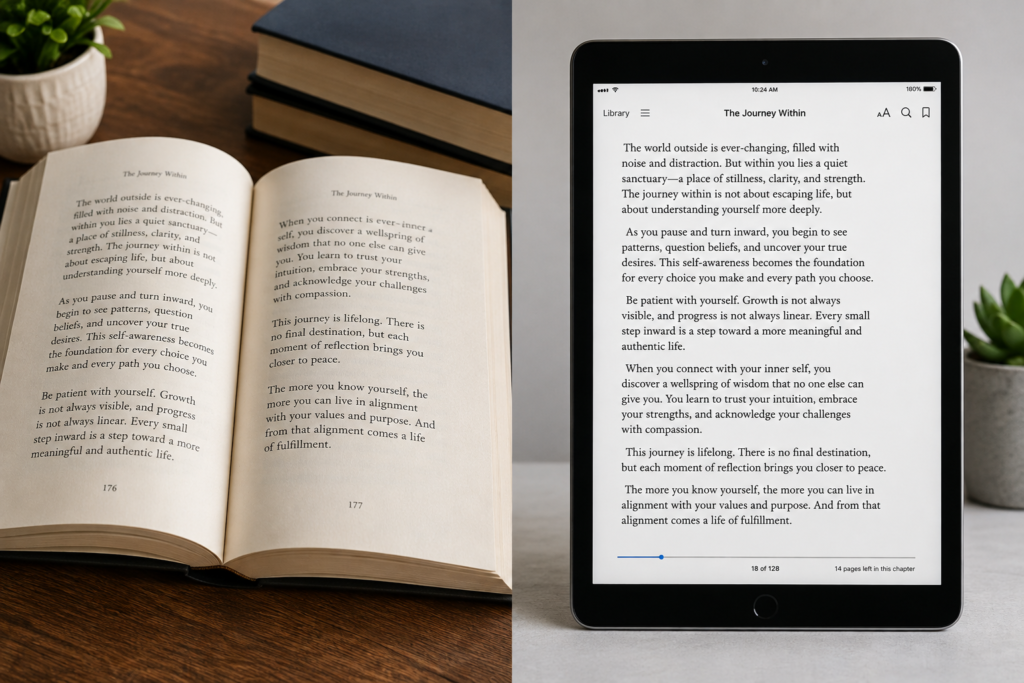
An e-book is a digital book that can be read using a computer, smartphone, tablet, or dedicated e-reading device. Printed books, on the other hand, are physical publications made with paper and ink.
Both formats provide access to information and stories, but the reading experience can be quite different.
Some readers prefer printed books because they enjoy physical pages and the traditional reading experience. Others prefer e-books because they are portable, searchable, and easy to store.
For students, the decision can also depend on the purpose of reading. A student researching a topic may benefit from digital search features, while someone reading a novel for enjoyment may prefer the physical experience of a printed book.
There is no single format that is best for everyone.
This article compares e-books and printed books in terms of convenience, accessibility, cost, storage, reading experience, study features, and other important factors.
What Are E-Books?
E-books are books provided in a digital format.
They can be accessed through:
- Smartphones.
- Tablets.
- Computers.
- Laptops.
- E-readers.
- Web-based reading platforms.
Common digital formats include EPUB and PDF, although many other formats and platform-specific systems exist.
Depending on the publication and software, an e-book may provide features such as search, bookmarks, highlighting, adjustable text, and links.
What Are Printed Books?
Printed books are physical publications containing pages of printed text and images.
They can be found in:
- Libraries.
- Bookstores.
- Schools.
- Colleges.
- Homes.
- Public institutions.
Printed books do not require a battery or special software. Once you own or borrow one, you can generally read it without electronic equipment.
1. Portability
Portability is one of the biggest differences between the two formats.
A single digital device can store many e-books. This means readers can carry a large collection without physically carrying every book.
For students, this can be useful when they need resources for several subjects.
Printed books require physical space and have a physical weight. Carrying multiple textbooks can therefore be less convenient.
Winner: E-Books
For carrying a large collection, e-books generally have the advantage.
2. Reading Experience
Printed books provide a physical reading experience.
Readers can turn pages, see the physical cover, and interact with the book without a screen.
Some people find this experience relaxing and enjoyable.
E-books provide a screen-based reading experience. They can offer adjustable text and other digital features, but some readers may prefer the feel of paper.
Winner: Personal Preference
The better experience depends on the individual reader.
3. Storage
A physical book requires shelf or storage space.
A large personal library can require several shelves or even an entire room.
E-books can be stored digitally on compatible devices or cloud-based systems, depending on the platform.
This makes it possible to maintain a large digital collection without physical shelves.
However, digital collections still require electronic storage and appropriate organization.
Winner: E-Books
Digital books generally require less physical space.
4. Search Function
Searching is an important advantage of digital books.
Suppose a student wants to find every occurrence of a specific term in a 400-page textbook.
An e-book application may allow the student to search for the term immediately.
With a printed book, the reader usually needs to use the index, table of contents, or manually search through the pages.
Winner: E-Books
Digital search can be especially useful for research and studying.
5. Adjustable Text
Many e-book applications allow readers to change certain display settings.
Depending on the format and application, users may be able to adjust:
- Font size.
- Font style.
- Display mode.
- Brightness.
- Page layout.
Printed books have a fixed physical layout.
Winner: E-Books
Digital reading provides more flexibility in display settings.
6. Accessibility
E-books can support certain accessibility features.
Depending on the device and software, digital books may work with:
- Screen readers.
- Text-to-speech.
- Magnification.
- Adjustable text.
- Other assistive technologies.
However, accessibility depends on how the e-book was created.
A poorly formatted digital document may not work effectively with assistive technologies.
Printed books may provide fewer adjustable digital options, although physical editions can sometimes be available in accessible formats.
Winner: Depends on the Resource
Neither format is automatically accessible to everyone.
7. Battery and Technology
Printed books have a simple advantage: they do not need electricity.
You can read a printed book during a power outage or in a location without electronic devices.
E-books usually require a compatible device, and some digital platforms require an internet connection.
If a device’s battery is empty, reading may be interrupted.
Winner: Printed Books
Printed books are independent of batteries and electronic hardware.
8. Cost
The cost of books varies widely.
Some e-books are inexpensive or legally available at no charge. Others may cost nearly as much as printed editions.
Printed books can also vary greatly in price depending on the publisher, edition, condition, and availability.
Used books may provide affordable alternatives.
Students should compare prices and also consider whether the resource is legally available through a library or educational institution.
Winner: Depends
Neither format is always cheaper.
9. Availability
Digital books can sometimes be accessed quickly after purchase, borrowing, or authorized access.
This can be useful when a student needs a particular resource immediately.
Printed books may require visiting a library, bookstore, or waiting for delivery.
However, some books may only be available in physical form, while others may only be legally available digitally.
Winner: Depends on Availability
The better option depends on where the particular title is available.
10. Note-Taking and Highlighting
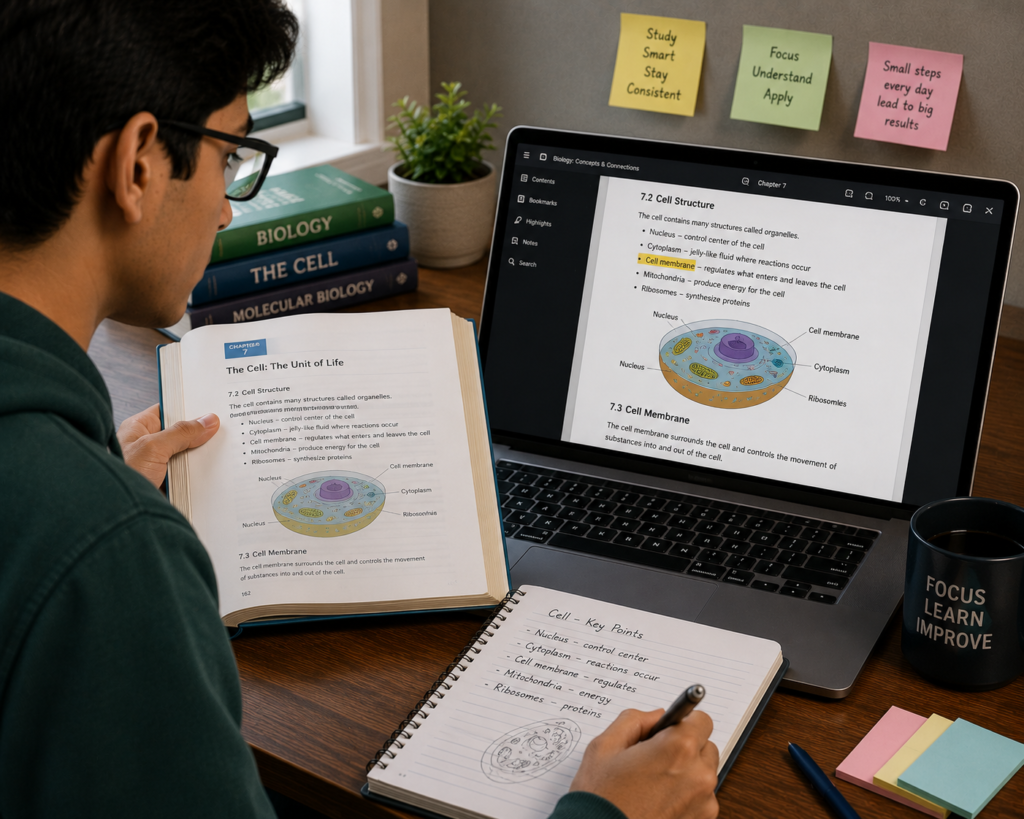
Many e-book applications allow readers to highlight passages and create notes.
These features can be particularly useful for academic study.
Printed books also allow highlighting and handwritten notes, although doing so permanently changes the physical book.
For borrowed books, writing or highlighting may not be permitted.
Digital notes can sometimes be easier to organize and search.
Winner: E-Books
Digital tools can make organizing study notes more convenient.
11. Distractions
Digital devices can provide distractions.
A student reading an e-book on a smartphone may receive messages, notifications, or social media alerts.
Printed books do not normally produce digital notifications.
For readers who struggle with digital distractions, a printed book can provide a simpler environment.
Winner: Printed Books
Physical books can make distraction-free reading easier.
12. Internet Requirements
Not every e-book requires the internet.
Some can be downloaded and read offline.
However, certain online reading platforms require an active internet connection.
Printed books do not require internet access.
Winner: Printed Books
Printed books are completely independent of internet access.
13. Environmental Considerations
Printed books require paper, ink, printing, packaging, and transportation.
E-books do not require a new physical copy for every reader, but they depend on electronic devices, electricity, data storage, and digital infrastructure.
Therefore, neither format should automatically be described as having no environmental impact.
The overall impact depends on many factors, including how often a device or physical book is used and how it is produced.
Winner: No Simple Answer
Environmental comparisons require consideration of the entire lifecycle of each format.
14. Sharing Books
Printed books can often be lent directly to friends or family, depending on ownership and applicable restrictions.
Digital books may be subject to licensing conditions that limit sharing.
Some digital library systems allow borrowing, but access is controlled by the platform’s terms.
Winner: Printed Books
Physical lending is generally more straightforward.
15. Durability
Printed books can last for many years if stored properly.
However, they can be damaged by water, fire, insects, tearing, or general wear.
Digital books do not physically tear, but access can depend on devices, storage systems, software, and licensing.
A digital file may also become difficult to use if a particular platform or format is no longer supported.
Winner: Depends
Both formats have different types of durability challenges.
16. Usefulness for Students
Students can benefit from both formats.
E-books can be useful for:
- Searching information.
- Carrying multiple resources.
- Taking digital notes.
- Adjusting text.
- Quick reference.
Printed books can be useful for:
- Focused reading.
- Screen-free study.
- Physical annotation.
- Reading without battery concerns.
Students can choose according to the task.
E-Books vs Printed Books: Comparison Table
| Feature | E-Books | Printed Books |
|---|---|---|
| Portability | Excellent | Limited by physical weight |
| Storage | Digital | Physical |
| Search | Usually available | Manual/index |
| Font adjustment | Often available | Fixed |
| Battery | Usually required | Not required |
| Internet | Sometimes required | Not required |
| Physical experience | Limited | Strong |
| Digital accessibility | Often available | Depends on edition |
| Digital distractions | Possible | Minimal |
| Sharing | Often restricted by license | Usually straightforward |
| Notes | Digital tools may be available | Physical writing/highlighting |
| Availability | Often immediate if authorized | May require purchase/borrowing |
Which Format Is Better for Studying?
There is no universal answer.
An e-book may be especially useful when you need to search for information quickly or carry many resources.
A printed book may be preferable when you want to study without a screen and minimize digital distractions.
Some students can use both.
For example, an e-book can be used for research and searching, while a printed textbook can be used for extended study sessions.
Which Format Is Better for Reading Novels?
This is largely a matter of personal preference.
Some readers enjoy the physical experience of holding a novel and turning its pages.
Others appreciate being able to carry an entire digital collection on one device.
The important thing is to choose the format that makes reading comfortable and enjoyable for you.

How Digital Libraries Fit Into Both Formats
Digital libraries have expanded access to electronic resources.
A digital library may provide e-books, academic articles, research materials, educational documents, and other digital resources.
Traditional libraries, meanwhile, may provide physical books alongside digital services.
Modern readers can therefore benefit from both systems.
When using digital resources, readers should check access permissions and respect copyright and licensing rules.
How to Choose Between an E-Book and Printed Book
Ask yourself a few questions:
What is my purpose?
Are you studying, researching, or reading for enjoyment?
Do I need search features?
If you frequently need to locate specific terms, digital reading may be useful.
Do I want a screen-free experience?
If yes, a printed book may be more suitable.
Do I need to carry several books?
If yes, digital books may be more convenient.
Do I need adjustable text?
If yes, check whether the digital version provides the settings you need.
What format is legally available?
Sometimes the choice is determined by which authorized edition is accessible.
Can E-Books and Printed Books Coexist?
Absolutely.
The popularity of e-books does not mean printed books have become useless.
Both formats serve different purposes.
A student may use an e-book for quick searches and a printed textbook for detailed study.
A researcher may read academic papers digitally but purchase important reference books in print.
A reader may enjoy novels in either format depending on personal preference.
Instead of viewing the formats as competitors, it is more useful to see them as different tools for reading.
Conclusion
The debate between e-books and printed books does not have one universal winner.
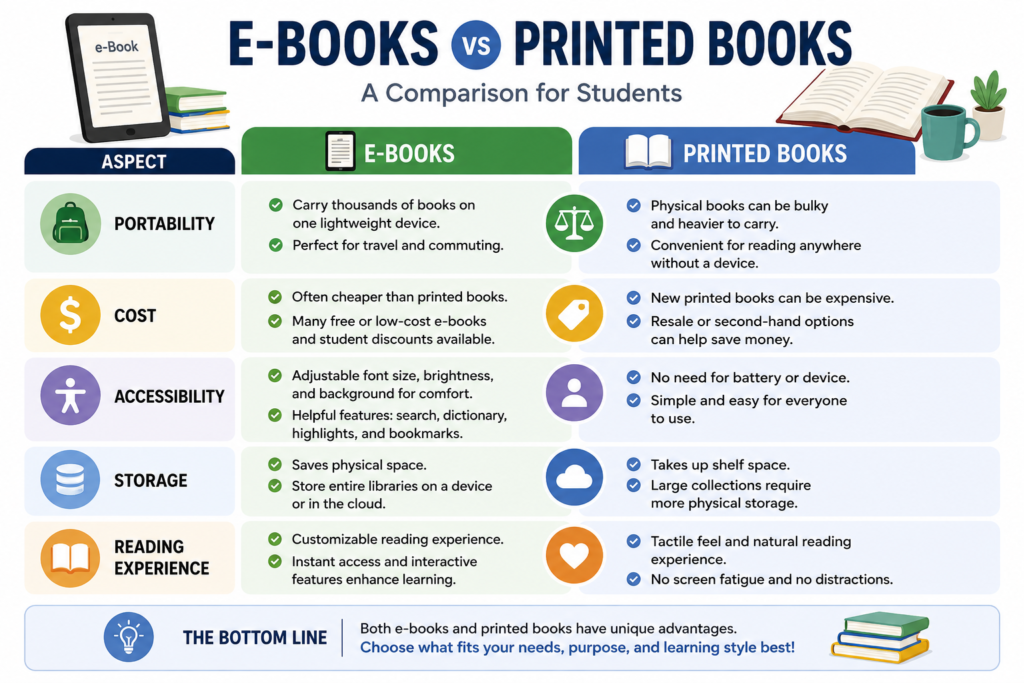
E-books provide portability, search functionality, adjustable display settings, digital organization, and convenient access to large collections.
Printed books provide a physical reading experience, independence from batteries and internet connections, and fewer digital distractions.
For students, the best option often depends on the task. Digital books can be particularly useful for research and quick reference, while printed books may be preferred for focused, screen-free reading.
The choice can also change from person to person. Some readers prefer digital books almost entirely, while others strongly prefer physical books. Many readers use both.
The most important thing is to select reliable and appropriate reading material and use it effectively.
Whether the pages are made of paper or displayed on a screen, books remain valuable tools for learning, discovery, imagination, and personal growth.
Frequently Asked Questions
1. Are e-books better than printed books?
Neither format is universally better. The best choice depends on the reader’s purpose, preferences, and circumstances.
2. Are e-books cheaper than printed books?
Not always. Prices vary by title, publisher, edition, and platform. Some digital books are free through legitimate sources, while others require payment.
3. Which is better for studying?
Both can be useful. E-books provide search and digital note-taking features, while printed books can reduce screen distractions.
4. Can e-books be read without the internet?
Some can. If a book is legally available for download, it may be possible to read it offline. Other platforms require online access.
5. Do e-books require a special device?
No. Many e-books can be read on computers, tablets, and smartphones, although some formats may require compatible software.
6. Which is easier to carry?
E-books are generally easier to carry because many books can be stored on one device.
7. Are printed books still useful?
Yes. Printed books remain widely used for education, research, libraries, and leisure reading.
8. Can I use both e-books and printed books?
Yes. Using both formats can allow readers to benefit from the advantages of each.