
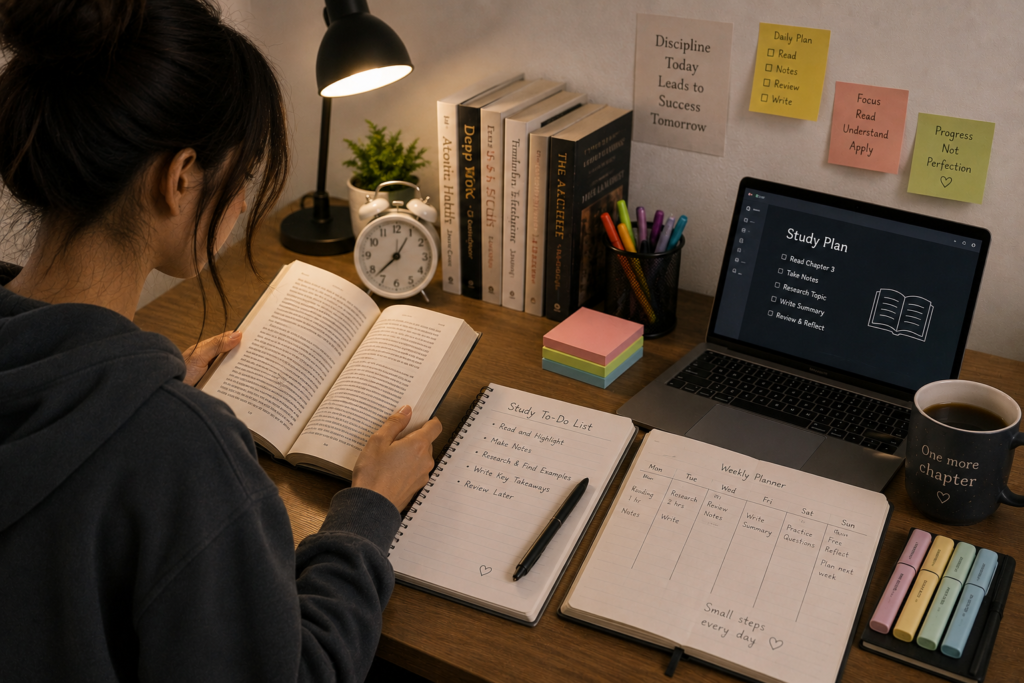
Introduction
Productivity is not simply about doing more tasks. It is about using your time effectively and giving proper attention to the things that matter.
For students, productivity can make a significant difference in everyday academic life. Students have to manage classes, homework, assignments, revision, reading, projects, and personal activities. Without good organization, it can become difficult to decide what should be done first.
Reading can be a useful part of a productive lifestyle. Regular reading can help students develop concentration, learn new information, improve vocabulary, and spend their free time more purposefully. When reading becomes a consistent habit, it can also encourage students to organize their time and reduce unnecessary distractions.
However, reading itself does not automatically make someone productive. The benefits depend on what you read, how you read, and how you manage your reading time.
This article explores the relationship between reading and productivity and provides practical ways students can make reading part of an effective daily routine.
What Is Productivity?
Productivity means using available time, energy, and resources effectively to accomplish meaningful goals.
For a student, productivity might mean:
- Completing homework on time.
- Preparing for examinations.
- Understanding difficult topics.
- Completing assignments.
- Reading useful material.
- Organizing study tasks.
- Taking appropriate breaks.
- Avoiding unnecessary distractions.
Productivity does not mean studying continuously without rest.
A productive routine should include a reasonable balance between work, learning, rest, and other activities.
What Is Time Management?
Time management is the process of deciding how to use your available time.
Students can use time management to:
- Set priorities.
- Plan tasks.
- Create schedules.
- Avoid procrastination.
- Divide large tasks into smaller steps.
- Allocate time for reading and revision.
Reading can become part of this system rather than something students do only when they have spare time.
How Can Reading Support Productivity?
Reading can support productivity in several ways.
A regular reading habit can help students:
- Practice concentration.
- Learn more efficiently.
- Improve vocabulary.
- Develop knowledge.
- Reduce unproductive screen time.
- Organize learning.
- Discover new ideas.
- Strengthen comprehension.
- Develop critical thinking.
- Create a structured daily routine.
These benefits can contribute to better learning and more effective use of time.
1. Reading Can Strengthen Concentration
Concentration is important for productivity.
When students read carefully, they need to keep their attention on the text and understand the ideas being presented.
Regular reading can provide practice in maintaining attention for a period of time.
This can be useful when students later need to:
- Read textbooks.
- Study notes.
- Complete assignments.
- Understand research articles.
- Prepare for examinations.
Reading should therefore be treated as an opportunity to practice focused attention.
2. Reading Can Improve Vocabulary
A strong vocabulary can make reading and learning easier.
While reading books and educational materials, students encounter words in different contexts.
Over time, they may become more familiar with:
- New vocabulary.
- Academic terms.
- Different sentence structures.
- Formal writing styles.
- Subject-specific language.
Better vocabulary can help students understand instructions, textbooks, articles, and assignments more effectively.
3. Reading Builds Knowledge
Reading is one of the simplest ways to learn about subjects beyond the classroom.
A student can read about:
- Science.
- History.
- Technology.
- Literature.
- Geography.
- Psychology.
- Education.
- Culture.
Knowledge gained through reading can also make it easier to understand new concepts because students can connect new information with what they already know.
4. Reading Can Reduce Unproductive Distractions
Free time can easily disappear through constant switching between entertainment, notifications, and other digital distractions.
Reading can provide an alternative activity that requires intentional attention.
For example, instead of spending a period of free time moving between unrelated online content, a student could spend part of that time reading a chapter of a useful book.
The goal is not to eliminate technology.
The goal is to make conscious choices about how time is spent.
5. Reading Can Help Create a Daily Routine
Habits become easier to maintain when they are connected to a consistent time.
For example:
After breakfast → 15 minutes of reading
or:
Before starting homework → 20 minutes of academic reading
A regular reading period can become a predictable part of the day.
This can help students develop a structured routine.
6. Reading Can Support Better Study Planning
Reading assignments can be divided into manageable sections.
For example, instead of saying:
“I need to read this entire book.”
a student can plan:
- Monday: Chapter 1.
- Tuesday: Chapter 2.
- Wednesday: Chapter 3.
- Thursday: Review notes.
- Friday: Continue reading.
Breaking a large reading task into smaller steps can make it easier to manage.
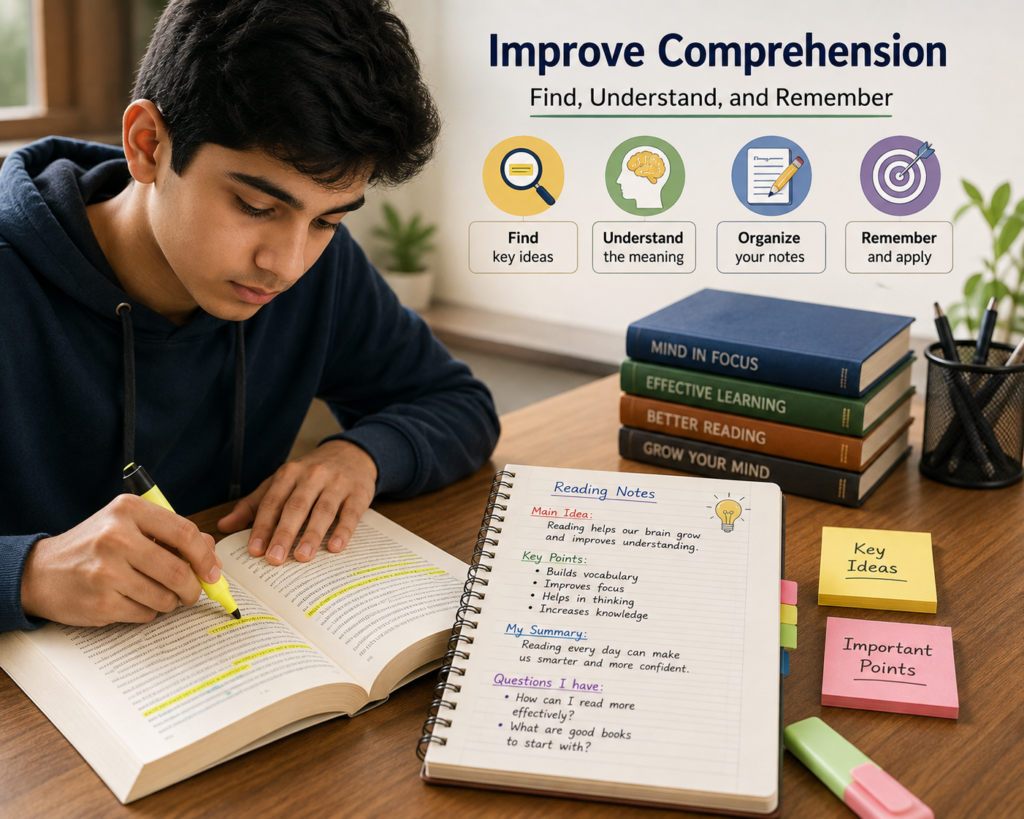
7. Reading Can Improve Comprehension
Productivity is not useful if a student completes a task without understanding it.
Good reading habits encourage students to:
- Identify main ideas.
- Recognize supporting details.
- Ask questions.
- Connect concepts.
- Summarize information.
- Review difficult sections.
These skills are useful for academic study.
8. Reading Can Encourage Critical Thinking
Reading different viewpoints encourages students to think about information rather than simply accepting every statement.
Students can ask:
- Is this information supported?
- What evidence is provided?
- Is there another perspective?
- What is the author’s purpose?
- Do different sources agree?
These questions help develop critical thinking.
Critical thinking can improve productivity because students can make better decisions about which information deserves their attention.
9. Reading Can Help Students Learn Independently
Independent learning means taking responsibility for learning beyond direct classroom instruction.
A student who develops a reading habit can explore subjects independently.
For example, after learning about computers in class, a student might read additional material about programming or digital technology.
This can turn curiosity into structured learning.
10. Reading Can Improve Communication Skills
Reading exposes students to different ways of expressing ideas.
It can help students notice:
- How arguments are structured.
- How paragraphs are organized.
- How examples are introduced.
- How explanations are developed.
- How conclusions are written.
These observations can support students when they write assignments, reports, and presentations.
11. Reading Can Make Study Sessions More Effective
Before studying a difficult topic, reading a simple introduction can provide background knowledge.
For example:
Introduction → Textbook → Detailed notes → Practice questions
Background reading can make a difficult topic easier to approach.
The key is to choose reading material that supports the learning goal rather than creating unnecessary extra work.
12. Reading Can Help With Goal Setting
Reading goals can be simple and realistic.
For example:
Daily goal: Read for 15 minutes.
Weekly goal: Complete two chapters.
Monthly goal: Finish one book.
Goals should be realistic enough to maintain consistently.
A small reading goal completed regularly can be more useful than an ambitious goal that becomes difficult to maintain.
13. Use a Reading Schedule
A reading schedule does not need to be complicated.
You can create a simple table:
| Day | Reading Goal |
|---|---|
| Monday | 15 minutes |
| Tuesday | 20 minutes |
| Wednesday | 15 minutes |
| Thursday | 20 minutes |
| Friday | 15 minutes |
| Saturday | 30 minutes |
| Sunday | Review |
Adjust the schedule according to your schoolwork and available time.
14. Choose the Right Reading Material
Productive reading starts with choosing useful material.
For academic goals, consider:
- Textbooks.
- Reference books.
- E-books.
- Academic articles.
- Research publications.
- Educational resources.
For personal development, you might choose books about:
- Communication.
- Learning.
- Creativity.
- Time management.
- General knowledge.
Choose material that supports your current goals.
15. Avoid Reading Too Many Books at Once
Having a long reading list can be motivating, but starting too many books simultaneously can make it harder to finish them.
Try choosing:
One main book + one optional book
or another manageable combination.
The ideal number depends on your reading goals and schedule.
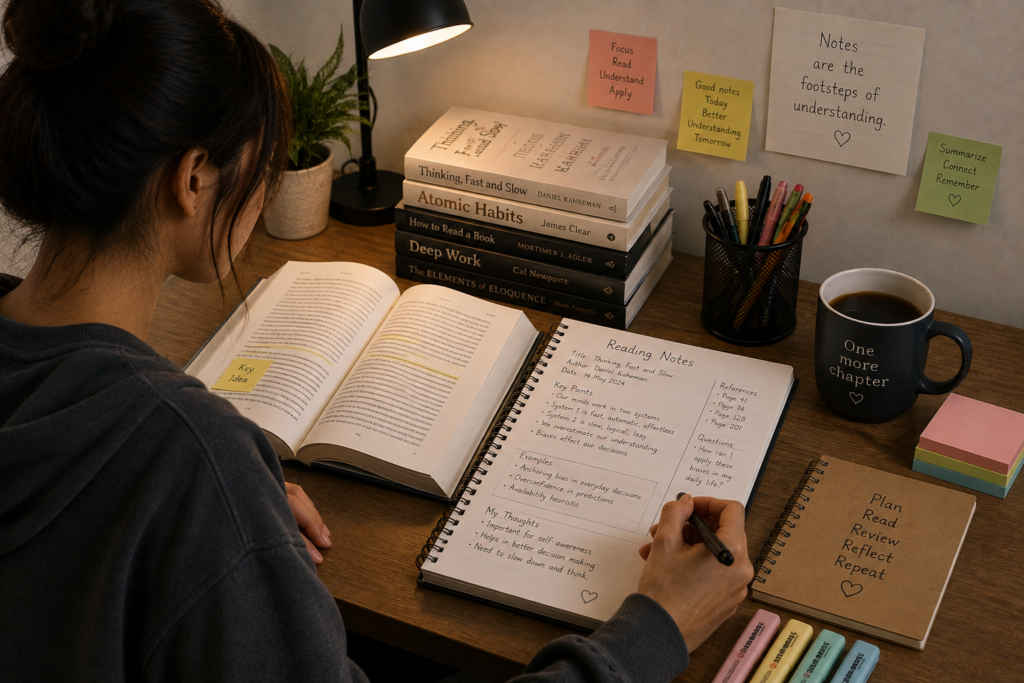
16. Take Useful Notes
Note-taking can make reading more productive.
Instead of copying entire paragraphs, record:
- Main ideas.
- Important facts.
- New vocabulary.
- Questions.
- Examples.
- Short summaries.
For academic reading, always record enough information to identify the source later.
17. Use Short Reading Sessions
Students do not always need to read for hours.
A short focused session can be useful.
Try:
15–20 minutes of focused reading → short break → continue if needed
The exact duration should match your schedule and ability to concentrate.
The goal is to maintain quality attention rather than simply counting pages.
18. Combine Reading With Other Study Methods
Reading works best when combined with active learning.
After reading a section, try:
- Summarizing it.
- Answering questions.
- Explaining it aloud.
- Creating flashcards.
- Writing key points.
- Practicing related questions.
This can make reading more active and purposeful.
19. Track Your Progress
A simple reading tracker can show your progress.
You can record:
- Book title.
- Starting date.
- Ending date.
- Pages or chapters completed.
- Key ideas learned.
- Notes.
Seeing progress can encourage consistency.
20. Review What You Read
Reading something once does not guarantee that you will remember it.
A short review can help.
For example:
Read today → Review tomorrow → Review again later
During review, ask:
- What were the main ideas?
- What did I learn?
- Which points are important?
- What do I still not understand?
Reviewing turns reading into a more active learning process.
Reading and Time Management: A Simple Example
Imagine a student has two hours available after school.
Instead of using the entire period without a plan, the student could organize it like this:
30 minutes: Rest and refresh.
40 minutes: Homework.
20 minutes: Reading.
20 minutes: Revision.
10 minutes: Prepare tasks for tomorrow.
This is only an example. Students should create schedules that fit their own responsibilities and needs.
The important idea is to give reading a defined place rather than waiting for “free time” that may never appear.
Common Mistakes That Reduce Reading Productivity
Reading Without a Purpose
Know why you are reading.
Choosing Material That Is Too Difficult
Use material appropriate for your current level.
Constantly Switching Books
Too many unfinished books can make reading less organized.
Checking Notifications During Reading
Frequent interruptions can break concentration.
Taking Excessive Notes
Notes should support understanding, not turn reading into unnecessary copying.
Setting Unrealistic Goals
A manageable goal is easier to maintain.
Never Reviewing
Important information can become difficult to remember without review.
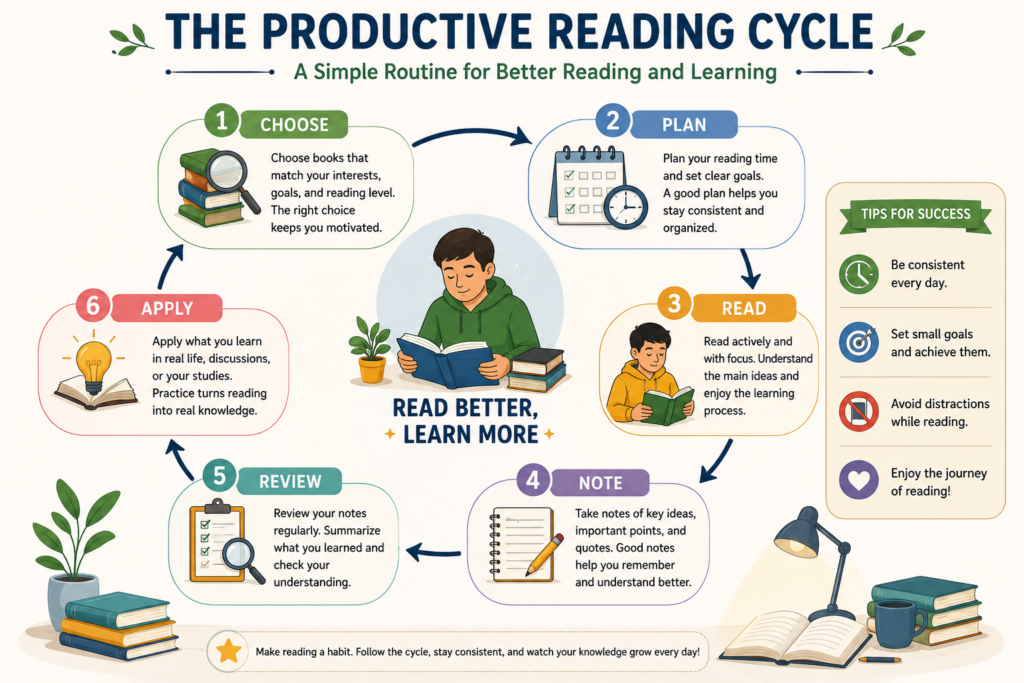
A Simple Productive Reading Method
Students can use this six-step method:
1. Choose
Select useful and appropriate reading material.
2. Plan
Decide when and how long you will read.
3. Read
Focus on the selected material.
4. Note
Record important ideas in your own words.
5. Review
Return to important information later.
6. Apply
Use what you learned in assignments, discussions, projects, or everyday learning.
This method turns reading from a passive activity into a structured learning process.
How Digital Libraries Can Support Productive Reading
Digital libraries can make reading more convenient by providing access to books and other educational materials in searchable collections.
Students can use digital libraries to:
- Search for specific topics.
- Find e-books.
- Explore academic resources.
- Save relevant materials.
- Search within documents.
- Access resources according to the library’s terms.
Digital tools can make finding material easier, but students still need to select appropriate and reliable sources.
Conclusion
Reading can become a valuable part of a productive student lifestyle when it is planned and used purposefully.
Regular reading can support concentration, vocabulary development, comprehension, knowledge, communication, and independent learning. It can also encourage students to organize their time and replace some unproductive distractions with meaningful activity.
However, productivity is not about reading as many pages as possible. The goal is to read with purpose, understand what you read, and use the information effectively.
A simple routine can make a significant difference:
Choose → Plan → Read → Note → Review → Apply
Students do not need to begin with long reading sessions. Even a manageable daily reading period can become a useful habit when maintained consistently.
By combining thoughtful book selection, realistic goals, focused reading, note-taking, and review, students can make reading an effective part of their study and time-management routine.
Frequently Asked Questions
1. Can reading improve productivity?
Reading can support productivity by helping students practice concentration, develop knowledge, improve comprehension, and establish structured learning habits.
2. How much time should students spend reading each day?
There is no single correct amount. A realistic period that fits the student’s schedule and can be maintained consistently is a good starting point.
3. Can reading reduce distractions?
A focused reading session can provide an alternative to unnecessary digital distractions, especially when notifications and interruptions are minimized.
4. Does reading improve time management?
Reading itself does not automatically improve time management, but planning regular reading sessions can help students practice scheduling and prioritizing activities.
5. Should students take notes while reading?
For academic reading, brief notes can help students remember important ideas and organize information. Notes should remain concise and useful.
6. Is reading better than watching educational videos?
Both can support learning. Reading encourages direct engagement with written information, while videos can provide visual and auditory explanations. The best choice depends on the learning goal.
7. How can I make reading more productive?
Choose relevant material, set a realistic reading period, reduce distractions, take useful notes, review important ideas, and apply what you learn.
8. Can digital books support productive reading?
Yes. Digital books can provide convenient access and searchable text, depending on the platform and resource.