
Introduction
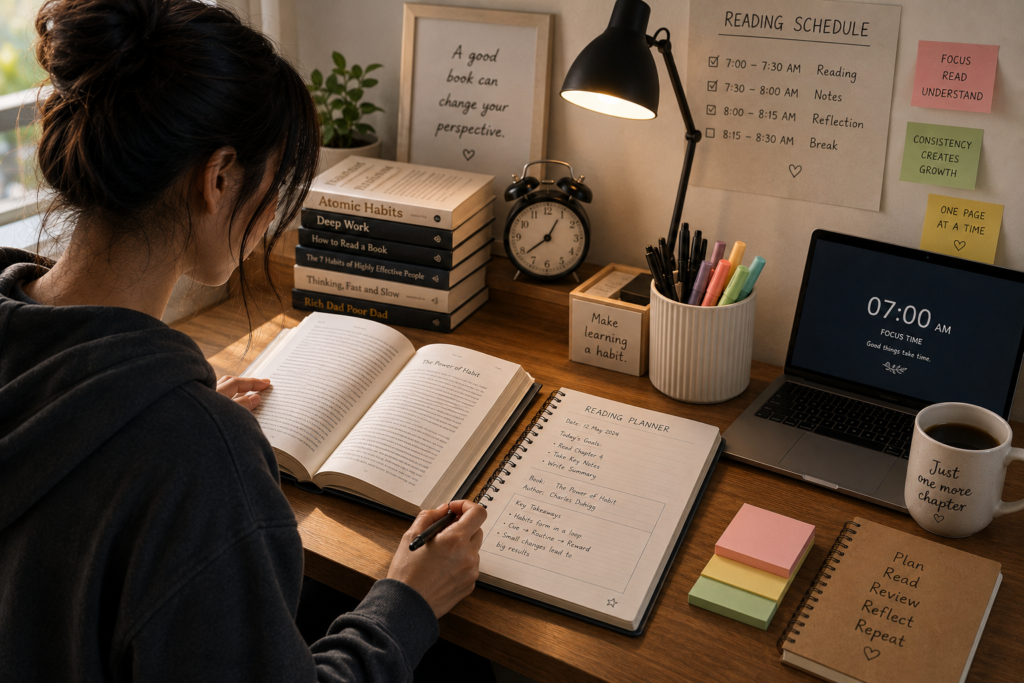
Reading is one of the most useful habits students can develop. It can support learning, improve comprehension, expand vocabulary, and introduce readers to new ideas. However, simply deciding to read more does not always lead to a consistent habit.
Many students start a book with enthusiasm but stop after a few days because of schoolwork, distractions, lack of planning, or an unrealistic reading goal.
A productive reading routine provides structure. Instead of reading only when there is free time, students can decide what they want to read, when they will read, how much time they can realistically spend, and how they will track their progress.
A productive routine does not need to be complicated. Even a short, consistent reading session can become valuable when it is connected to a realistic schedule.
This article explains how students can create a practical reading routine that fits into everyday life.
What Is a Reading Routine?
A reading routine is a regular pattern that determines:
- What you read.
- When you read.
- Where you read.
- How long you read.
- What you do after reading.
For example:
7:00 PM → 20 minutes of reading → 5 minutes of notes
This simple structure can make reading easier to maintain.
A routine should be flexible enough to accommodate schoolwork, assignments, examinations, and other responsibilities.
Why Is a Reading Routine Important?
Without a routine, reading may repeatedly get postponed.
A planned reading period can help students:
- Make reading consistent.
- Organize their time.
- Reduce last-minute work.
- Develop concentration.
- Track progress.
- Finish books more efficiently.
- Create a stronger learning habit.
The goal is not to make reading feel like another stressful obligation. A good routine should make reading easier to manage.
1. Decide Your Reading Goal
Start by asking:
Why do I want to read regularly?
Your goal could be:
- Improve vocabulary.
- Support school subjects.
- Read more fiction.
- Prepare for research.
- Learn about a new topic.
- Develop general knowledge.
- Read for relaxation.
A clear purpose makes it easier to select suitable books and measure progress.
2. Choose Realistic Reading Goals
Avoid setting a goal that is difficult to maintain.
For example, if you are new to regular reading, saying:
“I will read 100 pages every day.”
may be unrealistic.
Instead, try:
“I will read for 15 minutes every day.”
Once the habit becomes comfortable, you can adjust the amount.
Consistency is often more important than starting with a large target.
3. Choose a Regular Reading Time
A fixed reading time can make the habit easier to remember.
Possible times include:
- Before school.
- After completing homework.
- During a quiet afternoon period.
- In the evening.
- Before bedtime, when appropriate for your schedule.
Choose a time when you are usually available and able to concentrate.
4. Choose a Comfortable Reading Place
Your environment can affect concentration.
A useful reading area should ideally be:
- Comfortable.
- Well organized.
- Quiet enough for concentration.
- Properly lit.
- Free from unnecessary interruptions.
You do not need a special study room.
A desk, library corner, or other suitable quiet space can work.
5. Keep Your Book Ready
Make it easy to begin reading.
Keep your current book somewhere accessible.
For example:
Desk → Book → Notebook → Pen
When everything is ready, there are fewer steps between deciding to read and actually starting.
For digital reading, keep the relevant resource easy to access through the appropriate library or reading platform.
6. Start With Short Sessions
You do not need to read for hours.
A beginner might start with:
10–15 minutes per day
Another student might prefer:
20–30 minutes per day
The ideal duration depends on your schedule and concentration.
The important thing is to choose a manageable amount that you can repeat consistently.
7. Remove Unnecessary Distractions
Concentration can be interrupted by:
- Notifications.
- Unrelated websites.
- Frequent messages.
- Background noise.
- Constantly switching between tasks.
Before beginning, reduce unnecessary interruptions.
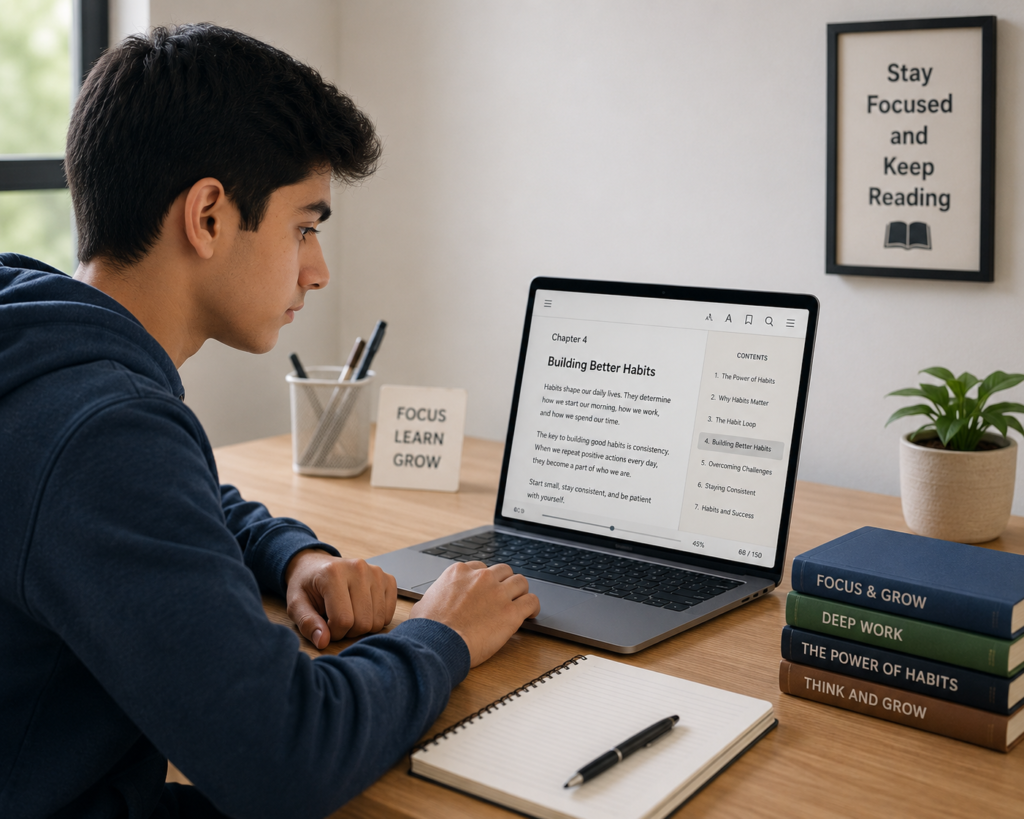
If you are using a device to read, use the appropriate settings or reading mode to minimize distractions when possible.
8. Use a Reading Timer
A simple timer can help create a clear beginning and ending point.
For example:
20 minutes reading → short break → continue if needed
A timer can be especially useful when you are learning to build a regular routine.
It can also prevent you from constantly checking the clock.
9. Set a Daily or Weekly Target
You can track either time or reading progress.
Time-Based Goal
20 minutes per day
Page-Based Goal
10 pages per day
Chapter-Based Goal
One chapter every two days
Choose the system that feels easiest to maintain.
10. Match Your Reading Routine to Your Schedule
A reading routine should fit your real life.
During normal school weeks, you might have more time.
During examination periods, your available time may decrease.
Instead of abandoning the habit completely, adjust the routine.
For example:
Normal week: 25 minutes per day.
Busy week: 10 minutes per day.
Holiday: 30–40 minutes when convenient.
Flexibility can help maintain consistency.
11. Create Separate Reading Categories
If you read for different purposes, organize your books.
For example:
Academic Reading
Textbooks and research resources.
Personal Reading
Novels and other books chosen for enjoyment.
Skill Development
Books about writing, communication, learning, or other useful skills.
This organization can help you decide what to read depending on your current goal.
12. Read Actively
Productive reading is more than moving your eyes across a page.
Ask questions such as:
- What is the main idea?
- What did I learn?
- Why is this information important?
- Do I agree with the author’s argument?
- How does this connect to what I already know?
Active reading helps you engage with the material.
13. Take Short Notes
For study-related reading, record important information.
You can write:
- Main ideas.
- Key terms.
- Questions.
- Examples.
- Short summaries.
Avoid copying large sections unnecessarily.
The purpose of notes is to help you understand and remember the material.
14. Review Your Notes
A reading routine becomes more useful when you review what you have learned.
After finishing a chapter, spend a few minutes asking:
What were the three most important ideas?
Write them down in your own words.
This turns reading into an active learning process.
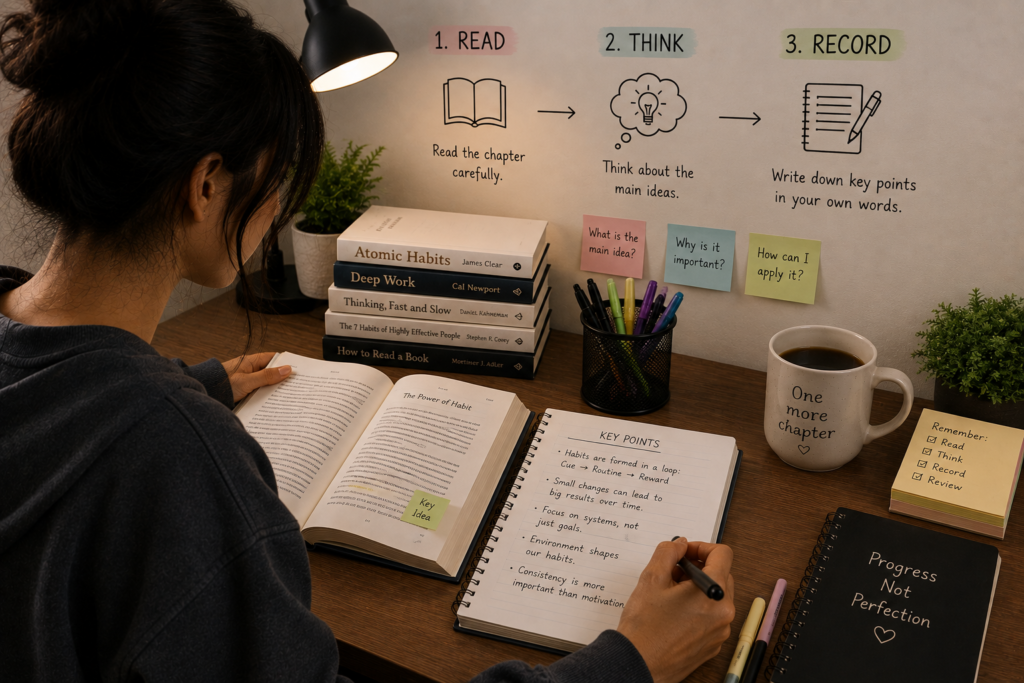
15. Use the “Read, Think, Record” Method
A simple method is:
Read
Focus on a section.
Think
Consider the main message.
Record
Write a short note about what you learned.
This method can be especially useful for academic books and research material.
16. Avoid Starting Too Many Books
A large reading list can become overwhelming.
Instead of starting five or six books at once, choose a manageable number.
For example:
One main book + one optional book
Once you finish one, choose another.
This can make your reading progress easier to track.
17. Choose Books Carefully
A productive routine depends partly on the quality and suitability of your reading material.
Before choosing a book, consider:
- Your purpose.
- Topic.
- Reading level.
- Author.
- Publication date.
- Length.
- Reviews.
- Relevance.
A suitable book is more likely to keep you interested.
18. Use Digital Libraries and E-Books
Digital libraries can make it easier to access reading materials.
Depending on the platform, students may be able to:
- Search by topic.
- Find e-books.
- Search within documents.
- Organize reading materials.
- Access academic resources.
Students should use legitimate resources and follow the platform’s access and copyright rules.
19. Track Your Reading Progress
A reading tracker can be very simple.
| Date | Book | Pages/Time | Main Idea |
|---|---|---|---|
| Monday | Book A | 20 minutes | Introduction |
| Tuesday | Book A | 15 minutes | Main concept |
| Wednesday | Book A | 20 minutes | Example |
| Thursday | Book A | 15 minutes | Chapter review |
Tracking progress can help you see whether your routine is working.
20. Reward Progress With Milestones
Completing a chapter, section, or book is a useful milestone.
You can keep a simple list:
☑ Started a new book
☑ Finished Chapter 1
☑ Finished Chapter 2
☑ Completed the book
☑ Wrote a short review
The purpose is to recognize progress and maintain motivation.
21. Don’t Force Yourself to Finish Every Book
Sometimes you discover that a book is not suitable.
Perhaps:
- The level is too advanced.
- The topic is no longer relevant.
- The writing style does not suit you.
- You selected it for the wrong purpose.
It is reasonable to reconsider your reading choice.
For academic assignments, follow the requirements of the task, but for personal reading, selecting another suitable book can be a better use of your time.
22. Make Reading Part of a Larger Study Routine
Reading should work alongside other learning activities.
A balanced study routine might include:
Reading → Notes → Practice → Review
For example, after reading a chapter about a science topic, you could review your notes and answer practice questions.
This helps connect reading with active learning.
23. Adjust Your Routine During Exams
Examination periods can change your priorities.
During busy weeks, you may reduce personal reading while keeping necessary academic reading.
For example:
Regular week: 20 minutes personal reading.
Exam week: Focus mainly on required academic material.
After examinations, you can return to your usual reading routine.
A good routine should adapt rather than become a source of unnecessary pressure.
24. Review Your Routine Every Few Weeks
Ask yourself:
- Am I reading consistently?
- Is my reading time realistic?
- Am I choosing suitable books?
- Am I remembering what I read?
- Are distractions affecting me?
- Should I change my schedule?
Your routine does not need to remain exactly the same.
Adjust it when your responsibilities or goals change.
A Sample Weekly Reading Routine
Here is an example:
| Day | Reading Activity |
|---|---|
| Monday | 20 minutes of reading |
| Tuesday | 20 minutes + short notes |
| Wednesday | 15 minutes of reading |
| Thursday | 20 minutes + review |
| Friday | 15 minutes of reading |
| Saturday | 30 minutes of deeper reading |
| Sunday | Review notes and plan next week |
This is only a model. Students should adapt it to their own schedules.
How to Stay Consistent
Consistency becomes easier when reading is connected to an existing habit.
For example:
After finishing homework → read for 15 minutes.
Or:
After breakfast → read one section.
This creates a clear connection between two activities.
Another useful approach is to keep the first goal small.
Once reading becomes familiar, you can gradually increase the amount when appropriate.
Common Problems and Simple Solutions
Problem: “I don’t have enough time.”
Solution: Start with a short session and place it into your existing schedule.
Problem: “I get distracted.”
Solution: Choose a quieter location and reduce unnecessary notifications.
Problem: “I lose interest.”
Solution: Check whether the book actually matches your interests and goals.
Problem: “I forget what I read.”
Solution: Write a short summary after each important section.
Problem: “I start too many books.”
Solution: Keep a smaller active reading list.
Problem: “I stop after a few days.”
Solution: Set a realistic goal and connect reading to an existing daily habit.
Conclusion
Creating a productive reading routine does not require a complicated schedule or hours of reading every day.
The most important elements are consistency, realistic goals, suitable books, focused attention, and regular review.
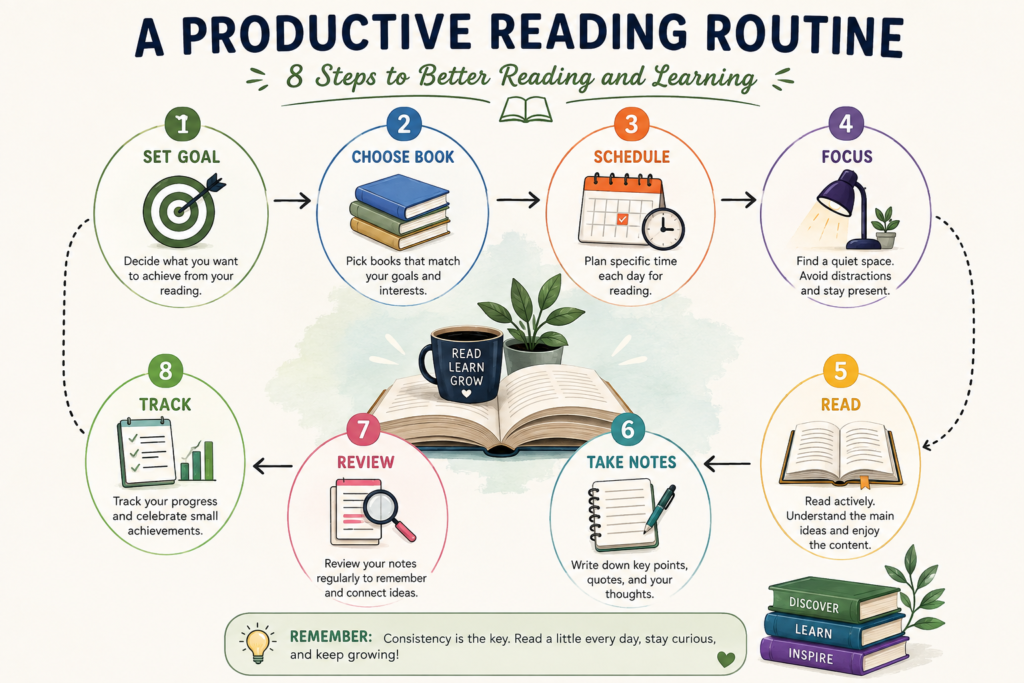
Start by deciding why you want to read. Choose appropriate material, select a manageable reading time, create a comfortable environment, reduce unnecessary distractions, and track your progress.
A simple routine such as 15–20 minutes of focused reading each day can become a valuable habit when maintained consistently.
Remember that productivity is not about how many pages you complete. It is about whether your reading helps you learn, understand, think, and make meaningful use of your time.
A practical reading routine can therefore become more than a way to finish books. It can become a long-term habit that supports learning, organization, curiosity, and personal growth.
Frequently Asked Questions
1. How do I start a productive reading routine?
Choose a clear goal, select a suitable book, choose a regular reading time, and begin with a manageable session.
2. How long should a daily reading session be?
There is no universal duration. Starting with 10–20 minutes can be practical for many students, and the amount can be adjusted according to your schedule.
3. What is the best time to read?
The best time is the period when you are usually available and able to concentrate. It could be morning, afternoon, or evening.
4. Should I read every day?
Regular reading can help build consistency, but your routine should fit your responsibilities. If daily reading is difficult, a realistic weekly schedule can still work.
5. How can I stay focused while reading?
Choose a suitable environment, reduce unnecessary distractions, and set a specific reading period.
6. Should I take notes while reading?
For academic material, short notes can help you remember and organize important ideas. For recreational reading, note-taking is optional.
7. How can I track my reading?
Record the book title, date, pages or reading time, and important ideas in a notebook or digital tracker.
8. What should I do if I don’t like a book?
For personal reading, you can reconsider your choice and select another suitable book. For required academic reading, follow your assignment requirements.