
Introduction
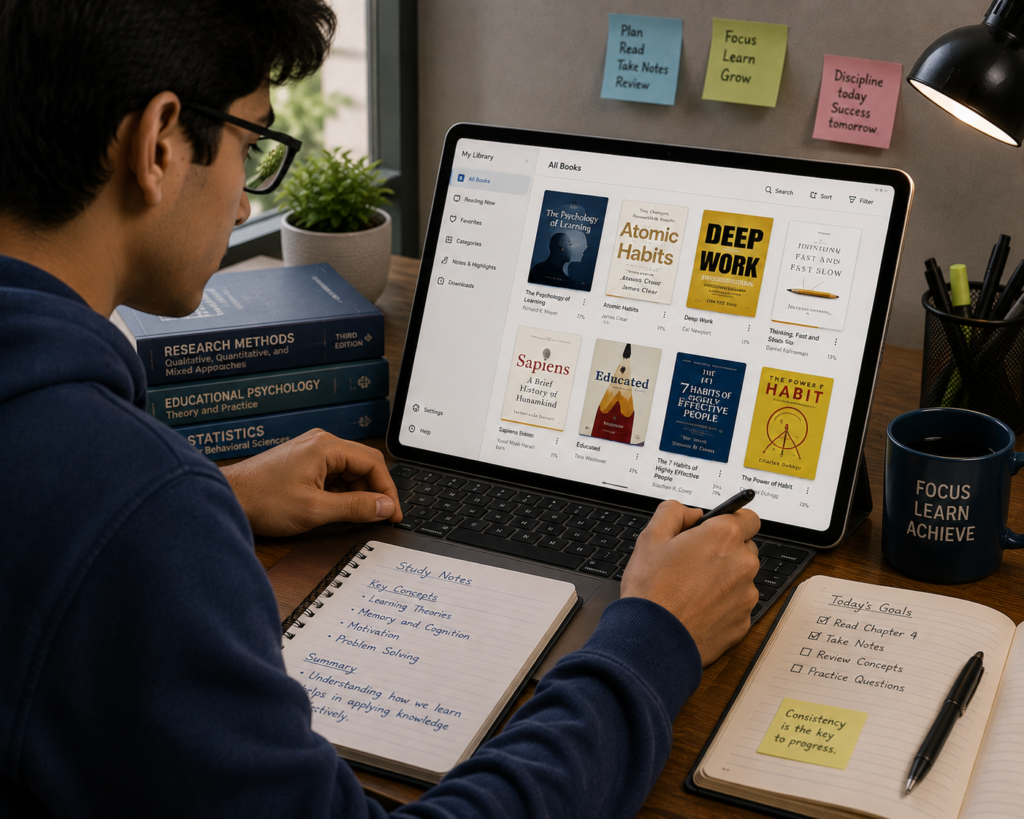
The way people read has changed significantly with the growth of digital technology. Printed books remain an important part of education and reading culture, but digital books have become increasingly common in schools, universities, libraries, and homes.
An e-book, or electronic book, is a digital version of a book or a book created specifically for digital reading. It can be accessed through devices such as laptops, tablets, smartphones, and dedicated e-readers.
For students, e-books can be particularly useful because education often requires access to many different types of information. A student may need textbooks, reference books, research papers, study guides, and additional reading material throughout the academic year.
Instead of carrying many physical books, students can organize numerous digital resources on one device.
However, the value of e-books is not limited to portability. Digital books can provide search functions, adjustable text, bookmarks, note-taking tools, and other features that may support learning.
This article explores the major benefits of e-books and explains how students and modern readers can use them effectively.
What Makes E-Books Different?
Traditional books are printed on physical pages, while e-books are stored and displayed digitally.
This difference creates several possibilities.
For example, readers can often search an e-book for a particular word, change the font size, create bookmarks, or access related information through links.
The exact features depend on the e-book format and reading platform.
An e-book can therefore function as more than a digital copy of a printed book. In many cases, it becomes an interactive reading resource.
1. E-Books Are Easy to Carry
One of the most obvious benefits of e-books is portability.
A student may need several books for different subjects. Carrying all of them physically can be inconvenient.
Digital books can be stored on a laptop, tablet, smartphone, or other compatible device.
This allows students to keep multiple resources available without carrying a separate physical book for every subject.
For students who travel between home, school, college, and libraries, portability can make reading more convenient.
2. E-Books Can Save Physical Space
Physical books require shelves, cabinets, or other storage areas.
A growing collection can eventually occupy considerable space.
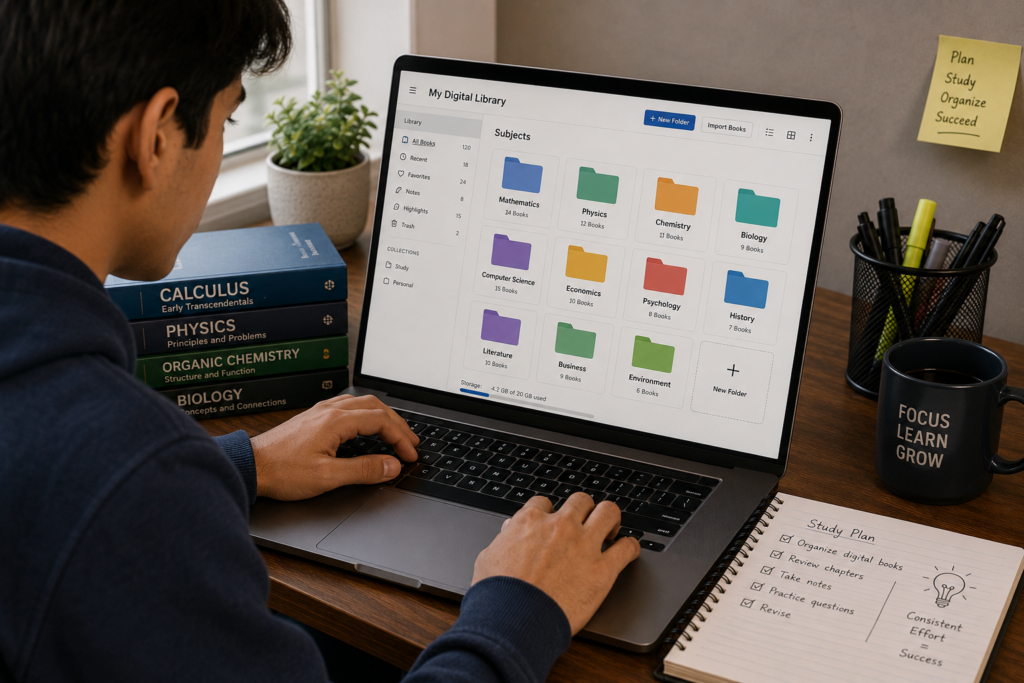
Digital books do not require physical shelves. They can be stored electronically and organized into folders, libraries, or collections.
This can be especially useful for students who have limited study space.
However, digital storage should still be organized carefully so that resources are easy to locate.
3. E-Books Are Easy to Search
Searching is one of the most useful features of digital reading.
Imagine that a student is reading a 300-page book and needs to find every section mentioning a particular concept.
With a suitable digital reader, the student may be able to search for the term instead of manually checking every page.
Search functionality can save time and make research more efficient.
It is especially useful for textbooks, academic publications, reference books, and technical material.
4. E-Books Can Offer Adjustable Text
Many reading applications allow users to change certain display settings.
Depending on the format and application, readers may be able to adjust:
- Font size.
- Font style.
- Screen brightness.
- Page layout.
- Reading mode.
These options can make digital reading more comfortable for different readers.
Students can adjust the display according to the device they are using and the environment in which they are reading.
5. E-Books Can Support Accessibility
Digital reading can provide accessibility features that may be helpful for some readers.
Depending on the device and software, users may have access to:
- Text enlargement.
- Screen readers.
- Text-to-speech.
- Adjustable display settings.
- Search tools.
These features can make some digital resources easier to access.
However, accessibility is not automatic. The structure and quality of the e-book also matter. Some poorly formatted documents may not work effectively with accessibility tools.
6. E-Books Can Make Research Faster
Research often involves searching through large amounts of information.
Digital books can make this process more efficient by allowing readers to search for keywords and move quickly between relevant sections.
A student researching a project might search for several important terms and then bookmark the most useful sections.
This can reduce the time spent manually locating information.
Students should still evaluate sources carefully and use reliable academic materials.
7. E-Books Can Help Students Organize Resources
Students often work with resources from different subjects.
Digital books can be organized into folders or collections.
For example:
Computer Science
- Programming books
- Algorithms
- Databases
- Web development
English
- Literature
- Grammar
- Writing guides
Science
- Physics
- Chemistry
- Biology
A simple organizational system can make it easier to find the right resource when needed.
8. E-Books Can Be Available Quickly
When a digital book is legally available through an authorized platform, it may be possible to access it immediately.
There is no physical delivery period for a resource that is already available digitally.
This can be helpful when students need information for an assignment or research project.
Availability still depends on the platform, licensing conditions, and the user’s access rights.
9. E-Books Can Support Remote Learning
Online education has made digital resources increasingly important.
Students studying from home may not always have immediate access to a physical library.
E-books can provide another way to access educational material when appropriate resources are available online.
Students can use digital textbooks and reference books alongside online lectures, assignments, and educational websites.
10. E-Books Can Include Helpful Features
Digital books can include features that physical books cannot easily provide.
Depending on the publication, readers may have access to:
- Hyperlinks.
- Search functions.
- Digital bookmarks.
- Highlighting.
- Notes.
- Multimedia.
- Interactive diagrams.
Not every e-book contains all of these features.
The available functions depend on the publisher, format, and reading software.
11. E-Books Can Support Independent Learning
Students do not always learn only from classroom lessons.
They may want to explore a subject independently.
E-books can provide additional resources for students who want to learn beyond their regular syllabus.
For example, a computer science student interested in programming can explore introductory programming books, while a literature student can read additional novels or literary criticism.
Independent reading allows learners to follow their own interests.
12. E-Books Can Encourage Reading Variety
A digital collection can contain different types of books.
A student might keep:
- Fiction.
- Non-fiction.
- Textbooks.
- Biographies.
- Research books.
- Reference materials.
- Study guides.
This variety allows readers to change their reading material according to their purpose and available time.
13. E-Books Can Make Note-Taking Convenient
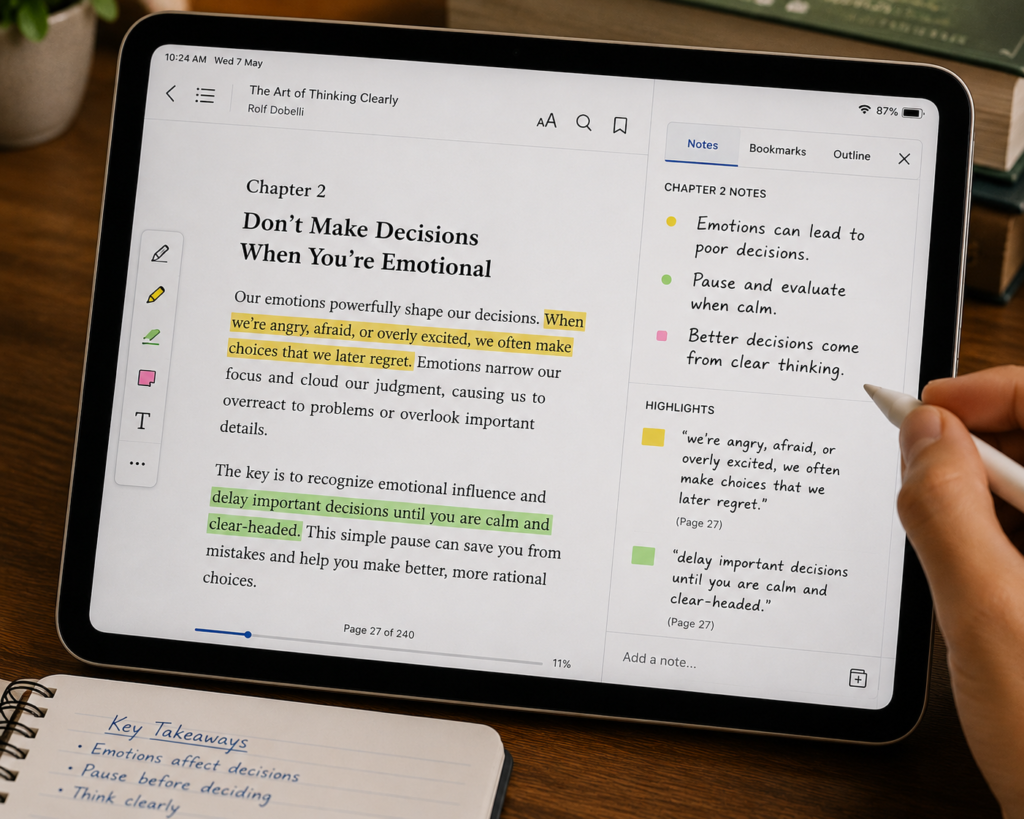
Many reading applications allow users to highlight text or create notes.
For academic reading, this can be useful when identifying important concepts.
A student might mark:
Definition
Important example
Question
Research point
New vocabulary
However, readers should avoid excessive highlighting. Mark only information that is genuinely useful for later review.
14. E-Books Can Help With Revision
Revision often requires returning to previously studied material.
Digital search and bookmarks can make this process easier.
A student preparing for an examination might bookmark important sections of a textbook and return to them later.
Search functions can also help locate specific terms quickly.
This can make digital revision more organized.
15. E-Books Can Be Useful for Language Learning
Students learning a language can use digital books to encounter vocabulary and sentence structures in context.
Some reading applications also provide dictionary or text-selection features.
A learner can read a suitable book and record unfamiliar vocabulary for later review.
Reading different genres can also expose learners to different writing styles and expressions.
16. E-Books Can Support Lifelong Learning
Learning does not stop after school or college.
Adults can use digital books to explore new interests, develop professional knowledge, learn languages, study history, or understand new technologies.
Because digital resources can be accessed from many devices, they can fit into different lifestyles.
17. E-Books Can Complement Physical Libraries
Digital books do not have to replace traditional libraries.
Instead, they can complement physical collections.
A library may provide both printed and electronic resources so that users can choose the format that suits their needs.
Some readers prefer physical books for long reading sessions, while others value the portability and search functions of digital resources.
A combination of both can provide a broader reading experience.
18. E-Books Can Help Reduce Paper Use
Because e-books are distributed digitally, they do not require printed pages for every reader.
This can reduce the physical materials required to produce and distribute individual copies.
However, digital technology also requires electronic devices, data storage, electricity, and infrastructure.
Therefore, it is more accurate to say that e-books change the resource requirements of publishing rather than assuming that they have no environmental impact.
19. E-Books Can Be Useful for Quick Reference
Sometimes a reader does not need to read an entire book.
They may simply need to check a definition, concept, formula, or explanation.
Digital search makes it easier to locate specific information within a suitable e-book.
This makes e-books particularly useful as reference resources.
20. E-Books Give Readers More Choice
Digital collections can offer a wide variety of subjects and formats.
Readers can explore materials according to:
- Subject.
- Author.
- Language.
- Genre.
- Academic level.
- Personal interest.
This variety can help students discover new subjects and develop independent reading habits.
How to Use E-Books Effectively
Having access to digital books is only the first step. Students should also develop good digital reading habits.
Organize Your Library
Create folders or collections for different subjects.
Use Bookmarks
Mark important chapters and sections for later review.
Take Useful Notes
Record important ideas rather than copying large amounts of text.
Reduce Distractions
Close unnecessary applications and notifications during study sessions.
Protect Your Eyes
Take regular breaks during extended screen-based reading.
Verify Sources
For academic work, use reliable and appropriate resources.
E-Books and Traditional Books: Which Should Students Choose?
There is no universal answer.
The best format depends on the purpose.
An e-book may be more convenient when:
- You need to carry several resources.
- You want to search within a book.
- You need adjustable text.
- You are studying while travelling.
- You need quick access to digital resources.
A printed book may be preferable when:
- You enjoy physical pages.
- You want to avoid screens.
- You are reading without electronic devices.
- You prefer a traditional reading experience.
Students can use both formats depending on the situation.
Common Mistakes When Using E-Books
Reading With Constant Notifications
Frequent interruptions can make it difficult to concentrate.
Downloading From Untrusted Sources
Readers should use legitimate platforms and respect copyright.
Saving Everything Without Organization
A large collection becomes difficult to use if files are not organized.
Excessive Screen Time
Long digital sessions should include appropriate breaks.
Depending on One Device
Important resources should be backed up or stored through reliable systems when appropriate.
Conclusion
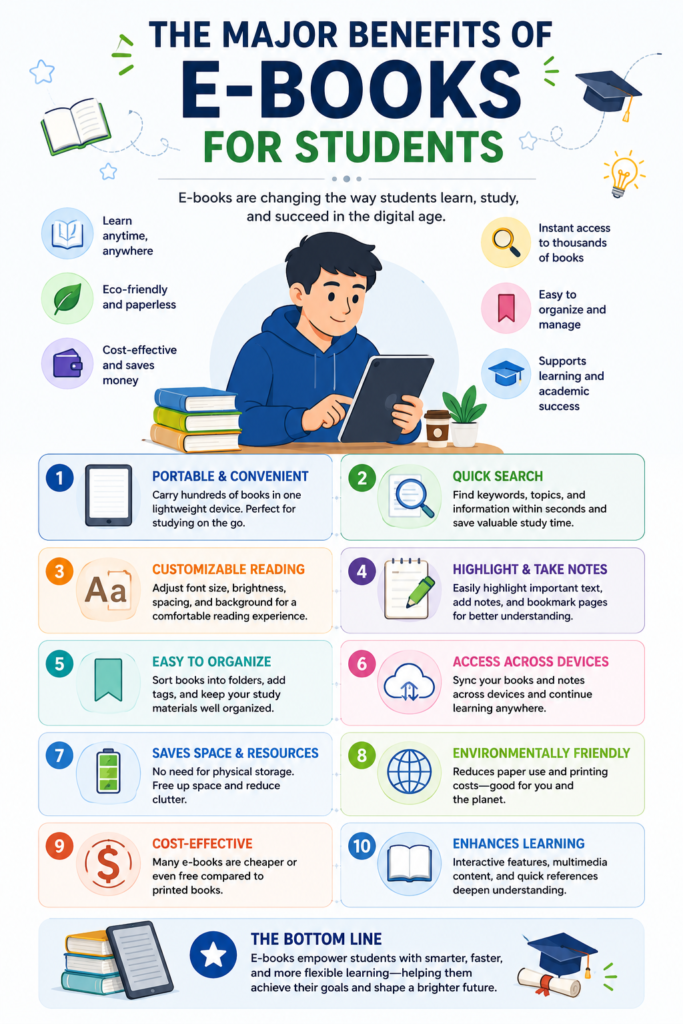
E-books have become a valuable part of modern reading and education. For students, they can offer portability, search functions, adjustable display settings, organizational tools, and convenient access to many types of digital resources.
They can support studying, research, independent learning, revision, language development, and personal reading.
At the same time, digital books should be used thoughtfully. Readers need to choose reliable resources, respect copyright and licensing requirements, manage distractions, and take appropriate breaks during extended screen use.
E-books do not have to replace printed books. Both formats can serve different purposes, and students can choose between them according to their needs.
The most useful reading format is ultimately the one that helps you access reliable information, understand it clearly, and use it effectively.
As digital libraries and educational platforms continue to develop, e-books are likely to remain an important resource for students and modern readers.
Frequently Asked Questions
1. What are the main benefits of e-books for students?
Major benefits include portability, search functions, organization, adjustable text, accessibility features, and convenient access to educational resources.
2. Are e-books better for studying than printed books?
Not necessarily. The best format depends on the student’s preferences, study environment, and purpose.
3. Can e-books help with research?
Yes. Search, bookmarks, and digital organization can make it easier to locate and manage information.
4. Can students take notes in e-books?
Many reading applications support highlighting and digital notes, although the available features vary.
5. Do e-books save physical space?
Yes. Digital collections can store many books without requiring physical shelves for each title.
6. Can e-books improve accessibility?
Some digital formats and applications provide features such as text enlargement and screen-reader support.
7. Are all free e-books legal?
No. Some free books are legitimately available, but others may be distributed without permission. Readers should use authorized sources.
8. Can e-books replace traditional libraries?
E-books can complement library collections, but they do not necessarily replace physical libraries or all the services they provide.