
Introduction
Reading is one of the simplest ways to continue learning throughout life. A book, article, research paper, or digital resource can introduce a reader to new knowledge, different perspectives, unfamiliar subjects, and ideas that may not be available through everyday experiences.
For students, reading is closely connected with academic success. It helps them understand textbooks, research information, examination questions, and educational materials. However, the value of reading goes beyond the classroom. Regular reading can also contribute to personal growth by encouraging curiosity, improving communication, and helping people understand different viewpoints.
In today’s digital environment, readers have access to an enormous amount of information. Digital libraries, eBooks, online journals, educational websites, and electronic documents have made learning resources more accessible than ever.
The important question is not simply how much a person reads, but what they learn from the material and how they use that knowledge.
This article explores the role of reading in both personal and academic growth and explains how readers can make their reading habits more meaningful.
What Is Personal Growth?
Personal growth refers to the process of developing knowledge, skills, understanding, confidence, and awareness over time.
Reading can contribute to this process by exposing people to ideas and experiences outside their immediate surroundings.
For example, a biography can introduce readers to another person’s experiences, while a science book can explain how the natural world works. A history book can provide insight into past societies, and a novel can present situations from different perspectives.
Through reading, people can continuously expand their understanding of the world.
What Is Academic Growth?
Academic growth involves developing knowledge and skills that support education and learning.
Students need more than memorization to succeed academically. They also need to understand information, analyze ideas, communicate clearly, conduct research, and solve problems.
Regular reading provides opportunities to practice many of these skills.
Whether a student is studying science, computer science, history, literature, mathematics, or social sciences, reading is likely to be an important part of the learning process.
1. Reading Expands Knowledge
One of the most obvious benefits of reading is the opportunity to learn new information.
A reader can explore subjects that may not be covered in detail in the classroom. Educational books and articles can provide explanations, examples, historical background, and additional information about a particular topic.
For students, additional reading can make classroom lessons easier to understand because they encounter the same concepts in different contexts.
2. Reading Improves Vocabulary
Regular reading introduces people to words that may not appear in everyday conversations.
Seeing a new word used within a sentence can help readers understand its meaning and proper usage. Over time, this exposure can expand vocabulary.
A stronger vocabulary can also help students express their ideas more clearly in assignments, examinations, presentations, and conversations.
Readers can strengthen this benefit by maintaining a vocabulary list and reviewing unfamiliar words regularly.
3. Reading Strengthens Communication Skills
Good communication requires the ability to understand information and express ideas clearly.
Reading exposes people to different writing styles, sentence structures, explanations, and methods of presenting arguments.
Students who read a variety of materials can observe how authors introduce topics, explain concepts, provide evidence, and reach conclusions.
These examples can support the development of stronger written communication skills.
4. Reading Develops Critical Thinking
Not every piece of information should be accepted without examination.
Reading different sources gives students opportunities to compare arguments, identify evidence, ask questions, and consider whether information is reliable.
For example, when researching a topic, a student may find several sources that present slightly different explanations. Comparing these sources encourages careful thinking rather than accepting the first result.
Critical thinking is especially important when using digital information because online content can vary greatly in quality.
5. Reading Encourages Independent Learning
A strong reader does not always have to wait for someone else to explain a subject.
Once students develop good reading and research skills, they can explore topics independently. They can search for relevant books, articles, academic resources, and other materials to answer their questions.
Digital libraries can be particularly useful for this purpose because they may provide organized collections of educational resources.
Independent learning can help students become more responsible and confident learners.
6. Reading Supports Better Writing
Reading and writing are closely connected.
When students read high-quality material, they see examples of how ideas can be organized and expressed. They become familiar with introductions, paragraphs, explanations, arguments, and conclusions.
This exposure can help them develop their own writing style.
For academic writing, students should also learn how to use sources appropriately, summarize information in their own words, and provide citations when required.
7. Reading Encourages Creativity
Reading can introduce people to ideas they might not have encountered otherwise.
Fiction can stimulate imagination through characters, settings, and stories. Non-fiction can introduce scientific discoveries, historical events, inventions, and real-world problems.
Combining information from different sources can sometimes lead to new ideas and creative approaches to problems.
For students working on projects, reading widely can therefore be a useful part of the creative process.
8. Reading Builds Curiosity
Curiosity encourages people to ask questions and search for answers.
A single book or article can lead to many new questions. A student reading about space might become interested in astronomy. Someone studying technology might want to understand artificial intelligence or computer security.
This process creates a cycle:
Read → Discover → Question → Research → Learn
This is an important part of lifelong learning.
9. Reading Introduces Different Perspectives
Books and articles allow readers to encounter perspectives that may differ from their own experiences.
Historical works can show how people lived in different periods. Biographies can describe individual experiences. Literature can explore different characters and situations.
Exposure to different perspectives can encourage readers to think more carefully about complex subjects.
This does not mean accepting every viewpoint. Instead, it gives readers more information with which to form thoughtful opinions.
10. Reading Supports Research Skills
Research requires more than finding information.
Students need to identify relevant sources, understand their content, compare information, evaluate reliability, and organize their findings.
Regular reading provides practice with these activities.
Academic resources such as books, journals, research papers, and reference materials can help students become more familiar with formal information.
When conducting research, readers should prioritize credible sources and follow their school’s or institution’s requirements for citations and academic integrity.
11. Reading Helps Students Understand Difficult Topics
Some subjects cannot be fully understood from a single explanation.
Reading multiple resources can provide different explanations of the same concept.
For example, if a student finds a textbook explanation difficult, an introductory article or another educational book may explain the concept using simpler language or additional examples.
This makes reading a useful tool for reviewing and reinforcing classroom learning.
12. Reading Encourages Lifelong Learning
Education does not end when a person leaves school or university.
People continue learning through their careers, hobbies, personal interests, and everyday experiences.
Reading makes lifelong learning easier because readers can explore new subjects whenever they want.
Digital resources have made this process especially convenient. A person can discover educational materials without needing to wait for a formal course or classroom lesson.
13. Reading Can Improve Study Habits
A regular reading routine can help students develop other positive study habits.
For example, students may learn to:
- Set reading goals.
- Organize notes.
- Review important information.
- Identify main ideas.
- Ask questions.
- Manage their study time.
These habits can be applied to many different subjects.
14. Reading Helps People Make Better Use of Information
Modern readers encounter information through books, websites, social media, videos, advertisements, and other sources.
Reading carefully helps people understand written information rather than simply reacting to headlines or short statements.
A careful reader can ask:
- Who created this information?
- What evidence is provided?
- Is the source credible?
- Is the information current?
- Are different perspectives available?
These questions are valuable skills in the modern information environment.
15. How Digital Libraries Support Growth
Digital libraries can play an important role in both personal and academic learning.
Depending on their collections and access policies, they may provide:
- eBooks
- Academic articles
- Research papers
- Journals
- Reference materials
- Educational documents
Search tools can help users locate relevant information quickly.
For students, this can make research more organized and convenient. For general readers, digital collections can provide opportunities to explore subjects beyond their normal interests.
Readers should always use materials according to the library’s terms, copyright requirements, and licensing conditions.

Practical Ways to Make Reading More Meaningful
Simply reading more does not necessarily mean learning more. Active reading can make the experience more useful.
Set a Purpose
Before starting, decide what you want to learn or understand.
Take Short Notes
Write down important concepts, questions, and useful vocabulary.
Review Important Ideas
After completing a chapter, summarize the main points in your own words.
Ask Questions
Think about what the author is explaining and why the information matters.
Compare Sources
For research topics, consult multiple credible sources rather than depending on one resource.
Apply What You Learn
Whenever possible, connect new knowledge to schoolwork, projects, discussions, or real-life situations.
Common Mistakes to Avoid
Some reading habits can reduce the value of a reading session.
Avoid:
- Reading only for speed.
- Ignoring unfamiliar concepts.
- Accepting every claim without checking it.
- Copying information without understanding it.
- Using unreliable sources for academic work.
- Trying to read too many books at once.
- Allowing constant digital distractions during focused reading.
Effective reading is about understanding and thinking, not simply completing pages.
Conclusion
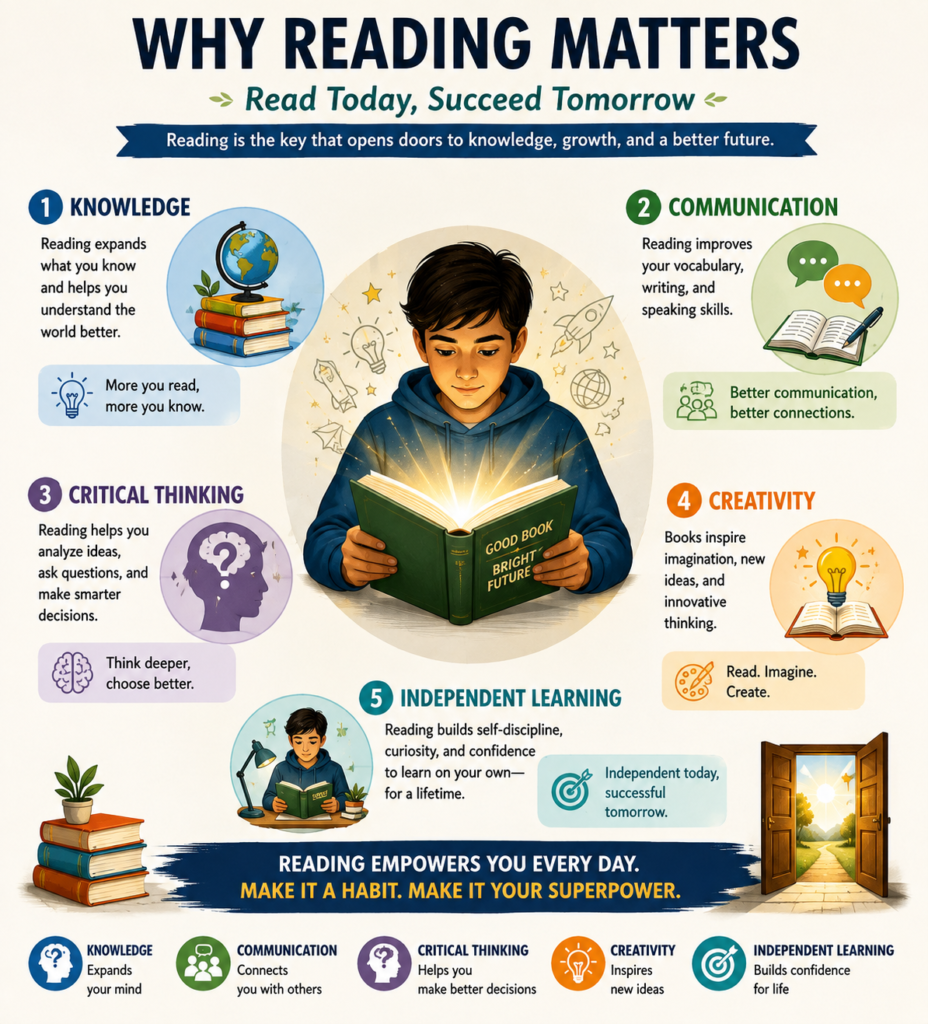
Reading plays an important role in both personal and academic growth. It provides opportunities to gain knowledge, improve vocabulary, strengthen communication, develop critical thinking, and explore different perspectives.
For students, reading supports classroom learning and research while helping them become more independent learners. For everyone else, reading provides a practical way to continue learning throughout life.
Digital libraries have added another dimension to this process by making many types of educational resources available in digital formats. When used responsibly, these resources can support research, study, and personal curiosity.
The most valuable reading habit is not simply reading a large number of books. It is reading with purpose, thinking about what you learn, checking information carefully, and applying useful knowledge.
By making reading a regular part of life, people can continue developing their knowledge and skills long after formal education has ended.
Frequently Asked Questions
1. How does reading support academic growth?
Reading helps students improve comprehension, vocabulary, research skills, critical thinking, and written communication.
2. Can reading help with personal development?
Yes. Reading exposes people to new ideas, experiences, perspectives, and knowledge, which can contribute to personal learning and awareness.
3. Does reading improve communication?
Regular exposure to different vocabulary and writing styles can support clearer understanding and expression.
4. Why is critical thinking important when reading?
Critical thinking helps readers evaluate evidence, compare ideas, recognize weaknesses in arguments, and determine whether information is reliable.
5. How do digital libraries support students?
Digital libraries can provide convenient access to eBooks, journals, research papers, and other educational resources, depending on their collections and access policies.
6. Should students read beyond their textbooks?
Additional reading can help students explore topics in greater depth and understand concepts from different perspectives.
7. How can I remember what I read?
Taking short notes, summarizing important ideas, asking questions, and reviewing information later can help reinforce learning.
8. What is the best way to read for academic purposes?
Read with a clear purpose, focus on credible sources, take organized notes, compare relevant information, and follow appropriate citation and academic-integrity practices.