

Introduction
Reading is often associated with school, university, or academic research, but it can be much more than a study activity. Reading can become a regular part of everyday life, providing opportunities to learn, explore new ideas, relax, and stay informed.
Many people want to read more but struggle to find enough time. A busy schedule, school responsibilities, work, household activities, and digital distractions can make reading seem difficult to fit into the day. However, building a reading routine does not require large amounts of free time. Small changes to your daily schedule can create regular opportunities for reading.
The most important step is to make reading convenient and realistic. Instead of waiting for a perfect time, connect reading with activities that are already part of your routine. With consistency, even short reading sessions can develop into a lasting habit.
Why Make Reading Part of Everyday Life?
Regular reading provides continuous exposure to information and ideas. Students can use it to support their studies, while general readers can explore subjects that interest them.
A daily reading routine can help you:
- Develop stronger reading skills.
- Learn new vocabulary.
- Explore different subjects.
- Improve comprehension.
- Stay informed.
- Support independent learning.
- Discover new interests.
Reading also gives you an opportunity to spend some time focusing on one activity rather than constantly switching between different sources of information.
1. Start With a Realistic Reading Goal
The first step is to create a goal that fits your schedule.
You might decide to read for 15 minutes each day or complete a few pages before going to sleep. A smaller goal is often easier to maintain than an ambitious target that becomes difficult during busy days.
Once reading becomes a regular part of your routine, you can adjust your goal according to your needs.
The purpose of a reading goal is to encourage consistency, not pressure.
2. Connect Reading With an Existing Routine
One of the easiest ways to build a new habit is to connect it with something you already do.
For example, you might read:
- After breakfast.
- During a regular afternoon break.
- After completing homework.
- Before bedtime.
- During a quiet weekend period.
When reading is connected to an existing routine, you do not have to repeatedly decide when to read.
3. Keep Reading Materials Nearby
Convenience matters.
Keep your current book near your study area, bedside table, or another place where you regularly spend time. If you use digital resources, save the book or article where it can be accessed easily.
When reading material is available immediately, it becomes easier to use short periods of free time productively.
4. Choose Materials You Actually Enjoy
A reading routine becomes easier when you enjoy what you are reading.
You can explore different genres and subjects, including:
- Fiction
- Biography
- History
- Science
- Technology
- Literature
- Educational articles
- Research publications
There is no need to restrict yourself to one category. Exploring different types of reading can help you discover what keeps you interested.
5. Create a Distraction-Free Reading Period
Digital devices can make focused reading difficult. Notifications, messages, and unrelated applications can interrupt your attention.
Before starting a reading session, silence unnecessary notifications and close applications that are not related to your reading.
If you are reading on a laptop or phone, use reading mode or full-screen mode when available.
Even a short period of uninterrupted reading can be more productive than a longer session filled with distractions.
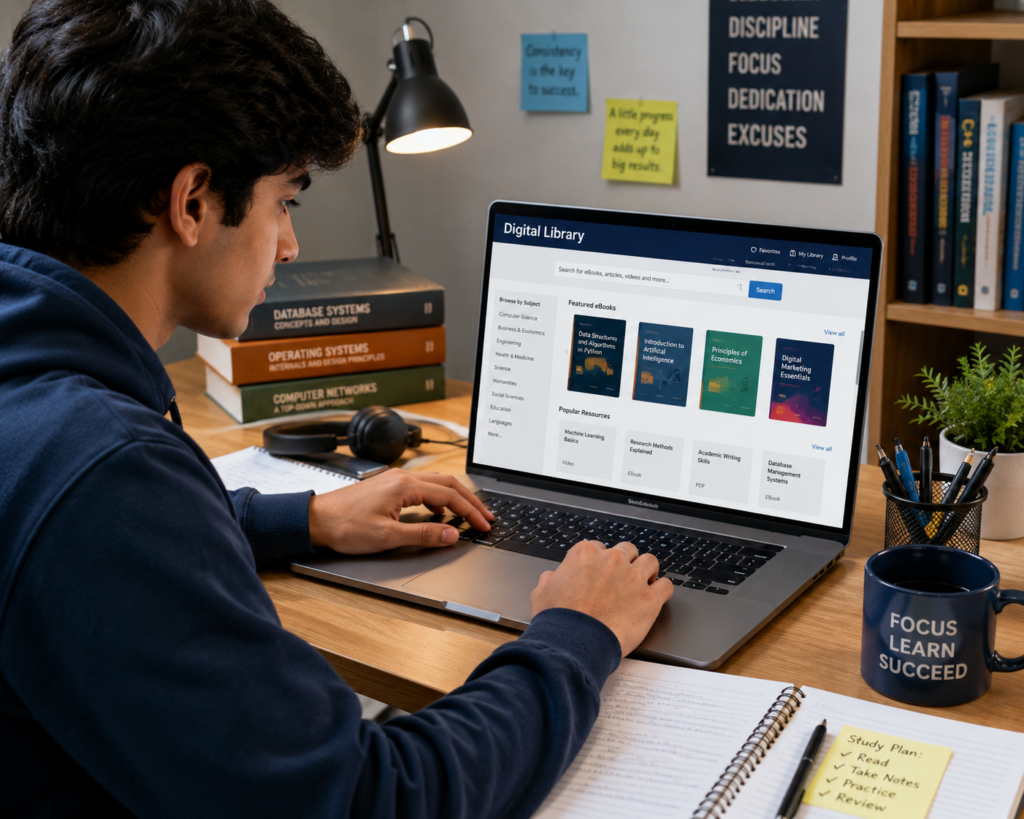
6. Use Digital Libraries
Digital libraries can make reading more convenient by providing access to electronic books, research papers, journals, and educational resources.
Instead of carrying several physical books, readers can access digital resources using compatible devices. Search features can also help users find specific subjects or authors quickly.
When using digital libraries, always follow the platform’s access rules and respect copyright and licensing requirements.
7. Keep a Reading List
A reading list can help you stay organized.
Whenever you discover an interesting book or article, add it to your list rather than trying to remember it later.
You can organize your list into categories such as:
Study: Materials needed for school or university.
Research: Academic resources for projects.
Interest: Topics you want to explore.
Leisure: Books you want to read for enjoyment.
This makes it easier to choose your next reading material.
8. Take Short Notes
You do not need to write detailed notes about everything you read.
Instead, record important ideas, useful vocabulary, questions, or facts that you want to remember.
For academic reading, notes can be particularly useful when you later need to prepare an assignment, presentation, or research project.
Short notes also encourage active reading because you are thinking about what information is actually important.

9. Mix Different Types of Reading
Reading the same type of material every day can sometimes become repetitive.
Try creating variety in your reading routine. For example, you might read a novel one day, an educational article the next, and a research-based resource later in the week.
Different types of reading require different approaches and can introduce you to new subjects and perspectives.
10. Read During Short Free Periods
You do not always need a long, uninterrupted period for reading.
A few available minutes can be used to read a short article, several pages, or part of a chapter.
The important thing is to avoid thinking that reading only counts when you have a large amount of free time.
Small sessions can add up over the course of a week.
11. Make Reading Social
Reading does not always have to be an individual activity.
You can discuss books with classmates, friends, teachers, or family members. Sharing ideas can make reading more interesting and help you understand different perspectives.
You can also recommend useful books to others and ask them about resources they have found valuable.
12. Review What You Have Read
After finishing a chapter or article, spend a few moments reviewing the main ideas.
Ask yourself:
- What did I learn?
- What was the most important idea?
- Did anything surprise me?
- How does this connect with what I already know?
- Do I want to learn more about this topic?
This simple reflection can make reading more meaningful.
13. Don’t Focus Only on the Number of Books
It can be tempting to measure reading success by counting completed books. However, the number of books is not the only measure of meaningful reading.
A carefully studied academic book may take much longer than a short novel or article. What matters is whether the material provides useful knowledge, enjoyment, or understanding.
Focus on the quality of your reading experience rather than competing with a particular number.
14. Give Yourself Flexibility
Your schedule will not be exactly the same every day.
During examinations, busy school weeks, or other demanding periods, you may have less time for reading. That is normal.
Instead of abandoning your routine completely, adjust your reading goal temporarily. A short session can help you maintain the habit until your schedule becomes less busy.
15. Build the Habit Gradually
A strong reading routine develops over time.
You might begin with 10–15 minutes a day. Once that feels comfortable, you can increase your reading time if you want.
The important thing is to create a routine that fits naturally into your life.
Consistency is more useful than setting a difficult goal that you cannot maintain.
Common Challenges and Simple Solutions
“I Don’t Have Enough Time”
Start with short reading sessions and use small periods of free time.
“I Get Distracted Easily”
Reduce notifications and choose a quieter reading environment.
“I Don’t Know What to Read”
Use your reading list, library categories, recommendations, or search filters to discover suitable materials.
“I Lose Interest Quickly”
Try a different subject, genre, author, or reading format.
“I Missed Several Days”
Simply return to your routine. A temporary interruption does not mean the habit has failed.
Conclusion
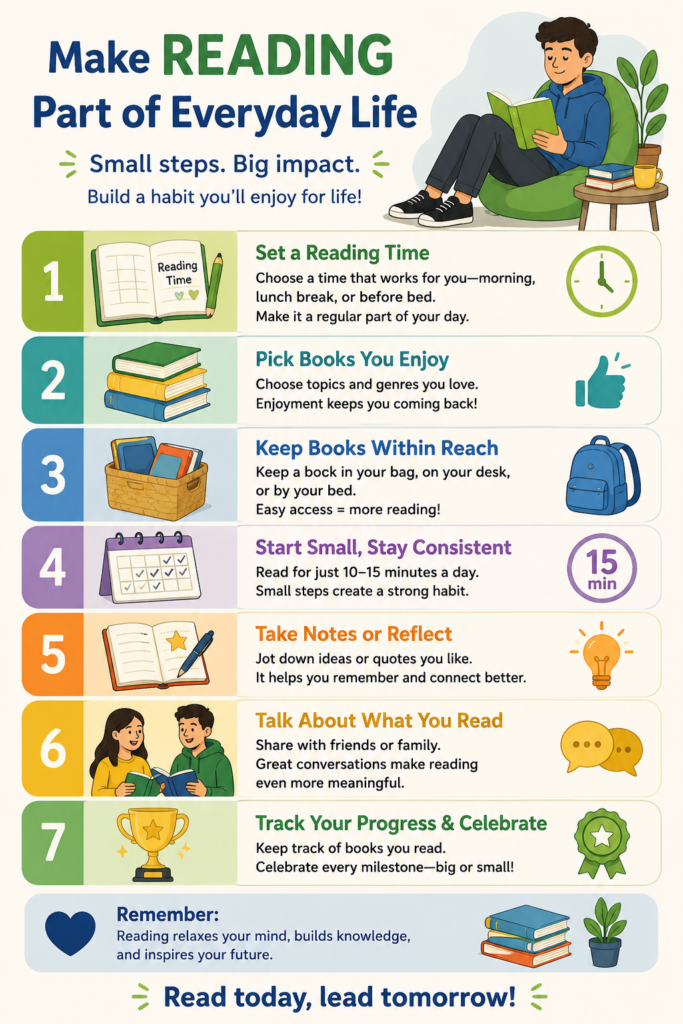
Making reading part of everyday life does not require a complicated schedule. Start with a realistic goal, choose material that interests you, and connect reading with an existing part of your routine.
Digital libraries can make the process more convenient by providing access to many types of resources, while printed books can offer a focused and traditional reading experience. Both can have a place in a balanced reading routine.
The key is consistency. You do not need to read for hours every day or finish a certain number of books. Even a short, focused reading session can become valuable when repeated regularly.
By making reading convenient, enjoyable, and flexible, you can turn it from an occasional activity into a lasting part of everyday life.
Frequently Asked Questions
1. How can I make reading a daily habit?
Choose a small reading goal and connect it with an existing routine, such as reading after homework or before bedtime.
2. How many minutes should I read each day?
There is no fixed requirement. Starting with 10–20 minutes can be a practical way to establish consistency.
3. What should I do if I don’t have much free time?
Use short periods throughout the day to read a few pages or a short article.
4. Are digital libraries useful for daily reading?
Yes. They can provide convenient access to eBooks, journals, and other educational materials, depending on the library’s collection and access policies.
5. Should I read only educational books?
No. A combination of educational and enjoyable reading can make your routine more varied and sustainable.
6. How can I stay interested in reading?
Choose subjects you enjoy, explore different genres, and occasionally try a new type of material.
7. Is it okay to stop reading a book?
Yes, if a book is not suitable for your purpose or interests. You can choose another appropriate resource.
8. What matters more: reading speed or understanding?
Understanding is generally more important than simply finishing a book quickly, particularly when reading educational or research material.