
Introduction
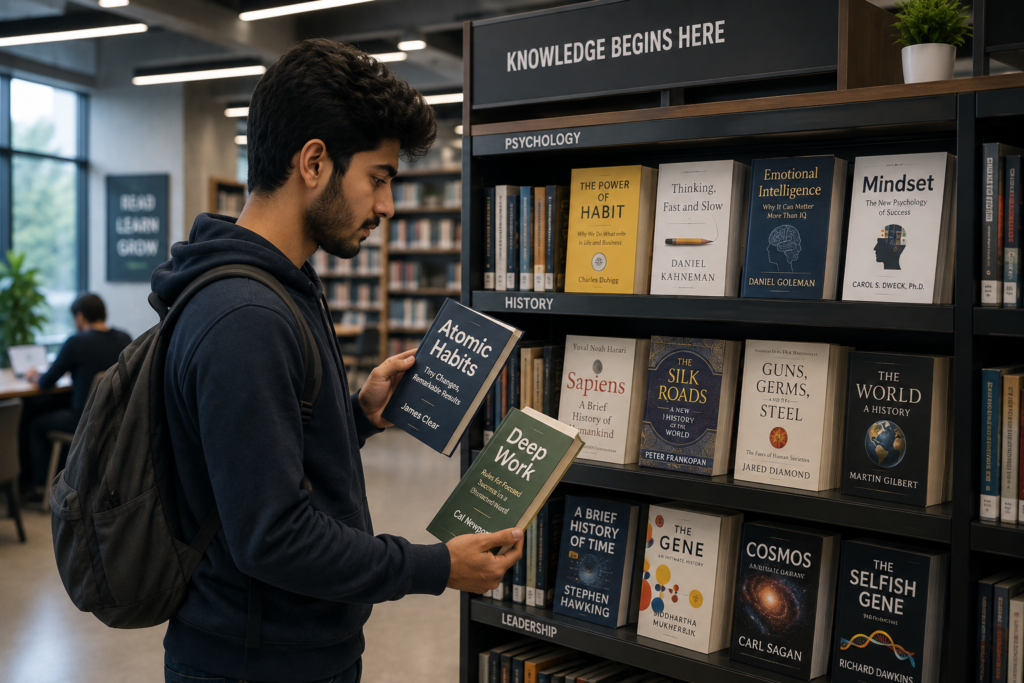
Choosing a book can sometimes be harder than finishing one. With thousands of books available in traditional libraries, digital libraries, bookstores, and online platforms, readers have more choices than ever before. While having many options is useful, it can also make it difficult to decide what to read next.
The right book depends on your purpose. A student preparing for an examination may need a textbook or reference book, while someone looking for relaxation may prefer a novel. A researcher may need scholarly articles and academic publications, whereas a beginner learning a new subject may benefit from a simple introductory guide.
Choosing books according to your goals makes reading more meaningful. Instead of selecting a book simply because it is popular, you can consider your interests, current knowledge, reading level, available time, and what you want to learn.
This guide explains how to choose books that match your personal and educational goals and how digital libraries can make the process easier.
Why Choosing the Right Book Matters
The book you choose can influence your motivation and reading experience. If the material is too difficult, you may lose interest or struggle to understand the main ideas. If it is too easy, you may not feel challenged enough to learn something new.
A suitable book should generally match your purpose and provide information at a level you can understand.
Choosing carefully can help you:
- Stay motivated to read.
- Learn more effectively.
- Save time.
- Discover new interests.
- Develop stronger reading habits.
- Find reliable information for research.
- Make reading more enjoyable.
The goal is not to find a universally “best” book. The goal is to find the book that is right for your particular purpose.
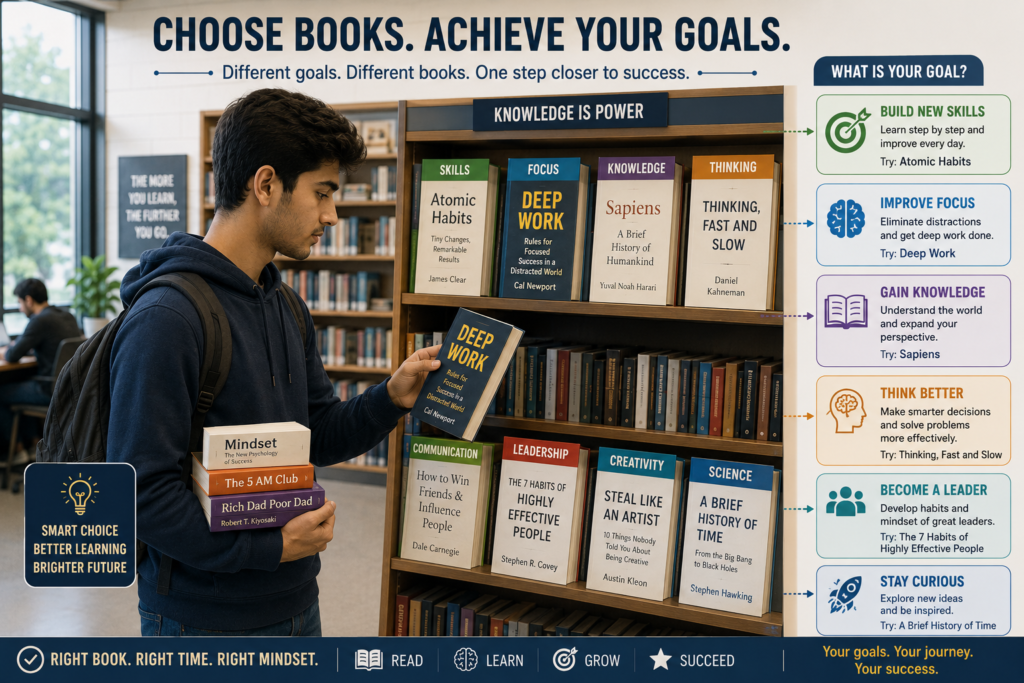
1. Identify Your Reading Goal
Before choosing a book, ask yourself one simple question:
Why do I want to read this book?
Your answer will immediately narrow your choices.
You might want to:
- Learn a new subject.
- Prepare for an examination.
- Improve your vocabulary.
- Conduct research.
- Develop a professional skill.
- Understand history.
- Explore literature.
- Enjoy a story.
- Learn about another person’s experiences.
Once your goal is clear, it becomes much easier to identify suitable resources.
2. Choose a Subject That Interests You
Interest is one of the strongest motivations for reading.
If you enjoy science, explore books about science and technology. If you enjoy history, look for historical books and biographies. Readers interested in literature can explore novels, poetry, and literary criticism.
You do not always need to choose a subject simply because it is academically important. Personal curiosity can lead to valuable learning experiences.
A book that genuinely interests you is more likely to keep you engaged until the end.
3. Consider Your Reading Level
The difficulty of a book should match your current reading ability.
For beginners, introductory books with clear explanations and familiar vocabulary may be more suitable. More experienced readers may prefer detailed academic books, technical publications, or advanced research material.
If you find every page difficult to understand, consider starting with an introductory resource before moving to more advanced material.
Progressing gradually can make complex subjects much easier to understand.
4. Check the Author and Publisher
Before relying on a book for academic or research purposes, learn something about its author and publisher.
Consider:
- The author’s qualifications.
- Their experience with the subject.
- The publisher’s reputation.
- Whether the book is intended for academic or general readers.
- Whether the information is supported by credible references.
For research projects, selecting authoritative sources is particularly important.
5. Read the Description and Contents
A book’s description provides a quick overview of its subject and purpose.
The table of contents can be even more useful. It shows the topics covered and helps you determine whether the book actually addresses the questions you want to explore.
For example, if you want to learn about digital libraries, look for chapters covering digital collections, search systems, accessibility, research, and information management.
Checking these details before starting a book can save time.
6. Check the Publication Date
Publication date matters more for some subjects than others.
A classic literature book may remain valuable for decades, while information about technology, software, science, or current research can change quickly.
When choosing a book for a modern subject, check whether a newer edition or more recent publication is available.
This does not mean older books are automatically unreliable. Historical and foundational works can remain extremely valuable.
7. Look at Reviews Carefully
Reviews can help you understand how other readers experienced a book.
However, do not choose a book based only on its rating. Look for reviews that explain specific strengths and weaknesses.
For example, readers might discuss:
- Writing style.
- Difficulty level.
- Organization.
- Accuracy.
- Usefulness.
- Depth of information.
Different readers have different expectations, so consider whether a reviewer’s priorities match your own.
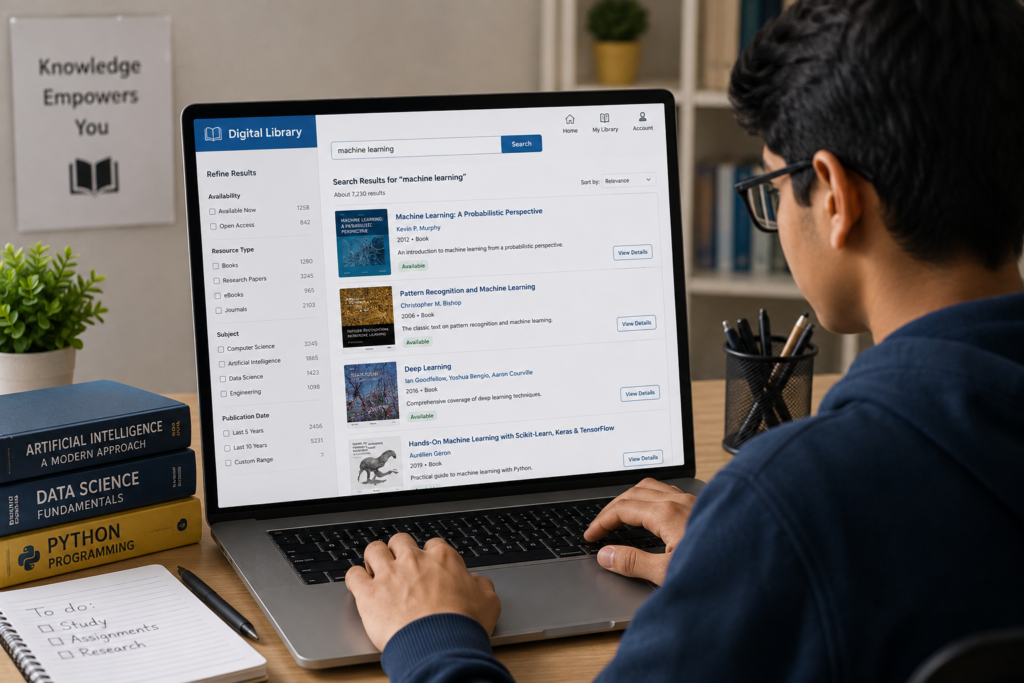
8. Use Digital Libraries for Discovery
Digital libraries can make book discovery much easier.
Instead of browsing thousands of physical books, you can search by title, author, subject, keyword, publication year, or resource type.
Some digital collections also allow users to save books, create reading lists, or organize resources for later use.
When using digital resources, always check the access conditions and respect copyright and licensing requirements.
9. Choose Between Fiction and Non-Fiction
Both fiction and non-fiction have an important place in reading.
Fiction
Fiction includes novels, short stories, and other imaginative works. It can introduce readers to different characters, situations, cultures, and perspectives.
Non-Fiction
Non-fiction includes factual and informational works such as biographies, history, science, education, and technology books.
You do not have to choose only one category. Reading a mixture can provide both enjoyment and educational value.
10. Consider the Time You Have
Your available time should influence your choice.
If your schedule is busy, a short book or collection of articles may be easier to complete. If you have more time available, you may choose a longer book that requires deeper study.
For students, it is useful to consider examination schedules, assignments, and other responsibilities before beginning a lengthy reading project.
A realistic choice is easier to finish than an ambitious one that does not fit your schedule.
11. Preview Before You Commit
If possible, read a sample chapter, introduction, or several pages before deciding whether to continue.
Ask yourself:
- Is the writing clear?
- Do I understand the main ideas?
- Does the subject interest me?
- Is the difficulty appropriate?
- Does this book support my goal?
A short preview can tell you a great deal about whether a book is suitable.
12. Choose Books That Challenge You Gradually
Reading should be comfortable enough to understand but challenging enough to encourage learning.
Once you become comfortable with one level, try something slightly more advanced.
For example, a student learning about computer science might begin with an introductory guide, move to a detailed textbook, and later explore technical research papers.
Gradual progression helps develop knowledge without making the learning process unnecessarily difficult.
13. Keep a Reading List
A reading list prevents you from wasting time deciding what to read next.
You can divide your list into categories such as:
- Books to read for school.
- Research materials.
- Fiction.
- Personal interests.
- Future reading.
- Recommended books.
Digital tools and library bookmarking features can make this organization easier.
14. Do Not Feel Obligated to Finish Every Book
Sometimes you start a book and discover that it does not meet your expectations.
If you have given it a fair opportunity and it is clearly not useful or suitable, you can put it aside and choose another resource.
The purpose of reading is learning and enjoyment, not simply increasing the number of completed books.
However, for required academic materials, you may need to continue reading specific sections even if the material is challenging.
15. Balance Educational and Enjoyable Reading
A healthy reading routine can include different purposes.
For example, a student might read an educational book during study time and a novel during free time.
This variety can prevent reading from feeling like only another academic responsibility.
Reading for enjoyment can also encourage people to maintain a reading habit over the long term.
How Digital Libraries Make Book Selection Easier
Digital libraries provide several tools that simplify the process of finding appropriate resources.
Search features can help you find materials by:
- Subject.
- Author.
- Title.
- Keywords.
- Publication date.
- Language.
- Resource type.
These features are particularly useful when researching a specific topic.
For example, a student researching environmental science can search for relevant keywords and then narrow results by publication date or document type.
Common Mistakes When Choosing Books
Avoid selecting books only because:
- They are popular.
- They have an attractive cover.
- Someone else recommended them.
- They have a high rating.
- They are very long.
- They appear difficult and therefore seem more impressive.
Instead, consider whether the book is actually useful for your purpose.
A simple, well-written introductory book may be more valuable to a beginner than an advanced publication that is difficult to understand.
Conclusion
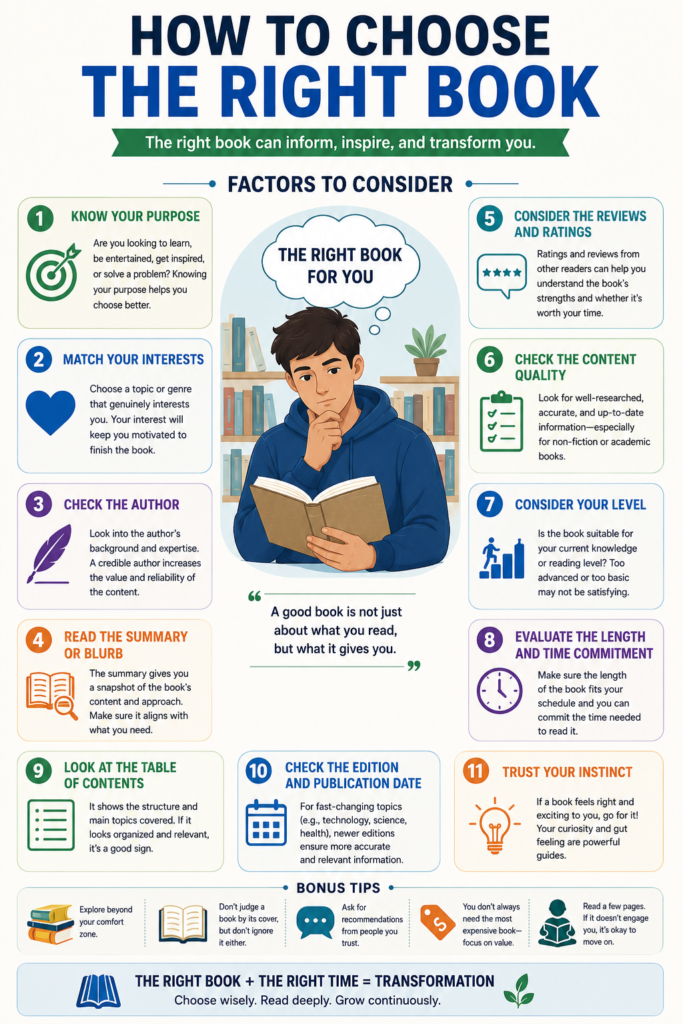
Choosing the right book is an important part of developing a successful reading habit. The best choice depends on your goals, interests, reading level, available time, and the quality of the information.
Before selecting a book, consider its subject, author, publisher, publication date, contents, and suitability for your needs. Digital libraries can make this process easier by providing powerful search and organization tools.
Remember that there is no single perfect book for everyone. A good book is one that helps you learn, think, explore, or enjoy reading according to your own goals.
By choosing thoughtfully and exploring different subjects and formats, you can build a reading collection that supports both your education and your personal growth.
Frequently Asked Questions
1. How do I choose the right book?
Start by identifying your reading goal, then consider the subject, difficulty, author, publication date, and available time.
2. Should students read difficult books?
Students can gradually move toward more challenging books, but the material should remain understandable enough to support effective learning.
3. How can digital libraries help me find books?
Digital libraries often provide search tools and filters for subjects, authors, keywords, publication dates, and resource types.
4. Should I read fiction or non-fiction?
Both can be valuable. Fiction can provide enjoyment and different perspectives, while non-fiction can provide factual and educational information.
5. Should I always finish a book?
Not necessarily. If a book is unsuitable for your purpose, you can choose another one. Required academic reading is an exception when the material is part of your course.
6. Why is the publication date important?
It is particularly important for subjects that change quickly, such as technology, science, and current research.
7. How can I know whether a book is reliable?
Check the author’s expertise, publisher, references, publication details, and whether the information is supported by credible evidence.
8. How many books should I read?
There is no ideal number. Focus on reading material that is useful and meaningful rather than trying to reach a particular number.

