

Introduction
Concentration and focus are important skills for students, researchers, professionals, and lifelong learners. In a world filled with notifications, short-form content, and constant digital distractions, maintaining attention on one task can sometimes be challenging.
Reading provides a simple opportunity to practice sustained attention. Whether you are reading a printed book, an eBook, an academic article, or a research paper, you need to follow information, understand ideas, and connect different parts of the text.
Regular reading can therefore support the development of focused learning habits. It also gives readers opportunities to remember information, summarize ideas, and reflect on what they have learned.
This article explores the relationship between reading, concentration, memory, and focus and provides practical ways to make reading sessions more effective.
Understanding Concentration, Memory, and Focus
Before looking at the benefits of reading, it helps to understand these three related skills.
Concentration
Concentration is the ability to direct attention toward a particular activity or source of information.
Focus
Focus involves maintaining attention on a specific task while avoiding unnecessary distractions.
Memory
Memory allows us to store and later recall information, experiences, and ideas.
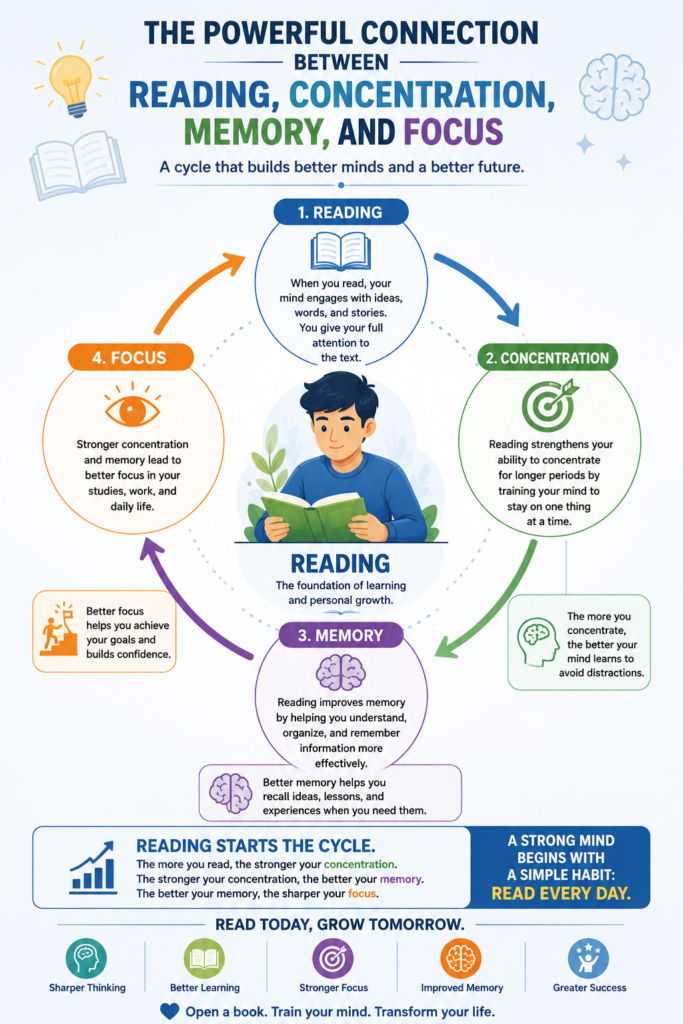
These skills work together during reading. You concentrate on the words, focus on the ideas, and use memory to understand and remember what you have read.
1. Reading Encourages Sustained Attention
Reading requires you to follow information continuously. When reading a chapter or a detailed article, you need to remember what came earlier to understand what comes next.
Regular reading gives you repeated opportunities to practice this type of sustained attention.
Starting with short sessions can be useful for beginners. As the routine becomes comfortable, readers can gradually spend more time with longer texts.
2. Reading Reduces Task Switching
Constantly switching between different activities can make it difficult to concentrate.
For example, someone who reads while repeatedly checking messages may struggle to understand the material. A dedicated reading session creates a clear period in which the reader focuses on one activity.
Putting away unnecessary distractions allows the mind to remain engaged with the text.
3. Reading Requires Active Thinking
Good reading is an active process.
Readers often need to:
- Understand the main idea.
- Connect new information with previous knowledge.
- Ask questions.
- Identify important details.
- Compare different ideas.
- Draw conclusions.
These activities encourage deeper engagement with the material rather than simply looking at words on a page.
4. Reading Supports Memory Through Repetition
When readers encounter information repeatedly, they have more opportunities to remember it.
For example, a student studying a subject might read a chapter, make notes, review important concepts, and return to the material later.
This combination of reading and review can make learning more meaningful.
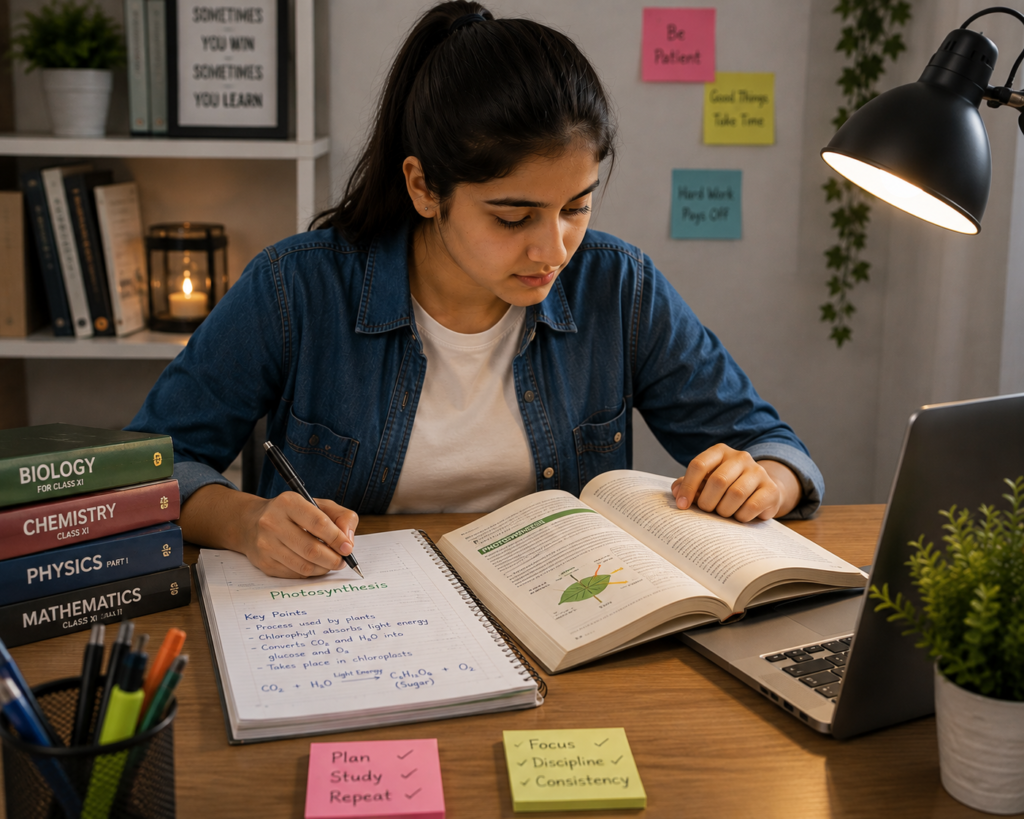
5. Taking Notes Strengthens Understanding
Taking notes while reading can help readers process important information.
Instead of copying entire paragraphs, write short notes containing:
- Main ideas
- Important facts
- Questions
- New vocabulary
- Key examples
After finishing a section, reviewing these notes can help reinforce understanding.
6. Reading Improves Comprehension
Concentration and comprehension are closely connected.
When readers maintain attention, they are more likely to understand relationships between ideas and recognize important details.
Regular reading exposes students to different writing styles and increasingly complex information, giving them opportunities to practice comprehension.
7. Reading Builds a Focused Routine
A consistent reading schedule can create a predictable period for focused learning.
For example, a student might reserve 20 minutes each evening for reading. Over time, this routine can make it easier to begin reading without spending time deciding when or where to do it.
The goal is to establish a realistic routine rather than an unnecessarily demanding schedule.
8. Reading Digital Resources Requires Careful Attention
Digital libraries provide convenient access to eBooks, journals, research papers, and other materials. However, digital devices also contain potential distractions.
When reading digitally, try to:
- Turn off unnecessary notifications.
- Close unrelated applications.
- Use reading mode when available.
- Keep only relevant tabs open.
- Take short breaks during longer sessions.
These simple steps can help maintain attention.
9. Reading Different Genres Challenges the Mind
Different types of reading require different forms of thinking.
A novel may require readers to remember characters and events. A science article may require understanding technical explanations. A historical text may require connecting events and dates.
Exploring different genres gives readers opportunities to practice different comprehension and reasoning skills.
10. Reading Encourages Reflection
After reading an important section, take a moment to think about what you have learned.
Ask yourself:
- What was the main idea?
- What new information did I learn?
- How does this connect to what I already know?
- What questions do I still have?
Reflection can help transform reading from a passive activity into an active learning experience.

Conclusion
Reading provides a practical way to practice concentration and focused learning. By following ideas, remembering information, taking notes, and reflecting on what they read, students and other learners can develop stronger study habits.
Reading alone is not a magic solution for every concentration challenge. However, regular focused reading can become one useful part of a broader learning routine.
The most effective approach is to begin with manageable sessions, reduce distractions, choose appropriate materials, and read actively rather than simply trying to finish as quickly as possible.
With consistency, reading can become both an enjoyable activity and a valuable tool for learning.
Frequently Asked Questions
1. Does reading improve concentration?
Regular focused reading provides repeated opportunities to practice sustained attention and may support stronger concentration habits.
2. How does reading support memory?
Reading requires understanding and connecting information. Taking notes and reviewing important ideas can further support remembering what you have learned.
3. How long should I read to improve focus?
There is no fixed amount of time. Starting with short, focused sessions and gradually developing a consistent routine is a practical approach.
4. Is reading on a phone as effective as reading a book?
Both printed and digital reading can provide valuable learning experiences. The important factors include the quality of the material, your level of engagement, and the distractions around you.
5. How can students concentrate while reading?
Students can choose a quiet environment, silence unnecessary notifications, set a realistic reading period, and take short notes.
6. Does taking notes help while reading?
Yes. Short notes can help readers identify important ideas and review information later.
7. Why is active reading important?
Active reading requires the reader to think about the information, make connections, ask questions, and identify important ideas.
8. Can digital libraries help students focus?
Digital libraries provide convenient access to educational materials. Students can improve their digital reading experience by minimizing device notifications and unrelated distractions.