
Introduction
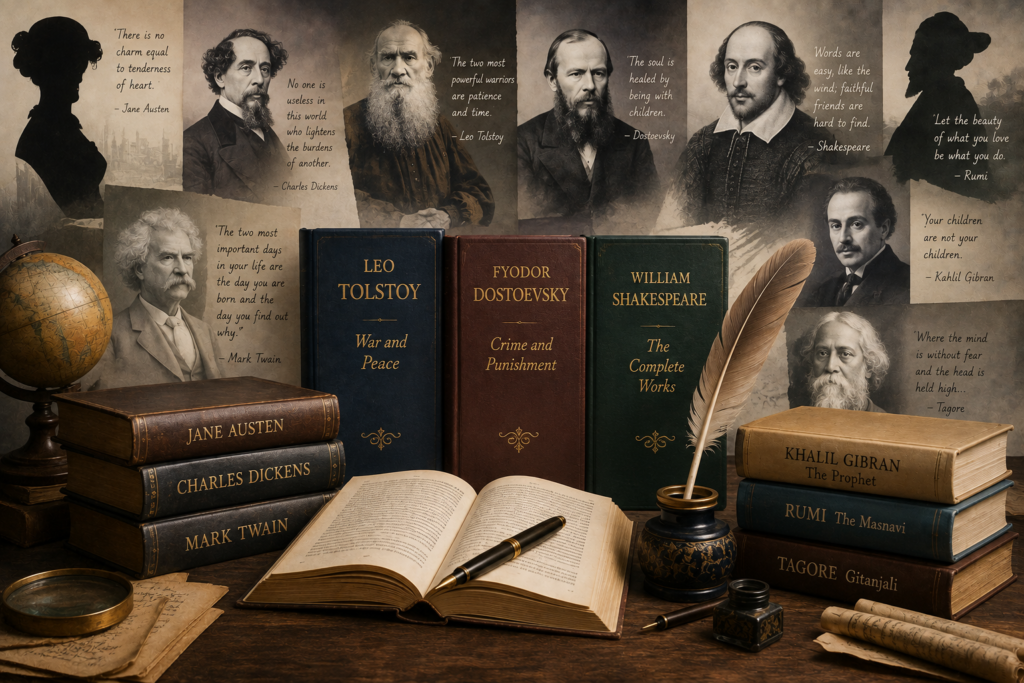
Books have the power to introduce readers to new ideas, different cultures, unfamiliar experiences, and completely new ways of thinking. Behind every book is an author who chooses the words, develops the ideas, creates the characters, and decides how a story or subject should be presented.
Throughout history, many authors have had a lasting influence on literature. Some introduced new styles of storytelling, while others explored social issues, human relationships, education, identity, history, or imagination. Their books have crossed generations and geographical boundaries, continuing to attract readers long after they were first published.
Studying famous authors is not only about memorizing names and book titles. It is also about understanding how writers influence the way people think, communicate, and understand the world.
Some authors became famous because of novels, some because of poetry, some because of plays, and others because of philosophical, historical, scientific, or educational writing.
This article explores the importance of authors, the ways they influence literature and readers, and examples of writers whose works have had a lasting cultural and literary impact.
What Is an Author?
An author is a person who creates a written work.
Authors may write:
- Novels.
- Short stories.
- Poetry.
- Plays.
- Essays.
- Biographies.
- History books.
- Educational books.
- Research works.
- Children’s literature.
An author’s role is not limited to putting words on a page. Authors communicate ideas, create experiences, preserve knowledge, and sometimes challenge readers to think about important questions.
Why Are Authors Important?
Authors contribute to society in many ways.
Their works can:
- Preserve history.
- Introduce new ideas.
- Encourage imagination.
- Teach lessons.
- Improve language skills.
- Explore human experiences.
- Question social problems.
- Entertain readers.
- Inspire future writers.
A single book can influence readers for many years.
Authors can also introduce readers to cultures and experiences they may never encounter personally.
1. William Shakespeare
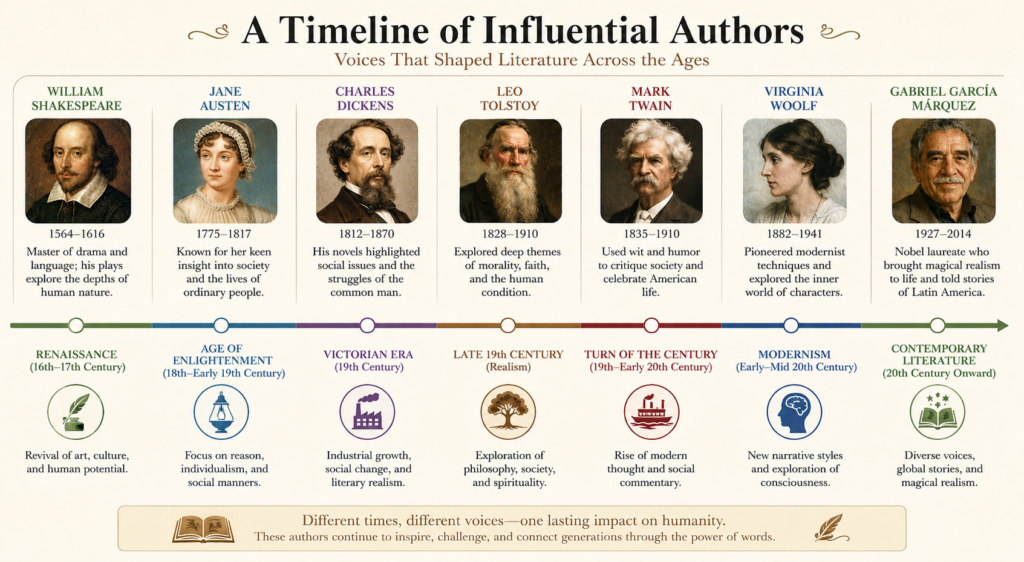
William Shakespeare is one of the most influential writers in English literature.
His plays and poetry explored subjects such as:
- Love.
- Ambition.
- Friendship.
- Jealousy.
- Power.
- Conflict.
- Human behavior.
His works continue to be studied in schools and universities and performed on stages around the world.
Shakespeare’s influence can also be seen in language and storytelling. His characters and themes have been adapted into countless books, films, plays, and other forms of entertainment.
His lasting popularity demonstrates how literature can remain relevant across centuries.
2. Jane Austen
Jane Austen is widely known for novels that explore relationships, society, family, and social expectations.
Her writing combines storytelling with observations about the society in which she lived.
Her novels continue to attract readers because the themes of relationships, social expectations, personal choices, and misunderstandings remain understandable to modern audiences.
Austen also demonstrated how ordinary social situations could become the foundation for engaging literature.
3. Charles Dickens
Charles Dickens became one of the major figures of nineteenth-century English literature.
His novels often explored poverty, inequality, childhood, family, education, and social conditions.
Dickens showed that fiction could entertain readers while also drawing attention to serious social problems.
His work demonstrates the ability of literature to encourage discussion about society and human responsibility.
4. Leo Tolstoy
Leo Tolstoy was a major Russian writer whose works explored morality, family, society, war, and human life.
His writing is known for its detailed characters and examination of difficult moral questions.
Tolstoy’s work demonstrates how literature can move beyond entertainment and encourage readers to think deeply about human behavior and society.
5. Mark Twain
Mark Twain is known for his novels, humor, and observations of American society.
His writing often used humor and satire to explore social attitudes and human behavior.
Twain’s work demonstrates how humor can be used to communicate serious ideas while keeping readers engaged.
6. George Orwell
George Orwell is known for works that examine political power, propaganda, surveillance, inequality, and the relationship between individuals and society.
His writing has influenced discussions about political language and the responsibilities of governments and citizens.
Orwell demonstrates how literature can encourage readers to question information and think critically about power and communication.
7. Virginia Woolf
Virginia Woolf was an important figure in modernist literature.
Her writing explored consciousness, identity, relationships, time, and everyday experiences.
Woolf experimented with literary techniques and demonstrated that storytelling does not always need to follow a simple chronological structure.
Her work continues to be studied for its innovative approach to narrative and character development.
8. Gabriel García Márquez
Gabriel García Márquez became one of the best-known Latin American writers.
His literature is associated with imaginative storytelling and the blending of extraordinary events with everyday life.
His work introduced many international readers to distinctive Latin American literary traditions and perspectives.
His success demonstrates how literature from one region can reach readers across the world.
9. Rabindranath Tagore
Rabindranath Tagore was a major Bengali writer, poet, philosopher, and educator.
His literary work included poetry, songs, stories, essays, and plays.
Tagore’s writing explored themes including:
- Nature.
- Humanity.
- Education.
- Spiritual reflection.
- Society.
His contribution demonstrates how literature can connect with education, philosophy, culture, and artistic expression.
10. Allama Muhammad Iqbal
Allama Muhammad Iqbal is one of the most influential figures in Urdu and Persian poetry.
His poetry explored themes such as:
- Self-development.
- Knowledge.
- Courage.
- Human potential.
- Intellectual growth.
- Spiritual reflection.
Iqbal’s work has had a particularly strong influence on South Asian literary and intellectual culture.
His example shows that poetry can become a powerful way of communicating philosophical and educational ideas.
11. Saadat Hasan Manto
Saadat Hasan Manto is widely regarded as an important Urdu short-story writer.
His stories often examined difficult social realities and human behavior.
Manto’s writing demonstrates that literature can address uncomfortable subjects and encourage readers to think about society from different perspectives.
His work remains an important part of Urdu literary studies.
12. Premchand
Munshi Premchand was an influential writer whose fiction explored social conditions, poverty, rural life, inequality, and human relationships.
His stories often focused on ordinary people and their challenges.
His work demonstrates that literature does not need to focus on extraordinary characters to be meaningful. Everyday experiences can also reveal important truths about society.
How Authors Influence Readers
Authors influence readers in many different ways.
Through Ideas
A book can introduce an idea that readers have never considered before.
Through Characters
Fictional characters can help readers understand different perspectives and experiences.
Through Language
Reading different writers exposes students to vocabulary, sentence structures, and writing styles.
Through Stories
Stories can help readers understand emotions, relationships, and social situations.
Through Questions
Some books do not provide simple answers. Instead, they encourage readers to ask better questions.
How Authors Influence Education
Authors play an important role in education.
Textbook authors organize information so students can understand complex subjects.
Literary authors help students explore:
- Language.
- Culture.
- History.
- Human behavior.
- Critical thinking.
Research authors contribute knowledge that can be used by teachers and students.
Reading different authors therefore expands education beyond a single classroom or textbook.
Authors and Cultural Preservation
Books can preserve cultural knowledge.
Authors may document:
- Traditions.
- Languages.
- Historical experiences.
- Social customs.
- Local stories.
- Cultural beliefs.
This allows future generations to learn about experiences from the past.
Literature can therefore become a record of how people thought and lived during different periods.
Authors Can Introduce Different Perspectives
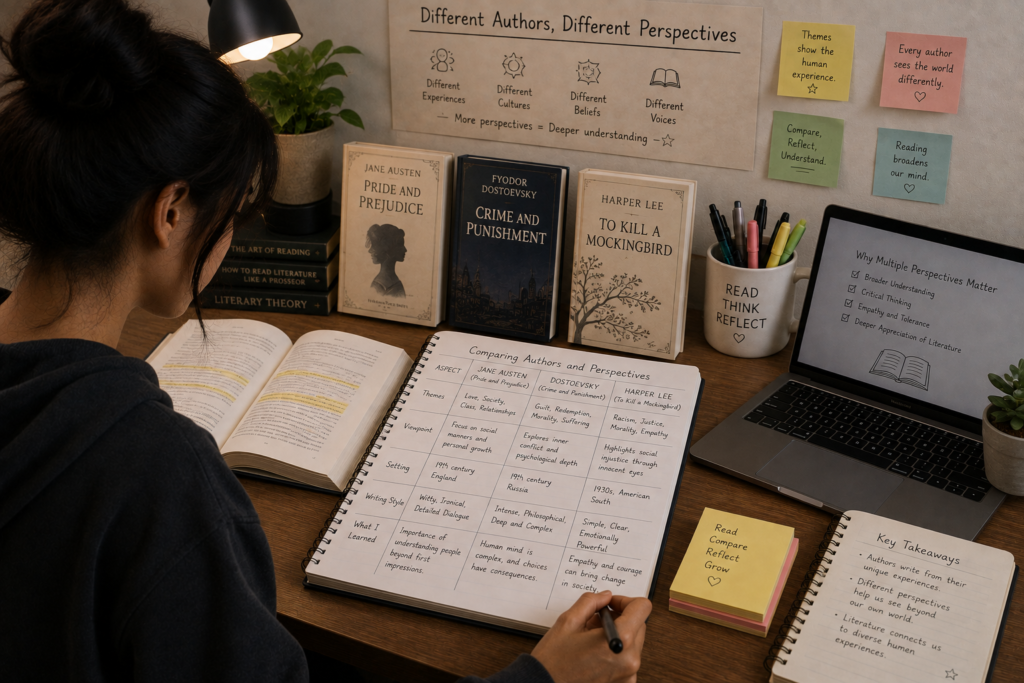
One of the greatest benefits of reading different authors is exposure to different viewpoints.
Two authors may write about the same subject but reach different conclusions.
This teaches readers that:
One topic can have multiple perspectives.
Students can compare different writers and ask:
- What does each author believe?
- What evidence or reasoning is used?
- How are their writing styles different?
- What can I learn from both perspectives?
This is an important critical-thinking skill.
How Students Can Learn From Famous Authors
Students do not need to become professional writers to learn from authors.
They can study:
Vocabulary
Notice unfamiliar words and how authors use them.
Structure
Observe how chapters and paragraphs are organized.
Arguments
Look at how nonfiction authors support their ideas.
Characters
Study how fictional characters develop.
Descriptions
Notice how writers create places, people, and situations.
Themes
Identify important ideas that appear throughout a book.
These observations can improve both reading and writing skills.
How to Discover New Authors
Students can discover authors through:
- School libraries.
- Public libraries.
- Digital libraries.
- Book reviews.
- Teacher recommendations.
- Literary websites.
- Reading lists.
- Book clubs.
- Recommendations from other readers.
A useful approach is to begin with one author and then explore similar writers.
For example:
Author → Related genre → Similar authors → New books
This can gradually expand your reading experience.
Don’t Read Only Famous Authors
Famous authors are useful to study, but readers should not limit themselves to well-known writers.
New and lesser-known authors can also offer:
- Fresh perspectives.
- Different storytelling styles.
- New topics.
- Diverse experiences.
- Innovative ideas.
The goal of reading is not simply to collect famous names. It is to discover meaningful writing.
Authors in the Digital Age
Technology has changed how authors publish and reach readers.
Today, readers can encounter writing through:
- E-books.
- Digital magazines.
- Online publications.
- Audiobooks.
- Educational platforms.
- Digital libraries.
This has made written content more accessible in many parts of the world.
However, digital availability also means readers need to evaluate sources carefully and distinguish reliable publications from unsupported online content.
How Digital Libraries Help Readers Discover Authors
Digital libraries can make author discovery easier.
Readers can search by:
- Author name.
- Book title.
- Subject.
- Genre.
- Keyword.
A student interested in a particular author can use a library catalogue to discover additional works.
This is particularly useful for research projects and literature studies.
Reading Authors From Different Cultures
Reading international authors can expand a student’s understanding of the world.
Literature from different regions can introduce:
- New cultural traditions.
- Different historical experiences.
- Different social perspectives.
- New storytelling techniques.
- Different languages and literary traditions.
Students should approach unfamiliar literature with curiosity and respect.
How to Analyze an Author’s Work
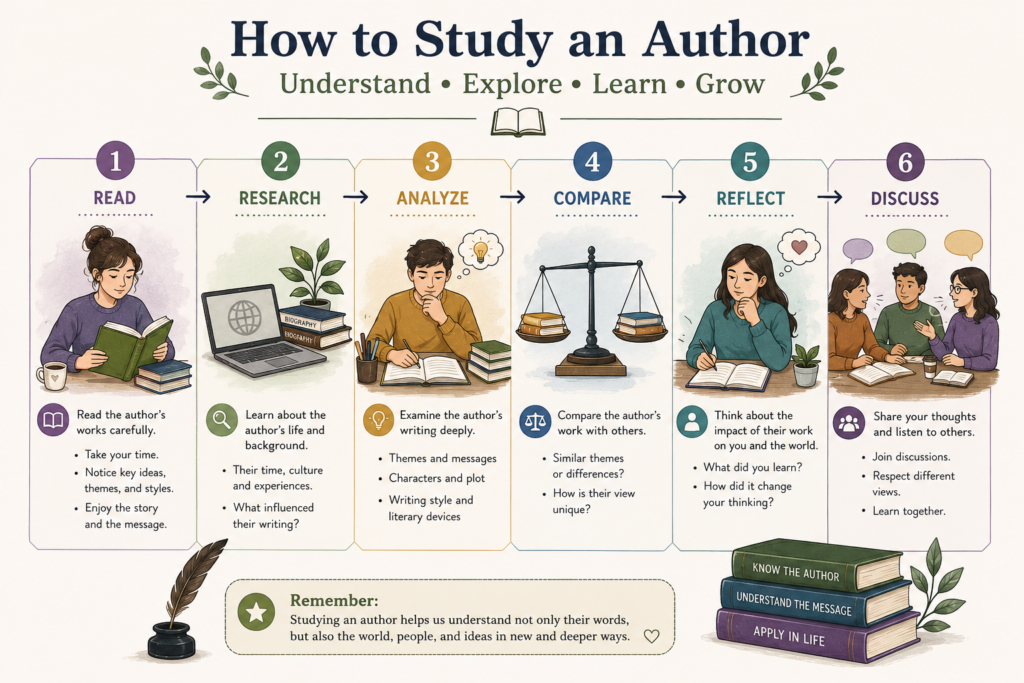
When reading an author, ask:
What does the author write about?
Identify recurring subjects and themes.
How does the author write?
Look at style, structure, vocabulary, and storytelling.
What message is being communicated?
Consider the author’s main ideas.
Who is the intended audience?
Think about who the work was written for.
Why is the work still relevant?
Consider which ideas continue to interest modern readers.
Common Mistakes When Studying Authors
Focusing Only on Biography
An author’s life can provide context, but the literary work itself should remain the main focus.
Memorizing Names Without Reading
Knowing an author’s name is less valuable than understanding their ideas and writing.
Treating Every Author as Perfect
Famous authors can still have weaknesses and controversial ideas. Readers should think critically.
Reading Only One Perspective
Comparing different authors can provide a broader understanding.
Ignoring Historical Context
Understanding when and where a work was written can help explain its themes and ideas.
Why Authors Continue to Matter
Even as technology changes, authors remain important because people continue to need stories, explanations, ideas, and knowledge.
Books can outlive their creators.
A work written decades or centuries ago can still influence a reader today.
This is one of the most remarkable features of literature: ideas can travel across generations through written words.
Conclusion
Authors play an essential role in literature, education, culture, and the sharing of ideas.
From Shakespeare and Jane Austen to Charles Dickens, George Orwell, Virginia Woolf, Gabriel García Márquez, Rabindranath Tagore, Allama Iqbal, Manto, and many others, writers have shown that books can do much more than entertain.
They can preserve history, explore human experiences, question social problems, introduce different cultures, develop language skills, and encourage critical thinking.
For students, reading different authors is an opportunity to discover new perspectives and improve their own communication skills. By paying attention to vocabulary, structure, themes, arguments, characters, and writing style, students can learn from authors even when they are not studying literature formally.
The best way to understand an author’s influence is not simply to memorize a list of famous names. Read their work, understand their ideas, compare different perspectives, and think about why their writing continues to matter.
Every generation discovers books in its own way, but the fundamental connection between authors and readers remains the same: one person writes, another person reads, and an idea travels across time.
Frequently Asked Questions
1. Why are authors important?
Authors create stories, preserve knowledge, communicate ideas, explore social issues, and provide readers with new perspectives.
2. Who is one of the most influential authors in English literature?
William Shakespeare is widely regarded as one of the most influential figures in English literature.
3. Why should students read different authors?
Different authors expose students to different writing styles, ideas, cultures, perspectives, and vocabulary.
4. How can authors influence society?
Authors can raise awareness of social issues, preserve cultural experiences, challenge ideas, and encourage readers to think critically.
5. Can authors help students improve writing?
Yes. Reading strong writing can help students observe vocabulary, sentence structure, organization, storytelling, and methods of presenting ideas.
6. How can I discover new authors?
You can explore school and public libraries, digital libraries, book reviews, teacher recommendations, reading lists, and different genres.
7. Should I only read famous authors?
No. Famous authors are useful to study, but lesser-known and contemporary writers can also provide valuable perspectives and enjoyable reading experiences.
8. How can digital libraries help me find authors?
Digital libraries often allow users to search collections by author, title, subject, or keyword, making it easier to discover additional works.