
Introduction
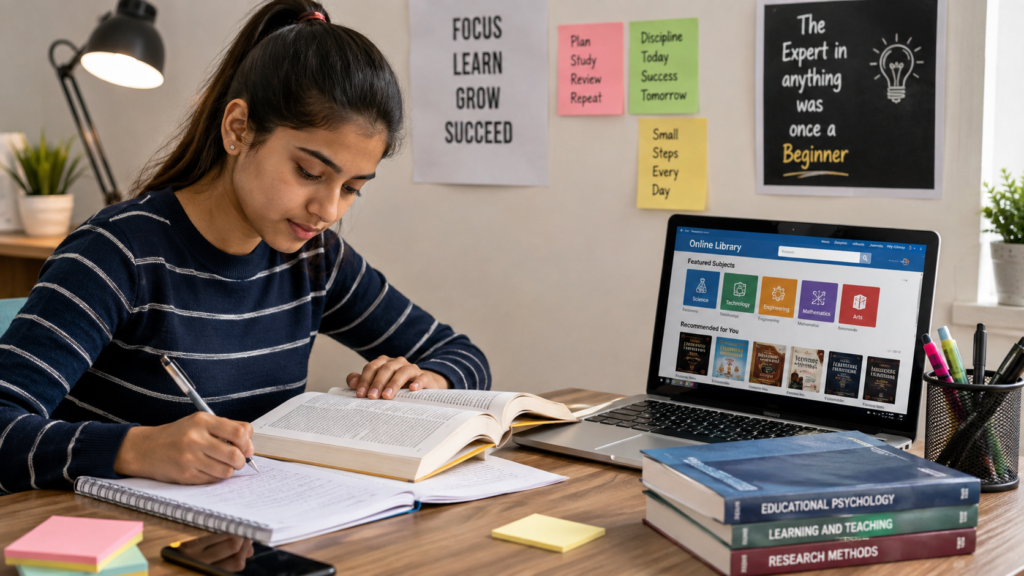
Learning is more than memorizing information for an examination. It is the process of understanding ideas, asking questions, solving problems, making connections, and applying knowledge in different situations.
Every student has the ability to improve their learning skills. Some students may understand a topic quickly, while others may need more time, examples, or practice. This difference does not mean that one student is capable and another is not. Learning methods can be developed and improved through consistent practice.
Good learning skills can help students make better use of their study time. Instead of repeatedly reading the same page, students can use active learning, effective note-taking, regular revision, research skills, and practice to understand information more deeply.
Digital resources can also support this process. E-books, digital libraries, educational articles, reference materials, and other legitimate online resources can provide additional explanations and opportunities for independent learning.
This guide explains practical ways students can strengthen their learning skills and develop a more effective approach to education.
What Are Learning Skills?
Learning skills are abilities that help a person understand, remember, organize, and use information.
Important learning skills include:
- Reading and comprehension.
- Note-taking.
- Research.
- Critical thinking.
- Problem-solving.
- Time management.
- Active recall.
- Communication.
- Organization.
- Self-evaluation.
These skills are useful not only for examinations but also for lifelong learning.
Why Are Learning Skills Important?
Students often have to manage large amounts of information.
Without an effective learning method, it can become difficult to decide:
- What information is important?
- What should be reviewed?
- Which sources are reliable?
- How should notes be organized?
- How can knowledge be applied?
Strong learning skills provide a system for answering these questions.
They can also make independent study easier because students become better at identifying what they know and what they still need to learn.
1. Set a Clear Learning Goal
Start every study session with a clear objective.
Instead of saying:
“I need to study biology.”
Set a specific goal:
“I will understand the main functions of the cell and explain them in my own words.”
A clear goal makes it easier to measure progress.
At the end of the session, ask yourself whether you achieved the goal.
2. Become an Active Reader
Reading is one of the most important learning activities, but effective reading involves more than moving your eyes across a page.
Before reading, look at:
- The title.
- Headings.
- Subheadings.
- Diagrams.
- Key terms.
- Summary sections.
Ask yourself what you expect to learn.
During reading, identify important ideas and connect them with information you already know.
After reading, close the book and try to explain the main points without looking at the text.
This makes reading a more active process.
3. Practice Active Recall
Active recall means trying to remember information without looking at the answer.
For example, after studying a chapter, close your textbook and ask yourself:
- What were the main ideas?
- What definitions did I learn?
- Can I explain the concept?
- What examples were given?
- Which part do I still find difficult?
You can also create questions and answer them from memory.
This helps you identify gaps in your understanding.
4. Use Spaced Review
Instead of reviewing a topic only once, return to it periodically.
For example:
Day 1: Learn the topic.
Day 2: Brief review.
Day 5: Test yourself.
Day 10: Review difficult areas.
The exact schedule can vary, but the basic idea is to spread learning across time rather than completing everything in one session.
5. Take Better Notes
Good notes do not need to contain every sentence from a textbook.
Focus on:
- Main ideas.
- Definitions.
- Examples.
- Important facts.
- Formulas.
- Questions.
- Connections between concepts.
Use headings and short points to make notes easier to review.
After taking notes, check whether you could understand the topic from your notes alone.
6. Explain Concepts in Your Own Words
One of the simplest ways to check understanding is to explain a concept without copying the textbook.
Imagine that you are teaching the topic to another student.
If you can explain it clearly and answer basic questions about it, you probably understand it reasonably well.
If your explanation becomes confusing, return to the source and review the difficult section.
7. Ask Questions
Curiosity is an important part of learning.
When you encounter something confusing, ask questions such as:
- Why does this happen?
- How does this process work?
- What causes this result?
- What is the difference between these two ideas?
- Where can this concept be applied?
Questions encourage deeper thinking instead of simple memorization.
8. Improve Reading Comprehension
Reading comprehension means understanding and interpreting what you read.
To improve it, try to:
- Read without rushing.
- Identify the main idea.
- Look for supporting details.
- Learn unfamiliar vocabulary.
- Summarize each section.
- Connect the information to previous knowledge.
Reading different types of appropriate material can also help students become more comfortable with complex ideas.
9. Use Digital Libraries for Additional Learning
Digital libraries can provide useful resources for students.
Depending on the library and its collection, students may find:
- E-books.
- Academic articles.
- Reference materials.
- Research publications.
- Educational documents.
A student who wants to explore a topic beyond the textbook can use legitimate digital library resources to find additional information.
Always check the source and follow copyright and access requirements.
10. Learn How to Evaluate Sources
Having access to information is not enough. Students also need to determine whether information is reliable.
Before using a source, consider:
Who wrote it?
Look for information about the author.
Who published it?
Check whether the organization or publisher is trustworthy.
When was it published?
Some topics require current information.
What evidence is provided?
Reliable educational material often identifies supporting evidence or references.
What is the purpose?
Consider whether the resource is educational, promotional, opinion-based, or designed for another purpose.
These questions help students become better digital researchers.
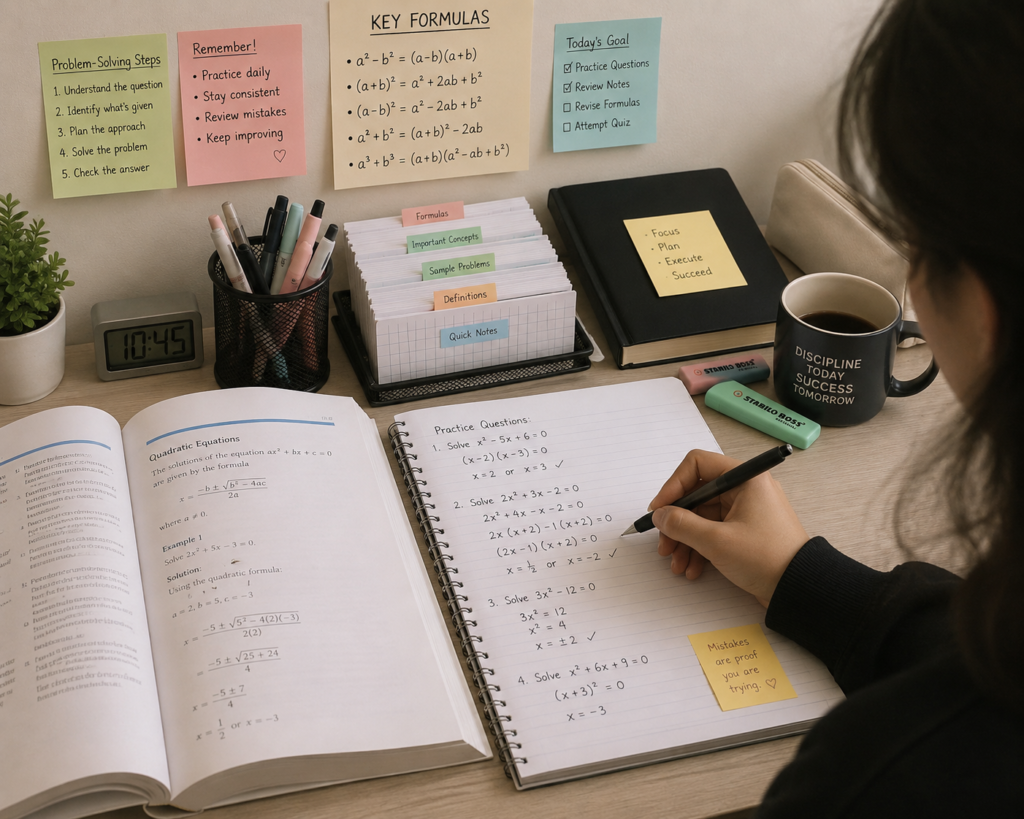
11. Practice Problem-Solving
Learning becomes stronger when students apply information.
For subjects such as mathematics, physics, chemistry, and computer science, practice questions can be particularly useful.
Do not simply read the solution.
Try solving the problem yourself first.
If you make an error, study the solution and identify where your reasoning changed from the correct approach.
Then try another similar problem.
12. Connect New Information With What You Already Know
New information is easier to understand when it connects to existing knowledge.
For example, when learning a new computer programming concept, think about how it relates to programming concepts you already understand.
When learning a new vocabulary word, connect it with a sentence or situation where it could naturally be used.
These connections can make information more meaningful.
13. Use Different Learning Formats
Sometimes one explanation is not enough.
If a topic is difficult, consider using another appropriate format:
- Written explanation.
- Diagram.
- Table.
- Example.
- Practice question.
- Educational video.
- E-book.
- Reference article.
Different formats can highlight different aspects of the same concept.
However, avoid collecting resources endlessly. Choose a few useful sources and spend enough time actually learning from them.
14. Organize Your Study Materials
Organization saves time.
Create separate folders for each subject and keep related resources together.
For digital materials, use meaningful names such as:
Physics_Waves_Notes.pdf
rather than:
File123.pdf
For physical materials, use labeled notebooks or folders.
A simple organization system makes revision easier.
15. Improve Time Management
Good time management is not about studying every available minute.
It means deciding what needs to be done and giving important tasks appropriate attention.
Create a list of priorities.
For example:
High priority: Assignment due tomorrow.
Medium priority: Review today’s lesson.
Low priority: Organize older notes.
This helps prevent important tasks from being forgotten.
16. Break Difficult Topics Into Smaller Parts
A difficult chapter can seem overwhelming when viewed as one large task.
Divide it into sections.
For example:
Chapter: Electricity
- Basic concepts.
- Current.
- Voltage.
- Resistance.
- Circuits.
- Practice questions.
- Revision.
Study one part at a time.
After completing each section, check your understanding before moving forward.
17. Learn From Your Mistakes
Mistakes provide useful information.
If you repeatedly answer a question incorrectly, do not simply memorize the correct answer.
Ask:
What caused my mistake?
Perhaps you:
- Misunderstood the question.
- Forgot a rule.
- Used the wrong formula.
- Made a calculation error.
- Missed an important detail.
Once you identify the cause, you can work on that specific weakness.
18. Practice Writing
Learning is not only about understanding information. Students also need to communicate what they know.
Practice writing:
- Short answers.
- Summaries.
- Explanations.
- Research notes.
- Essays.
- Assignment responses.
After writing, check whether your ideas are clear and logically organized.
Writing can also reveal gaps in understanding.
If you cannot explain an idea clearly, you may need to review it.
19. Teach What You Have Learned
Teaching another person can be a useful way to test your understanding.
Choose a topic and explain:
- What it is.
- Why it matters.
- How it works.
- An example.
- Any important exceptions.
You do not need to be a professional teacher. Even explaining the concept aloud to yourself can help reveal areas that need more attention.
20. Create a Distraction-Free Study Routine
Learning requires attention.
Before starting a study session:
- Put unnecessary devices aside.
- Turn off unrelated notifications.
- Close entertainment websites.
- Keep only the required materials nearby.
- Choose a suitable study environment.
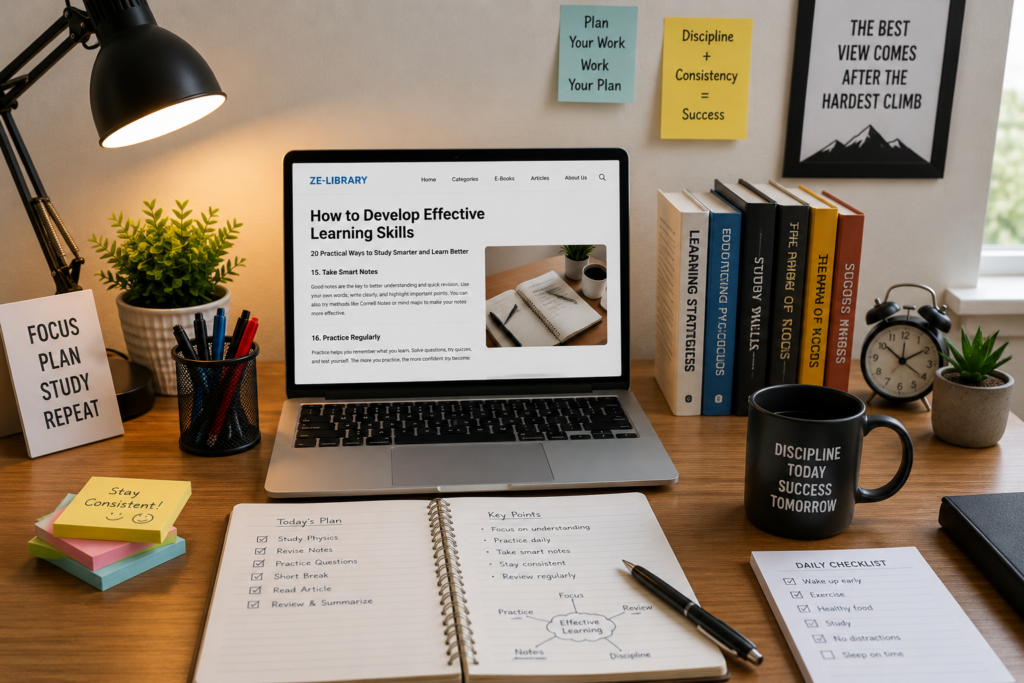
If you are using a laptop for research, keep your work focused on the resources you actually need.
A Simple Learning Method Students Can Follow
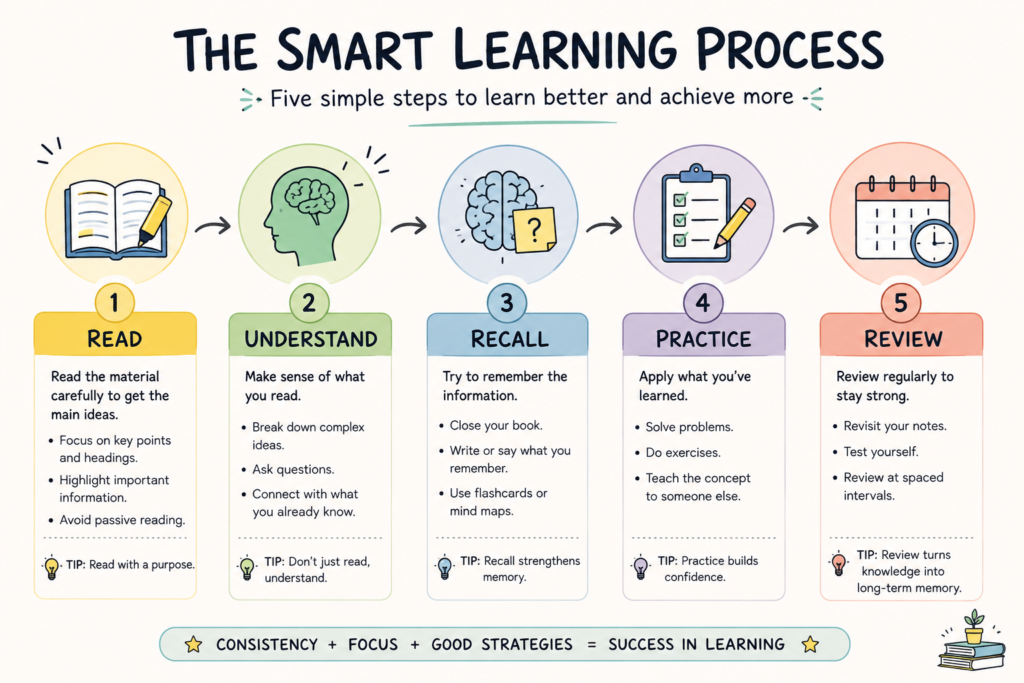
Students can use this five-step process for many subjects.
Step 1: Preview
Look at the headings, key terms, and learning objectives.
Step 2: Learn
Read the material carefully and understand the main concepts.
Step 3: Recall
Close the book and explain what you remember.
Step 4: Practice
Answer questions or apply the information.
Step 5: Review
Return to difficult areas and revise them later.
This method encourages students to participate actively in their learning.
Learning Skills for Different Subjects
Different subjects require different approaches.
Mathematics
Focus on concepts, worked examples, and repeated problem-solving practice.
Science
Use explanations, diagrams, experiments where appropriate, and practice questions.
Computer Science
Combine reading with coding, problem-solving, and practical exercises.
English
Read regularly, improve vocabulary, practice writing, and review grammar.
History
Use timelines, summaries, comparisons, and connections between events.
The key is to match the learning method with the subject.
Common Learning Mistakes
Memorizing Without Understanding
Memorization can be useful, but students should understand concepts whenever possible.
Studying Only Before Exams
Regular learning and review can make examination preparation more manageable.
Using Too Many Resources
More resources do not automatically mean better learning.
Copying Notes Without Thinking
Writing information down is not enough. Students should process and understand it.
Ignoring Difficult Topics
Avoiding difficult concepts can make later topics harder.
Studying With Constant Distractions
Frequent interruptions can make study sessions less focused.
How Digital Resources Can Support Learning
Digital resources can make independent learning easier when used responsibly.
Students can use e-books to explore additional topics, digital libraries to find legitimate research materials, and educational articles to discover alternative explanations.
Searchable digital resources can also save time when looking for specific terms.
However, students should remember that digital information must still be evaluated.
A website being easy to access does not automatically make its information accurate.
The best digital learning approach combines technology with critical thinking, careful reading, and active practice.
How Parents and Teachers Can Support Better Learning
Students benefit when teachers and families encourage healthy learning habits.
Teachers can:
- Explain difficult concepts.
- Recommend reliable resources.
- Provide feedback.
- Encourage questions.
- Help students develop research skills.
Parents and families can:
- Provide a suitable study environment.
- Encourage consistent routines.
- Support reading.
- Help students manage responsibilities.
The student’s own effort remains important, but a supportive environment can make learning easier.
Conclusion
Learning skills can be developed through regular practice. Students do not need a complicated system to become better learners. Small improvements in reading, note-taking, research, organization, problem-solving, and revision can make a meaningful difference.
The most important step is to become an active learner.
Instead of simply reading information, ask questions, explain ideas in your own words, practice what you have learned, and review difficult areas.
Digital resources can also expand learning opportunities. E-books, digital libraries, educational articles, and other legitimate resources can provide additional information beyond the classroom.
At the same time, students should evaluate sources carefully and avoid treating every piece of online information as reliable.
Effective learning is a continuous process. There will always be difficult topics, mistakes, and new subjects to explore. By developing strong learning habits and remaining willing to learn from mistakes, students can become more independent and capable learners.
Frequently Asked Questions
1. How can students improve their learning skills?
Students can improve learning skills through active reading, note-taking, regular revision, practice, research, time management, and self-evaluation.
2. What is active learning?
Active learning involves working with information through activities such as explaining concepts, answering questions, solving problems, and recalling information.
3. Are digital libraries useful for students?
Yes. Digital libraries can provide access to e-books, academic articles, reference materials, and other educational resources, depending on their collections.
4. How can students improve reading comprehension?
Students can improve comprehension by identifying main ideas, learning unfamiliar vocabulary, summarizing sections, asking questions, and connecting new information with existing knowledge.
5. Why is practice important for learning?
Practice allows students to apply knowledge and identify areas where they need more understanding.
6. How can students learn from mistakes?
Students should identify why an error occurred, review the relevant concept, and practice similar questions.
7. Should students use many different learning resources?
Not necessarily. A few reliable and relevant resources are usually more useful than collecting a large number of materials without studying them carefully.
8. How can students stay focused while studying?
They can create a suitable study environment, reduce notifications, close unrelated applications, and keep their study goals clear.