
Introduction
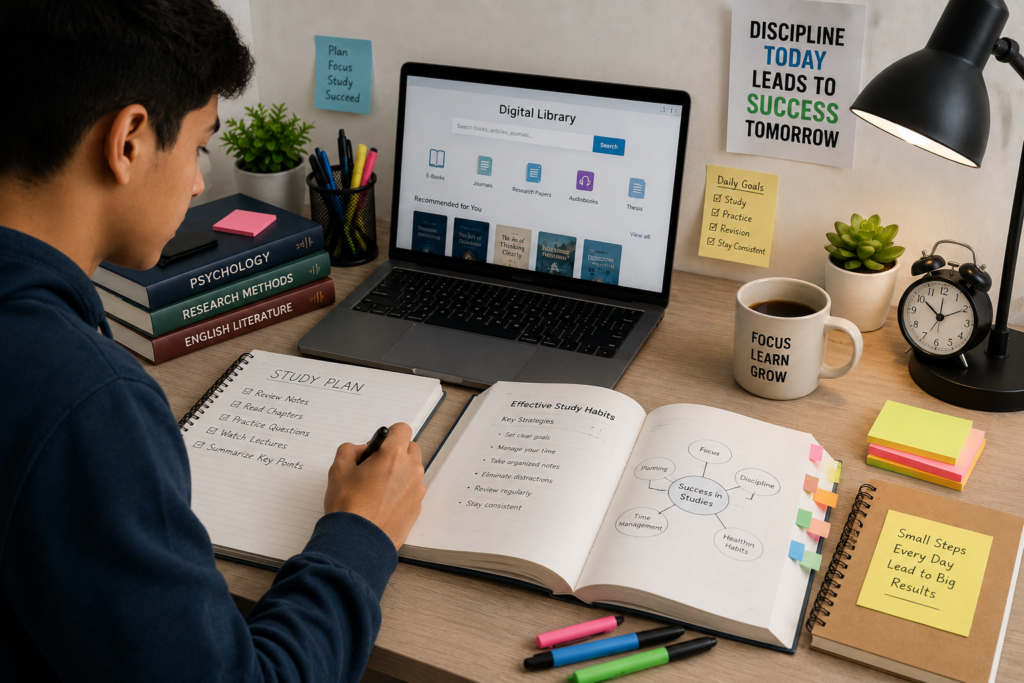
Studying is an important part of student life, but spending many hours with a textbook does not always mean that learning is taking place effectively. A student can study for several hours and still struggle to remember important information if the study method is not suitable.
Good study habits can make learning more organized and meaningful. They can help students understand lessons, remember important concepts, prepare for examinations, and manage their academic responsibilities more effectively.
A good study routine does not have to be complicated. It can begin with simple habits such as setting clear goals, organizing study materials, reviewing lessons regularly, taking useful notes, practicing questions, and reducing distractions.
Every student is different, so there is no single study method that works perfectly for everyone. The important thing is to experiment with different approaches and find a routine that supports your subjects, schedule, and learning needs.
This article discusses practical study habits that students can use to make their learning more effective.
Why Good Study Habits Matter
Study habits are the regular actions students take when learning.
These habits influence how students use their available time and how effectively they process information.
Good study habits can help students:
- Organize their work.
- Understand difficult topics.
- Remember information.
- Prepare for examinations.
- Complete assignments on time.
- Reduce unnecessary stress.
- Develop independent learning skills.
The goal is not simply to study for longer. It is to make study time more purposeful.
1. Set Clear Study Goals
Before beginning a study session, decide what you want to accomplish.
Instead of saying:
“I will study physics.”
Set a more specific goal:
“I will review the laws of motion and solve five practice questions.”
A specific goal gives the session a clear direction.
At the end, you can check whether you completed the task.
2. Create a Realistic Study Schedule
A study schedule can help students divide their time among different subjects.
For example:
| Time | Activity |
|---|---|
| 4:00–4:40 | Mathematics |
| 4:40–5:20 | Physics |
| 5:20–5:35 | Break |
| 5:35–6:15 | Computer Science |
| 6:15–6:30 | Review |
The schedule should be realistic.
Do not create a timetable that leaves no time for breaks, meals, rest, or other responsibilities.
A flexible schedule is usually easier to maintain than an extremely strict one.
3. Study in a Suitable Environment
Your study environment can influence concentration.
Choose a place where you can work comfortably and where unnecessary interruptions are limited.
A useful study area might include:
- Appropriate lighting.
- A comfortable chair.
- A clean desk.
- Necessary books.
- Notebook and stationery.
- A laptop or tablet when required.
You do not need an expensive study setup. Organization and fewer distractions are more important.
4. Remove Unnecessary Distractions
Digital devices can be useful for studying, but they can also interrupt concentration.
Notifications, social media, games, and unrelated websites can quickly take attention away from the lesson.
During focused study sessions, consider:
- Turning off unnecessary notifications.
- Closing unrelated browser tabs.
- Keeping entertainment applications closed.
- Putting your phone away when appropriate.
- Using a distraction-free study environment.
The goal is not to avoid technology completely. It is to use it intentionally.
5. Use Active Learning
Active learning means doing something with the information rather than simply reading it repeatedly.
For example, after reading a topic, try to:
- Explain it in your own words.
- Answer questions.
- Create a short summary.
- Draw a diagram.
- Solve a problem.
- Teach the concept to someone else.
Active learning can help you identify what you understand and what still needs review.
6. Take Useful Notes
Good notes should help you understand and remember information.
Instead of copying every sentence from a textbook, identify the important ideas.
You can record:
- Definitions.
- Formulas.
- Main points.
- Examples.
- Important dates.
- Questions.
- Key vocabulary.
Use headings and bullet points to keep information organized.
7. Review Lessons Regularly
Waiting until the night before an examination to review everything can be difficult.
Regular review gives students opportunities to revisit information before it becomes unfamiliar.
A simple pattern might be:
Learn → Review → Practice → Review Again
The exact schedule can vary according to the subject and examination timetable.
8. Practice With Questions
Practice questions are particularly useful for subjects that require problem-solving.
After studying a topic, answer questions without immediately checking the solution.
Then compare your answer with the correct one.
If you make a mistake, identify why.
Was the problem caused by:
- A misunderstanding?
- A calculation error?
- Forgetting a formula?
- Misreading the question?
Understanding mistakes can make practice more useful.
9. Use the Feynman Technique Carefully
One simple learning approach is to explain a concept in simple language.
Choose a topic and imagine that you are explaining it to someone who has never studied it.
If you cannot explain a particular part clearly, that may indicate that you need to review it.
This method can be useful for identifying gaps in understanding.
10. Use Digital Resources Wisely
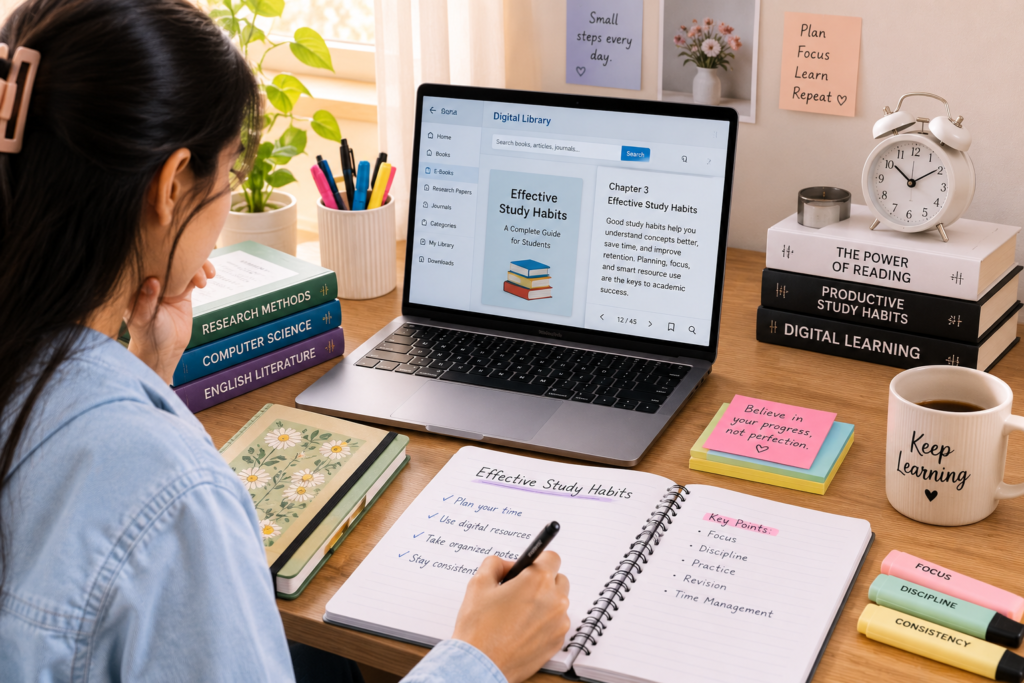
Students can use digital libraries, e-books, academic articles, educational websites, and online reference materials to support their studies.
For example, if a textbook explanation is unclear, a student can look for another reliable explanation.
Digital resources can also help students:
- Find definitions.
- Research topics.
- Access additional reading.
- Search long documents.
- Organize study materials.
However, students should evaluate sources carefully and avoid copying information directly into assignments.
11. Read Beyond the Textbook
Textbooks are important, but additional reading can provide broader understanding.
Students can explore:
- E-books.
- Reference books.
- Academic articles.
- Educational websites.
- Digital library resources.
Additional reading can introduce different explanations, examples, and perspectives.
Students should choose resources that are appropriate for their academic level.
12. Break Large Tasks Into Smaller Parts
A large assignment can feel difficult when viewed as one huge task.
Break it into smaller steps.
For example:
Research assignment
- Choose the topic.
- Find reliable sources.
- Read the material.
- Take notes.
- Create an outline.
- Write the first draft.
- Check the information.
- Edit the final version.
- Add citations.
Small steps can make large tasks easier to manage.
13. Use a To-Do List
A simple to-do list can help students remember academic responsibilities.
For example:
- Read Chapter 4.
- Complete mathematics questions.
- Review physics notes.
- Research English assignment.
- Prepare computer science practice questions.
Mark tasks as you complete them.
This provides a clear picture of what remains to be done.
14. Learn From Mistakes
Mistakes are part of learning.
Instead of simply checking the correct answer and moving on, ask why the mistake happened.
For example, if you answer a question incorrectly, write a short note explaining the correct concept.
This creates a personal record of areas that need improvement.
15. Ask for Help When Needed
Independent learning is valuable, but students do not have to solve every problem alone.
If a topic remains confusing, ask:
- A teacher.
- A classmate.
- A tutor.
- A parent or family member.
- A reliable educational resource.
Asking a specific question is often more useful than simply saying, “I don’t understand.”
For example:
“I understand the first step, but I don’t understand why this formula is used in the second step.”
This gives the person helping you a clear starting point.
16. Use Short Breaks
Long study sessions without breaks can become tiring.
Short breaks can give you an opportunity to step away from the material before returning to your work.
During a break, you might:
- Stretch.
- Drink water.
- Walk around.
- Rest your eyes.
- Get some fresh air.
The length and frequency of breaks can depend on the student’s schedule and concentration.
17. Keep Study Materials Organized
An organized study system saves time.
For physical materials, use separate folders or notebooks for different subjects.
For digital resources, create clearly named folders.
For example:
Class 11
→ Physics
→ Computer Science
→ English
→ Chemistry
→ Mathematics
Use meaningful file names so that documents can be found quickly.
18. Use a Reading and Revision System
Reading alone does not always guarantee understanding.
After reading a chapter, try this process:
Read
Understand the main ideas.
Recall
Close the book and explain what you remember.
Write
Record important points.
Practice
Answer relevant questions.
Review
Return to difficult areas later.
This turns reading into an active learning process.
19. Avoid Last-Minute Studying
Last-minute studying can be tempting when an examination is approaching.
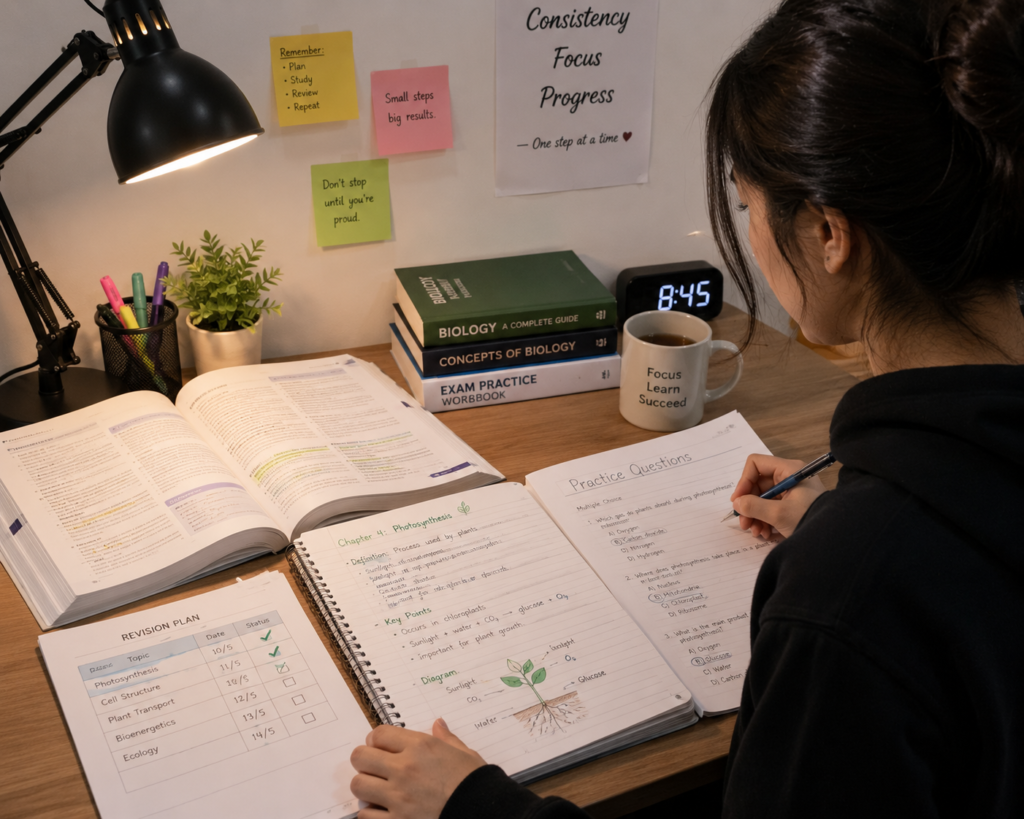
However, spreading learning over multiple sessions can provide more opportunities for understanding and review.
A student can divide a large syllabus into smaller sections and work through them gradually.
The exact pace depends on the amount of material and the available preparation time.
20. Review Your Study Habits
Every few weeks, evaluate your study routine.
Ask yourself:
- Which methods help me understand topics?
- Where do I lose concentration?
- Which subjects need more practice?
- Am I completing my goals?
- Are my study sessions realistic?
- Do I need to change my schedule?
A study routine should be adjusted when your needs change.
A Simple Study Session
Here is an example of a structured study session:
First 5 Minutes — Prepare
Choose the topic and remove distractions.
Next 20 Minutes — Learn
Read the lesson and understand the main concepts.
Next 10 Minutes — Recall
Close the material and explain what you remember.
Next 10 Minutes — Practice
Answer questions or solve problems.
Final 5 Minutes — Review
Write down what you learned and identify anything that needs further study.
This is only an example. Students can adjust the timing to suit their needs.
Study Habits for Different Subjects
Different subjects may require different approaches.
Science
Use diagrams, explanations, formulas, and practice questions.
Mathematics
Focus on understanding concepts and solving problems.
Computer Science
Combine reading with coding practice and problem-solving.
English
Read regularly, develop vocabulary, practice writing, and review grammar.
History
Use timelines, summaries, and connections between events.
The most effective method depends on the nature of the subject.
Common Study Mistakes
Studying Without a Goal
Starting without knowing what you want to accomplish can make a session unfocused.
Reading Without Testing Yourself
Repeated reading can create a feeling of familiarity without confirming actual understanding.
Ignoring Difficult Topics
Avoiding difficult material can create larger problems later.
Using Too Many Resources
Too many books and websites can become confusing.
Studying Only Before Exams
Leaving everything until the last moment can make revision difficult.
Keeping an Unrealistic Schedule
A timetable that is impossible to maintain will eventually be abandoned.
How Digital Libraries Can Support Better Study Habits
Digital libraries can complement a student’s study routine by providing access to additional reading materials.
For example, students can use a digital library to:
- Find an e-book related to a lesson.
- Search for reference material.
- Read additional articles.
- Explore a topic beyond the textbook.
- Find research resources.
Students should use legitimate resources and follow the relevant access and copyright requirements.
Conclusion
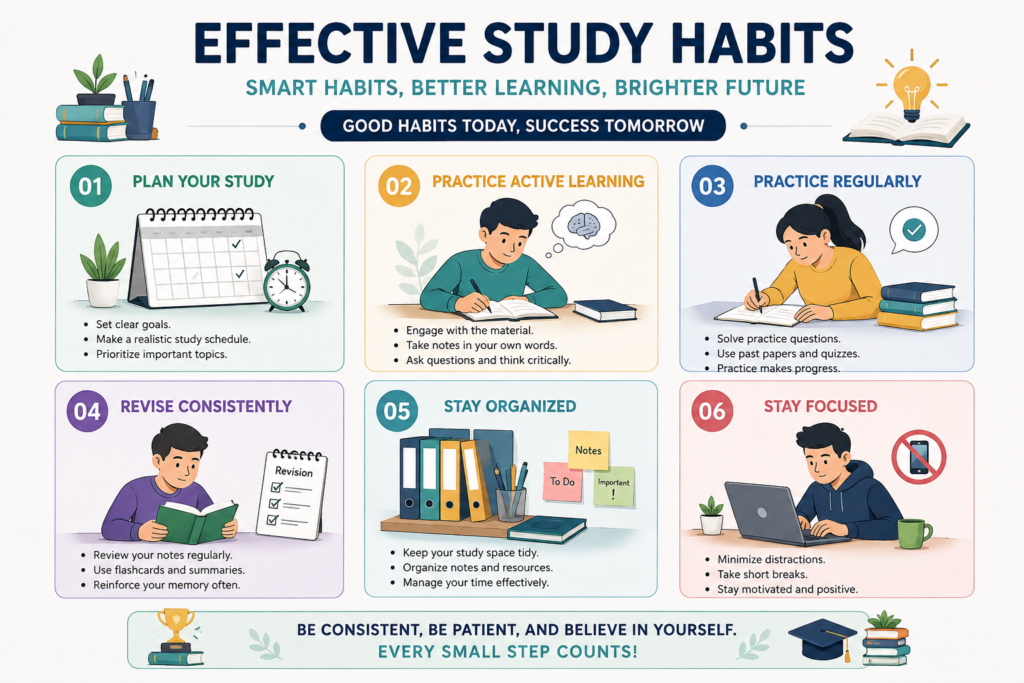
Good study habits are not about spending the maximum possible number of hours with a textbook. They are about using study time with purpose.
Students can improve their learning by setting clear goals, creating realistic schedules, organizing materials, reducing distractions, practicing actively, reviewing lessons regularly, and learning from mistakes.
Digital resources can also support education by providing access to e-books, digital libraries, research materials, and additional explanations. However, students should use these resources carefully and evaluate information before relying on it.
Most importantly, students should remember that effective learning is a gradual process. A single long study session cannot replace consistent practice and review.
Start with a few practical habits and improve them over time. A well-organized routine can make learning more manageable and help students become more independent and confident learners.
Frequently Asked Questions
1. What are the best study habits for students?
Useful habits include planning study sessions, setting clear goals, taking notes, practicing questions, reviewing regularly, and reducing distractions.
2. How long should a student study?
There is no universal number of hours. Study time should depend on the student’s subjects, responsibilities, goals, and ability to concentrate.
3. Is reading enough for effective studying?
Reading is useful, but active recall, practice, note-taking, and review can make studying more effective.
4. How can students avoid distractions?
Students can turn off unnecessary notifications, close unrelated applications, and create a suitable study environment.
5. Are digital resources useful for studying?
Yes. E-books, digital libraries, academic articles, and educational resources can provide additional information and explanations.
6. How can students remember what they study?
Regular review, active recall, practice questions, summaries, and explaining concepts in your own words can support retention.
7. What should students do when they make mistakes?
Identify why the mistake occurred, review the relevant concept, and practice a similar problem.
8. Should students study every subject in the same way?
Not necessarily. Different subjects may require different approaches, such as problem-solving for mathematics or writing practice for English.