
Introduction
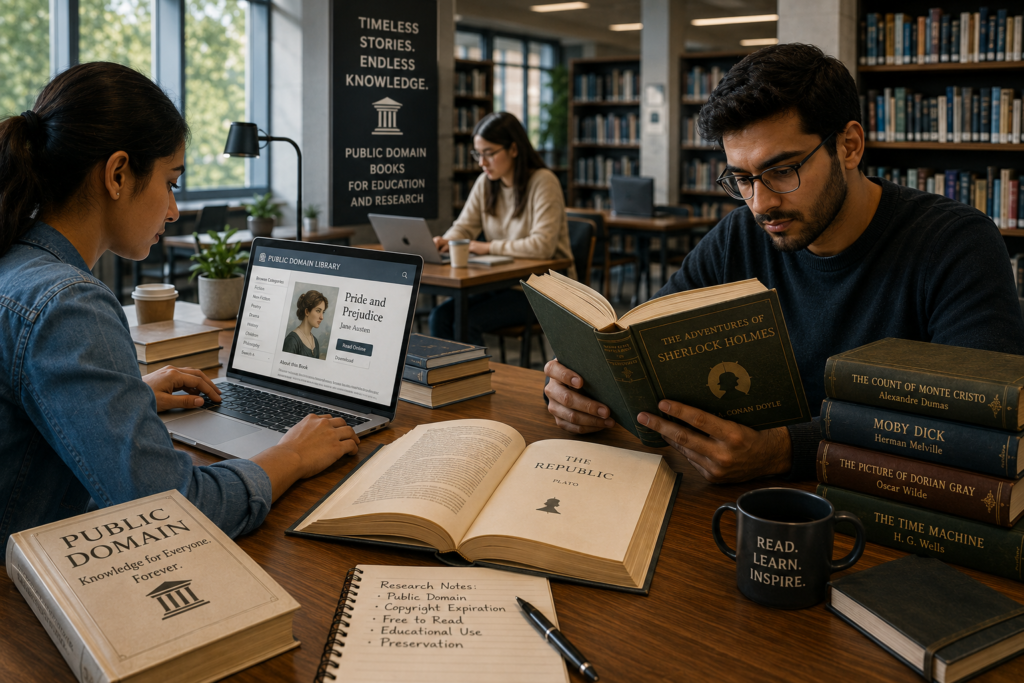
Public domain books are an important resource for students, researchers, teachers, and general readers. They can provide access to classic literature, historical texts, poetry, essays, and other works that are no longer protected by copyright in the relevant jurisdiction.
For students, these books can support literature studies, research projects, vocabulary development, and independent learning. Researchers can use historical texts to understand how ideas, language, culture, and literature developed over time.
One of the biggest advantages of public-domain books is accessibility. Many are available through libraries and digital collections, allowing readers to explore important works without needing access to expensive physical editions.
However, public-domain status should always be checked carefully because copyright laws differ between countries, and newer translations or editions may have separate copyright protection.
This article explores the major benefits of public-domain books and explains how students and researchers can use them effectively.
What Are Public Domain Books?
A public-domain book is a work that is not protected by copyright in a particular jurisdiction.
This may happen because:
- The copyright term has expired.
- Copyright did not apply to the work.
- The creator intentionally placed the work into the public domain where legally possible.
- Another legal circumstance makes the work public domain.
The exact rules vary by country.
A public-domain original should also be distinguished from newer translations, adaptations, annotations, or editions that may have their own copyright.
1. Easy Access to Classic Literature
One of the most important benefits of public-domain books is access to classic literature.
Readers can explore works from earlier periods and discover how literature developed over time.
These collections may include:
- Novels.
- Poetry.
- Plays.
- Essays.
- Short stories.
- Historical writing.
Students studying literature can use these works to understand different literary periods and writing traditions.
2. Supports Student Learning
Public-domain books can complement school and college studies.
A student studying literature might read an original classic work alongside classroom notes.
A history student might examine an older text to understand how people communicated ideas during a particular period.
Reading beyond the textbook can provide additional context and examples.
3. Useful for Research
Researchers can use public-domain texts as primary or historical sources.
They may study:
- Language.
- Literature.
- History.
- Culture.
- Education.
- Philosophy.
- Social attitudes.
For example, a researcher studying nineteenth-century literature can examine original texts from that period.
These materials can provide evidence that modern summaries cannot always provide.
4. Provides Historical Perspectives
Books preserve ideas from the periods in which they were written.
Reading historical works can help students understand:
- How people communicated.
- What subjects interested readers.
- How social issues were discussed.
- How language changed.
- How literary styles developed.
Historical texts should be read within their context, because ideas and social attitudes can change over time.
5. Helps Improve Vocabulary
Older literature can introduce students to unfamiliar vocabulary and expressions.
While reading, students can:
- Identify unfamiliar words.
- Look up their meanings.
- Examine how they are used.
- Record useful words.
- Use appropriate new vocabulary in their own writing.
This can support language development.
6. Improves Reading Comprehension
Reading complete books requires readers to follow ideas over longer periods.
Students need to remember:
- Characters.
- Events.
- Arguments.
- Themes.
- Relationships.
- Important details.
Regular practice with longer texts can help students develop stronger comprehension skills.
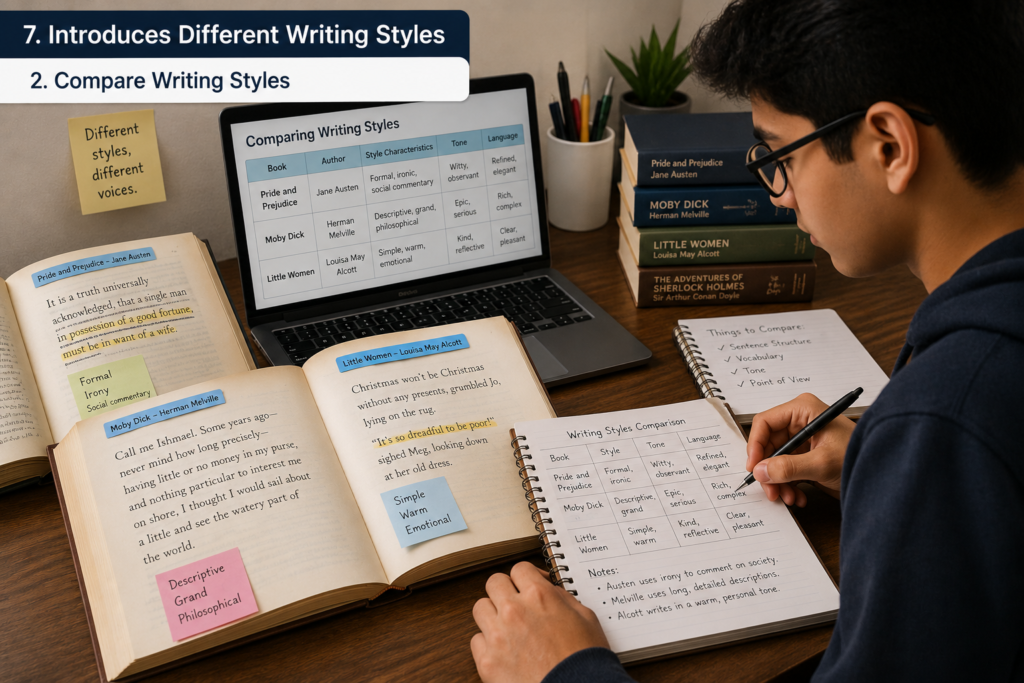
7. Introduces Different Writing Styles
Different authors have different approaches to writing.
Some may use:
- Detailed descriptions.
- Dialogue.
- Formal language.
- Satire.
- Poetry.
- Symbolism.
- Complex arguments.
Studying different styles can help students recognize how writers communicate ideas in different ways.
8. Encourages Critical Thinking
Public-domain books can encourage students to think critically.
Instead of simply accepting everything they read, students can ask:
- What is the author’s main argument?
- What evidence is provided?
- What assumptions does the author make?
- What historical context influenced the work?
- Do modern readers interpret the work differently?
These questions help turn reading into active learning.
9. Supports Literary Analysis
Literature students can use public-domain works to practice analysis.
They can examine:
Characters
How do characters develop?
Themes
What major ideas appear throughout the work?
Setting
How does the setting affect the story?
Language
What techniques does the author use?
Structure
How is the work organized?
Historical Context
How does the time period influence the writing?
10. Helps Students Compare Authors
Reading public-domain works from different authors makes comparison possible.
Students can compare:
- Writing styles.
- Themes.
- Characters.
- Historical periods.
- Genres.
- Cultural perspectives.
For example:
Author A → Author B → Similarities → Differences → Analysis
This can be useful for assignments and research.
11. Provides Resources for Teachers
Teachers can use public-domain works to create educational activities.
For example:
- Reading exercises.
- Discussion questions.
- Vocabulary activities.
- Literature assignments.
- Historical reading tasks.
- Writing exercises.
Because public-domain works can generally be used without copyright permission in the relevant jurisdiction, they can be particularly useful for creating educational materials.
The specific legal status of any additional material should still be checked.
12. Useful for Independent Learning
Students do not always need a classroom to learn from books.
Public-domain collections can support independent learning.
A student interested in:
- History.
- Literature.
- Philosophy.
- Poetry.
- Language.
can explore books independently and create a personal reading plan.
This encourages curiosity and self-directed learning.
13. Helps Preserve Cultural Heritage
Public-domain literature can preserve important cultural and historical works.
Digitization allows older books to be stored in electronic formats, reducing dependence on fragile physical copies.
Libraries and archives can preserve these works for future generations.
This makes public-domain books important not only for individual readers but also for cultural preservation.
14. Supports Digital Learning
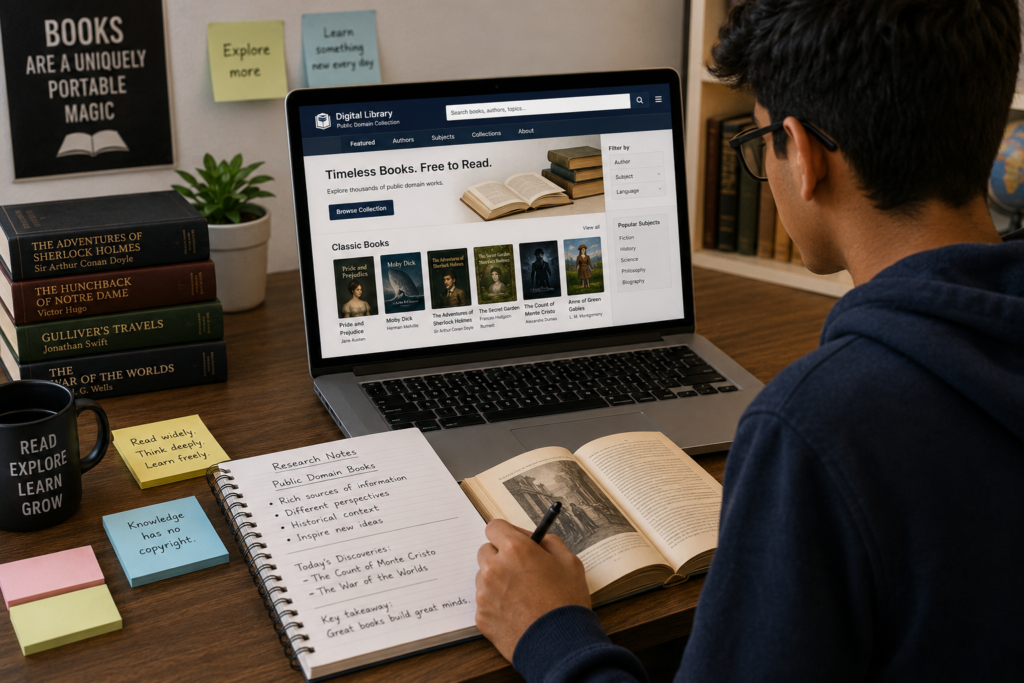
Public-domain books work particularly well with digital learning.
Readers may be able to access them through:
- E-readers.
- Computers.
- Tablets.
- Digital library platforms.
Depending on the collection, digital books may also offer searchable text and different reading formats.
This makes historical material easier to incorporate into modern learning.
15. Can Be Used for Research Projects
Students can use public-domain texts as sources for projects involving:
- Literature.
- History.
- Cultural studies.
- Language.
- Education.
For example, a student might research how the portrayal of a particular topic changed across different periods.
Public-domain books can provide original texts for comparison.
16. Encourages Reading Beyond Textbooks
Textbooks are important, but students can benefit from reading additional materials.
Public-domain books can introduce students to writers and subjects outside their required curriculum.
This can make reading more exploratory and enjoyable.
17. Can Support Writing Development
Reading good writing can help students observe how authors:
- Begin chapters.
- Develop ideas.
- Create transitions.
- Build arguments.
- Describe situations.
- Develop characters.
- Conclude sections.
Students should not copy an author’s wording, but they can learn from writing techniques and apply those lessons in their own original work.
18. Provides Primary Sources
For historical research, original texts can sometimes serve as primary sources.
A primary source is generally material created during the period or by a person directly connected to the subject being studied.
Examples can include:
- Historical books.
- Original essays.
- Diaries.
- Speeches.
- Letters.
Researchers must evaluate the reliability and context of each source rather than assuming that every historical document is automatically accurate.
19. Helps Understand Language Change
Language changes over time.
Public-domain literature can allow students to observe:
- Older vocabulary.
- Changing spelling.
- Different sentence structures.
- Historical expressions.
- Changes in writing conventions.
Comparing older and modern writing can demonstrate how language evolves.
20. Encourages Cultural Understanding
Public-domain literature from different regions can introduce readers to different cultures.
Students can learn about:
- Traditions.
- Historical experiences.
- Social structures.
- Local storytelling.
- Cultural values.
Reading across cultures can broaden perspectives when works are studied thoughtfully and in context.
21. Can Inspire Creative Projects
Public-domain works can provide inspiration for new projects.
Depending on applicable copyright law, readers may be able to create:
- Adaptations.
- Educational resources.
- New editions.
- Performances.
- Illustrations.
- Creative interpretations.
However, users must make sure that the specific material they adapt is actually public domain and that they are not incorporating separately copyrighted material.
22. Useful for Book Discussions
Public-domain books can be excellent choices for reading groups and book discussions.
Readers can discuss:
- Characters.
- Themes.
- Historical context.
- Writing style.
- Personal interpretations.
Different readers may interpret the same work differently, creating opportunities for meaningful discussion.
23. Helps Develop Research Skills
Finding and using public-domain books teaches students an important research process.
They learn to:
- Search for a source.
- Identify the author.
- Check publication information.
- Evaluate reliability.
- Check copyright status.
- Read the source.
- Take notes.
- Cite the source.
These skills are useful far beyond literature research.
24. Teaches Responsible Digital Literacy
The internet contains enormous amounts of information.
Public-domain research teaches an important lesson:
Available online does not always mean free to use.
Students need to understand:
- Copyright.
- Public domain.
- Licensing.
- Attribution.
- Source reliability.
These are essential parts of responsible digital citizenship.
25. Public Domain Books Can Connect the Past and Present
Perhaps the greatest benefit of public-domain literature is its ability to connect different generations.
A reader today can open a book written many years ago and encounter ideas, stories, and perspectives from another period.
This creates a direct connection between historical literature and modern readers.
How to Use Public Domain Books Effectively
Step 1: Choose a Purpose
Decide whether you are reading for:
- Education.
- Research.
- Entertainment.
- Historical study.
- Literary analysis.
Step 2: Choose a Suitable Book
Select a book appropriate for your topic and reading level.
Step 3: Check the Source
Use a reliable library or digital collection where possible.
Step 4: Verify Copyright Status
Remember that public-domain rules vary between jurisdictions.
Step 5: Take Useful Notes
Record important ideas, quotations, and page information.
Step 6: Cite the Source
Follow the citation style required by your school or institution.
Important Copyright Considerations
Public-domain status is not necessarily worldwide.
A work may be public domain in one country but still protected in another.
Also remember:
Public-domain original ≠ public-domain translation
and
Public-domain book ≠ every modern edition
Before publishing, redistributing, or commercially using a work, verify the applicable legal status.
Conclusion
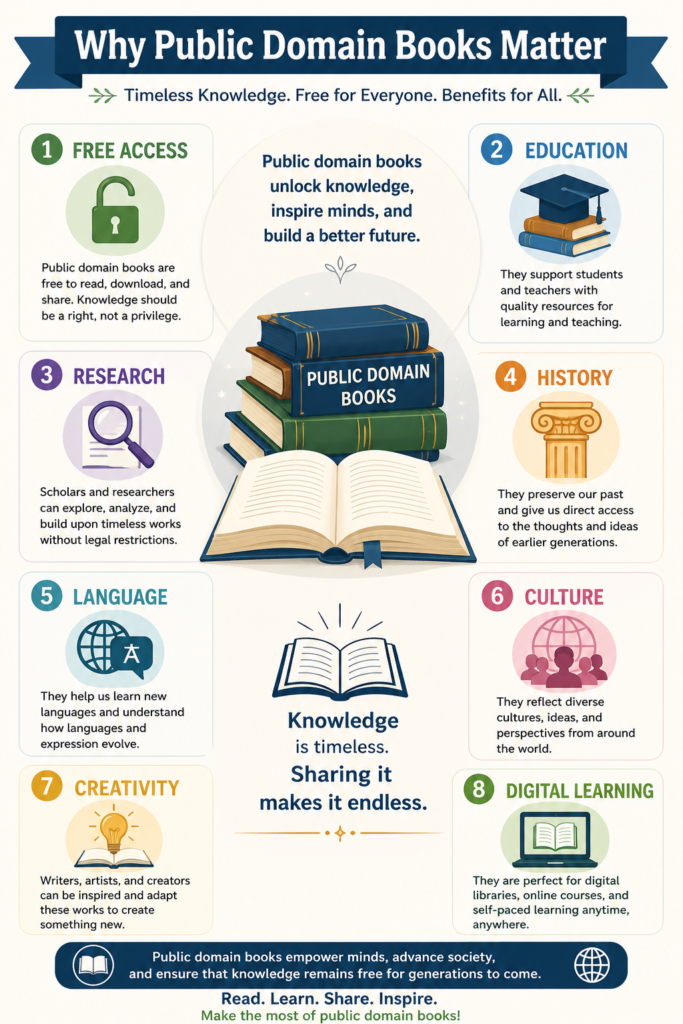
Public-domain books provide valuable opportunities for students, researchers, teachers, and general readers.
They can make classic literature and historical texts more accessible, support academic research, improve reading skills, introduce different writing styles, and help readers understand cultural and historical perspectives.
For students, these books can be used to practice literary analysis, vocabulary development, critical thinking, research, and independent learning. Researchers can use them to examine original texts and investigate how literature, language, and ideas have changed over time.
Digital libraries have made many public-domain works easier to discover and access. However, readers should remember that public-domain status depends on the relevant copyright laws and jurisdiction. A modern translation, annotated edition, illustration, or other adaptation may have separate copyright protection.
The best approach is to verify the status of the exact material being used, select reliable sources, take organized notes, and provide proper citations.
Public-domain books are more than old books. They are valuable connections to literature, history, culture, and knowledge. When used responsibly, they can help today’s students and researchers learn from the written works of earlier generations.
Frequently Asked Questions
1. What are the main benefits of public-domain books?
They can provide access to classic literature, historical texts, educational materials, and research sources without copyright restrictions applying to the underlying public-domain work.
2. Are public-domain books useful for students?
Yes. They can support literature studies, vocabulary development, research, critical thinking, and independent learning.
3. Can researchers use public-domain books?
Yes. Public-domain books can be valuable primary or historical sources, depending on the research topic.
4. Do public-domain books need citations?
Yes. Public-domain status does not eliminate the need for academic attribution.
5. Can I modify a public-domain book?
Generally, public-domain works can be adapted or modified, but users should verify that all material being used is actually public domain.
6. Are public-domain translations free to use?
Not necessarily. A newer translation may have its own copyright.
7. Where can students find public-domain books?
Students can search libraries, university collections, national library resources, and reputable digital repositories.
8. Why are public-domain books important for digital libraries?
They allow libraries and archives to preserve historical works digitally and make them more accessible to readers.