
Introduction
Books are an important source of knowledge, education, history, and entertainment. However, not every book is available for people to freely copy, modify, or redistribute. Copyright law gives creators certain rights over their works for a particular period.
When copyright protection expires, a work may enter the public domain. Public-domain works can generally be used by the public without needing permission from the original copyright holder, although the exact rules can depend on the country and the specific work.
Public-domain books are especially valuable for students, researchers, teachers, libraries, and readers interested in classic literature and historical works. They can provide access to older novels, poems, plays, essays, and other written materials.
This article explains what public domain means, how books enter the public domain, why public-domain books are useful, and how readers can find and use them responsibly.
What Does Public Domain Mean?
The public domain refers to creative works that are not protected by copyright in a particular jurisdiction.
This can happen for several reasons. For example, copyright protection may have expired, or a work may never have been eligible for copyright protection under the applicable law.
Once a work is in the public domain, people can generally use it without obtaining permission from a copyright owner.
However, an important point is that public-domain status can vary between countries.
A book that is public domain in one country may still be protected in another.
What Is Copyright?
Copyright is a form of legal protection given to creators of original works.
Depending on the applicable law, copyright can give the rights holder control over activities such as:
- Reproduction.
- Distribution.
- Adaptation.
- Public performance.
- Certain forms of public communication.
Copyright is intended to give creators legal control over the use of their work for a defined period.
After the applicable copyright term ends, a work may enter the public domain.
Public Domain vs. Copyrighted Books
The difference can be understood simply.
Copyrighted Book
The work is still protected by copyright. Certain uses may require permission or must fall within an applicable legal exception or license.
Public-Domain Book
Copyright protection has expired or otherwise does not apply to the work in the relevant jurisdiction, allowing uses that would otherwise require copyright permission.
However, readers should still check the legal status of a particular edition, translation, or digital file.
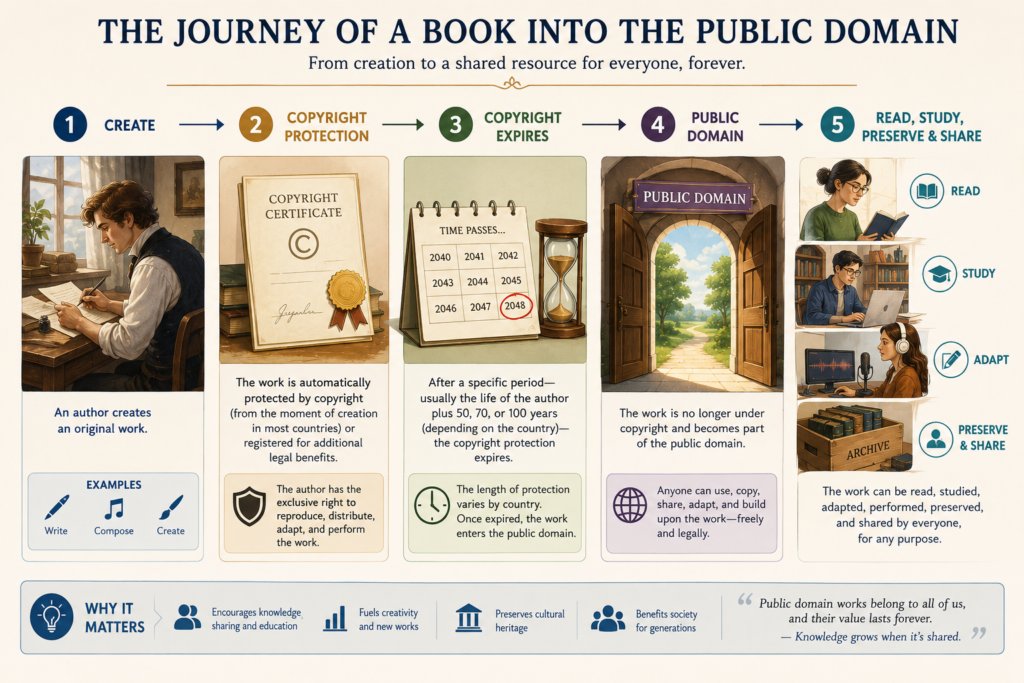
How Does a Book Enter the Public Domain?
There is no single rule that applies to every country and every work.
A work may enter the public domain because:
- Its copyright term has expired.
- The work was created under circumstances where copyright did not apply.
- The creator intentionally dedicated the work to the public domain where legally possible.
- Other legal circumstances prevent copyright protection from applying.
The specific rules depend on the country’s copyright law.
This is why readers should be careful when making statements about whether a particular book is public domain worldwide.
Why Do Copyright Terms Matter?
Copyright terms determine how long copyright protection lasts.
The term can depend on factors such as:
- Country.
- Date of publication.
- Date of creation.
- Date of the author’s death.
- Type of work.
- Whether the work was published.
- Special historical copyright rules.
Because these rules can be complicated, readers should verify public-domain status using reliable sources when legal certainty is important.
Are All Old Books Public Domain?
No.
A book being old does not automatically mean that it is public domain everywhere.
For example, an older original work may be public domain while a newer translation of that work may still be protected by copyright.
Similarly, a new introduction, annotations, illustrations, or editorial material can have separate copyright protection.
Therefore, readers should distinguish between:
The original work
and
A particular modern edition of the work.
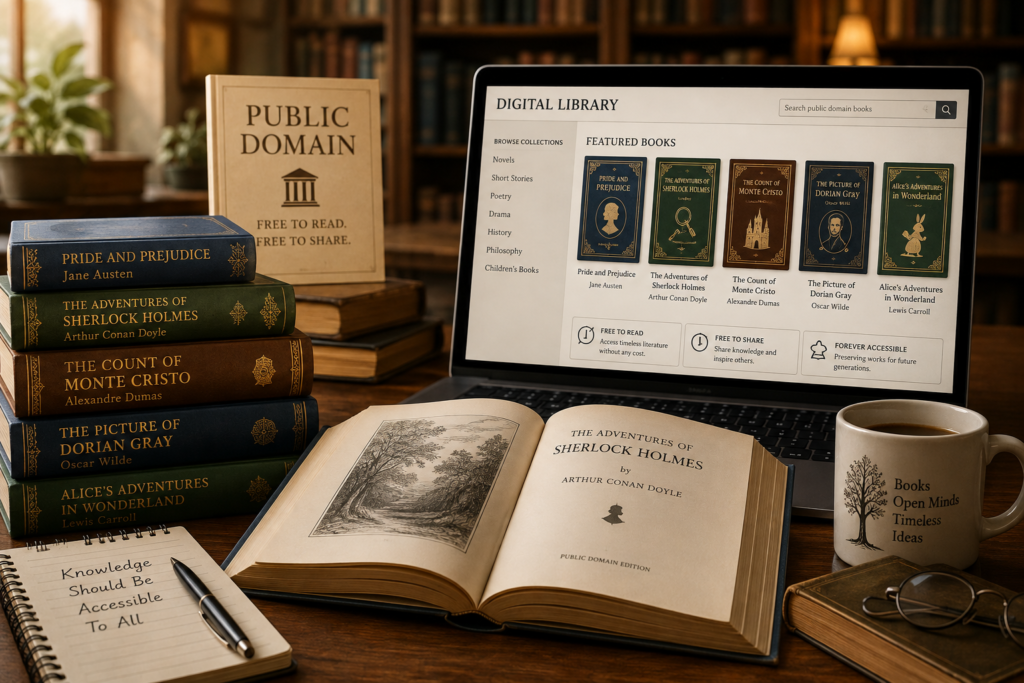
Public Domain and Digital Libraries
Public-domain books are particularly useful for digital libraries because they can often be digitized and made available to readers without obtaining permission from a copyright owner for the public-domain text itself.
Digital libraries can organize these works by:
- Author.
- Title.
- Subject.
- Language.
- Publication period.
- Genre.
This makes it easier for students and researchers to discover historical and literary materials.
Benefits of Public Domain Books
1. Access to Classic Literature
Public-domain collections can include important works from earlier periods.
Students can explore:
- Classic novels.
- Poetry.
- Plays.
- Essays.
- Historical writing.
- Philosophical works.
This allows readers to explore literary history without being limited to recently published books.
2. Useful for Education
Teachers and students can use public-domain works for educational activities, subject discussions, and literary analysis where appropriate.
Students can study:
- Themes.
- Characters.
- Writing styles.
- Historical context.
- Vocabulary.
- Literary techniques.
Public-domain works can therefore support classroom and independent learning.
3. Useful for Research
Researchers can use public-domain sources to study historical texts, literary development, cultural changes, and earlier ideas.
For example, a literature student might compare an original public-domain novel with later interpretations or adaptations.
4. Accessibility
Public-domain books can often be available through digital collections in formats that make reading easier.
Depending on the platform, readers may find:
- E-books.
- Scanned pages.
- Searchable text.
- Different file formats.
This can make historical literature easier to access.
5. Opportunity for New Creative Work
Public-domain works can also provide opportunities for new creative projects.
Depending on applicable law, creators can potentially:
- Adapt stories.
- Create new editions.
- Produce translations.
- Develop educational versions.
- Create performances.
However, the creator should make sure that the specific source material being used is actually public domain.
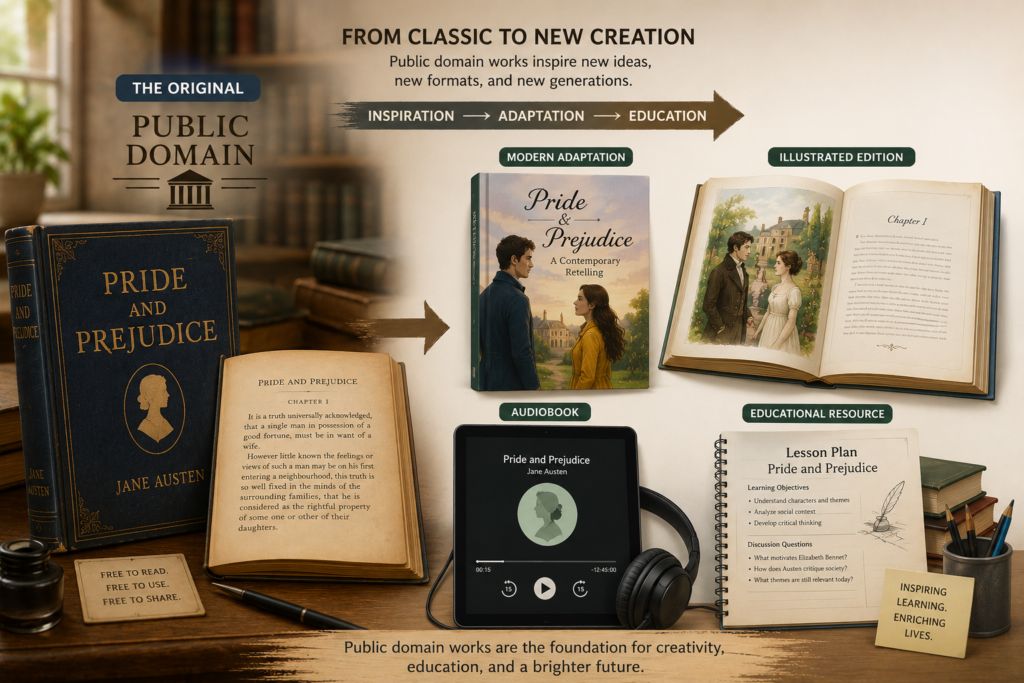
Public Domain Does Not Mean “Free in Every Possible Way”
This is an important distinction.
When the underlying work is public domain, that does not necessarily mean that every copy, edition, translation, photograph, or recording of it is also free of copyright.
For example:
Original public-domain novel
may be freely usable.
But:
Modern translation of that novel
may have its own copyright.
Likewise, a modern annotated edition may contain new copyrighted material.
Always identify exactly what material you are using.
Public Domain and Translations
Translations deserve special attention.
Suppose an original novel was written many years ago and is now public domain.
A translation created much later may still be protected by copyright.
Therefore:
Original work ≠ every translation
Students should check the status of the particular translation they want to use.
Public Domain and Illustrations
The same principle applies to illustrations.
An old book may contain public-domain illustrations, but a modern edition may add new artwork.
A reader should not assume that every image associated with a public-domain book is automatically public domain.
When using images online, verify their licensing or copyright status separately.
How Students Can Use Public Domain Books
Students can use public-domain books in several educational ways.
Literature Study
Analyze characters, themes, language, and literary techniques.
Historical Study
Examine how people wrote and communicated during earlier periods.
Vocabulary Development
Study older and formal language in context.
Comparative Research
Compare different editions, authors, or literary traditions.
Writing Practice
Study how experienced authors structure stories and arguments.
How to Find Public Domain Books
Readers can look for public-domain works through:
- Libraries.
- Digital library collections.
- University libraries.
- National library collections.
- Reputable public-domain repositories.
- Copyright information databases.
When searching online, do not assume that a website’s label automatically proves worldwide public-domain status.
Look for information about:
- The original publication.
- Author.
- Date.
- Copyright status.
- Country or jurisdiction.
- Edition or translation.
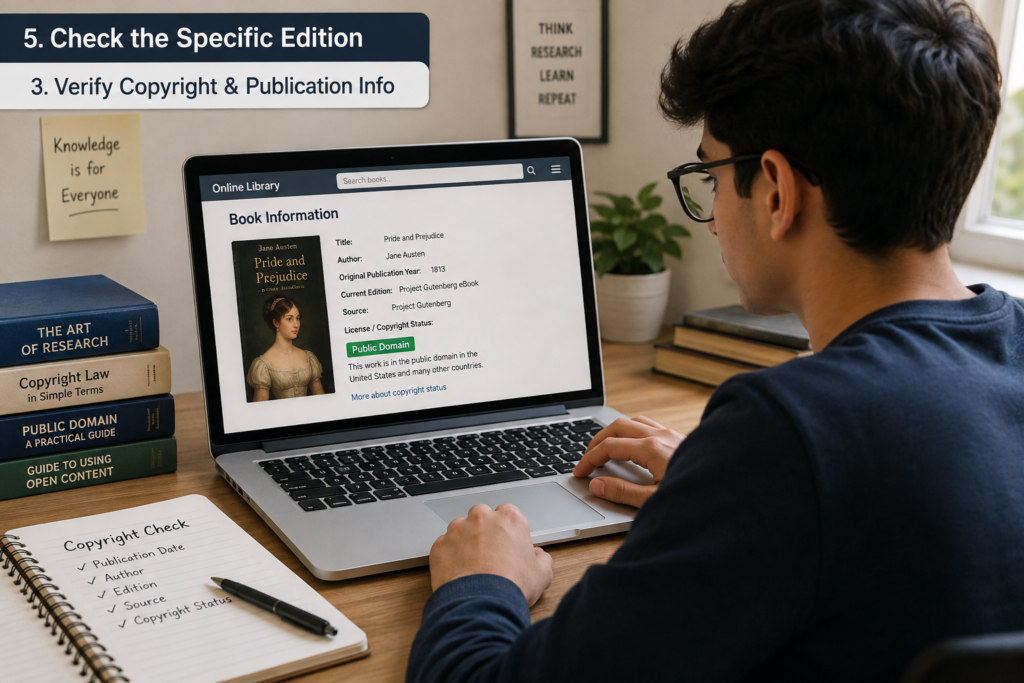
How to Check a Public Domain Book
Before using a book for a project, follow these steps.
Step 1: Identify the Work
Record the exact title and author.
Step 2: Check Publication Information
Find the publication date and edition details.
Step 3: Identify the Country
Determine which country’s copyright rules matter for your intended use.
Step 4: Check the Copyright Status
Use a reliable source to determine whether the work is public domain.
Step 5: Check the Specific Edition
Make sure you are not accidentally using a copyrighted translation, introduction, annotations, or illustrations.
Public Domain Books for Researchers
Researchers can benefit from public-domain collections because historical texts provide evidence about earlier periods.
Researchers may study:
- Historical language.
- Social attitudes.
- Literary movements.
- Cultural traditions.
- Educational practices.
- Historical events.
- Changes in writing styles.
When using public-domain books in academic research, students should still provide proper citations.
Public domain does not mean citation is unnecessary.
Academic honesty requires readers to acknowledge their sources.
Public Domain and Academic Citations
Even if a book is public domain, students should cite it when they use information, quotations, ideas, or evidence from it.
A citation helps readers:
- Identify the source.
- Find the original material.
- Verify information.
- Understand where an idea came from.
Public-domain status concerns copyright. Citation concerns academic attribution.
These are different concepts.
Public Domain Books and Open Education
Public-domain works can also contribute to educational resources.
Teachers and educational websites may use public-domain material to create:
- Reading exercises.
- Historical resources.
- Literature lessons.
- Study guides.
- Educational activities.
The legal status of any new material added to the resource should still be considered separately.
Common Misunderstandings About Public Domain
“Every old book is public domain.”
Not necessarily. Copyright rules vary.
“If I find it online, it must be public domain.”
False. Online availability does not automatically remove copyright.
“A public-domain book needs no citation.”
False. Academic sources should still be cited.
“A public-domain original makes every translation public domain.”
False. Translations can have separate copyright.
“Everything on a public-domain website is automatically public domain.”
Not necessarily. Check the status of the specific material.
Public Domain and Modern Editions
Modern editions can contain new material such as:
- Introductions.
- Notes.
- Commentary.
- New translations.
- Illustrations.
- Editorial material.
The original work may be public domain while these additions remain protected.
This distinction is especially important for students who download books from digital collections.
Why Public Domain Matters for Libraries
Public-domain works help libraries preserve and provide access to cultural and historical materials.
Digitization can protect older texts from physical deterioration while making them available to a wider audience.
Digital collections can also allow readers to search and access materials without physically visiting a library.
This is one reason public-domain literature remains valuable in the digital age.
Public Domain and Cultural Heritage
Public-domain books can provide access to literary and historical heritage.
They allow new generations to explore works created during earlier periods.
Readers can discover:
- Historical stories.
- Traditional literature.
- Classic poetry.
- Early educational texts.
- Philosophical writing.
These works can help people understand how literature and ideas developed over time.
Tips for Using Public Domain Books Responsibly
1. Verify the Status
Do not rely on assumptions.
2. Check the Jurisdiction
Copyright rules can differ between countries.
3. Check the Edition
A modern translation or edition may have separate rights.
4. Cite Your Sources
Use proper academic citations.
5. Respect Additional Rights
Images, recordings, and supplementary material may have separate copyright.
6. Use Reliable Collections
Prefer established libraries and reputable digital repositories.
Why Students Should Explore Public Domain Books
Public-domain books offer an opportunity to explore literature and historical knowledge while learning how copyright works.
Students can discover classic authors, compare writing styles, study historical perspectives, and use older sources in research.
They also learn an important digital-literacy skill:
Not everything available online is automatically free to use.
Understanding copyright and public-domain status helps students become more responsible users of information.
Conclusion
Public-domain books are an important part of the world’s literary and educational heritage.
They can provide access to classic literature, historical texts, poetry, plays, essays, and many other forms of writing. Students can use these resources to develop reading skills, explore different cultures, study literary history, and support research.
However, public-domain status should be understood carefully. A work may be public domain in one country but protected in another. A public-domain original may also have modern translations, annotations, illustrations, or editions that carry separate copyright protection.
The safest approach is to identify the exact work and edition, check its copyright status using reliable information, and cite the source properly when using it for academic purposes.
For digital libraries and educational websites, public-domain books can be especially valuable because they help preserve older works and make them accessible to new generations.
Ultimately, public-domain literature connects the past with the present. It allows today’s readers to discover ideas and stories from earlier generations while encouraging responsible and informed use of digital resources.
Frequently Asked Questions
1. What are public-domain books?
Public-domain books are works that are not protected by copyright in the relevant jurisdiction, allowing uses that would otherwise require copyright permission.
2. Are public-domain books free?
The public-domain work itself can generally be used without copyright permission, but access, scanning, formatting, or a particular edition may involve other considerations.
3. Can students use public-domain books for assignments?
Yes. They can be valuable sources for literature, history, and research assignments. Students should still cite them properly.
4. Are all old books public domain?
No. Age alone does not determine public-domain status. Copyright rules vary by country and by work.
5. Can I copy a public-domain book?
Generally, public-domain works can be copied, subject to applicable law and any separate rights in the particular edition or accompanying material.
6. Are modern translations of public-domain books also public domain?
Not necessarily. A newer translation may have its own copyright protection.
7. Do I need to cite a public-domain book?
Yes. Public-domain status does not remove the need for academic attribution.
8. Where can I find public-domain books?
Libraries, university collections, national libraries, and reputable digital repositories can be useful places to search.