
Introduction
Libraries have always been at the heart of education, research, and lifelong learning. For centuries, traditional libraries have provided people with access to books, manuscripts, newspapers, and reference materials in physical spaces designed for study and knowledge sharing. In recent decades, however, digital libraries have emerged as a modern alternative, allowing users to access educational resources through computers, tablets, and smartphones.
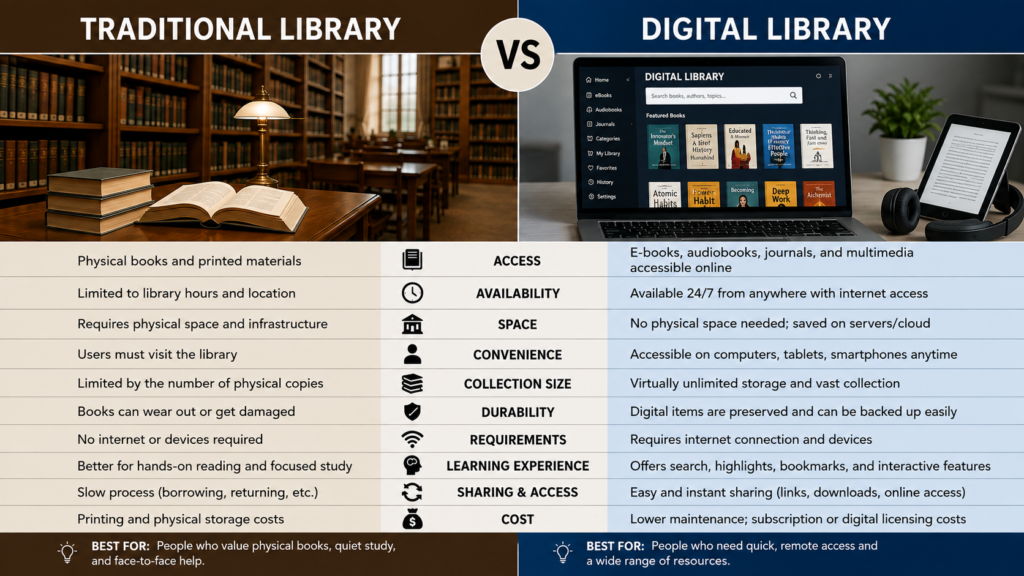
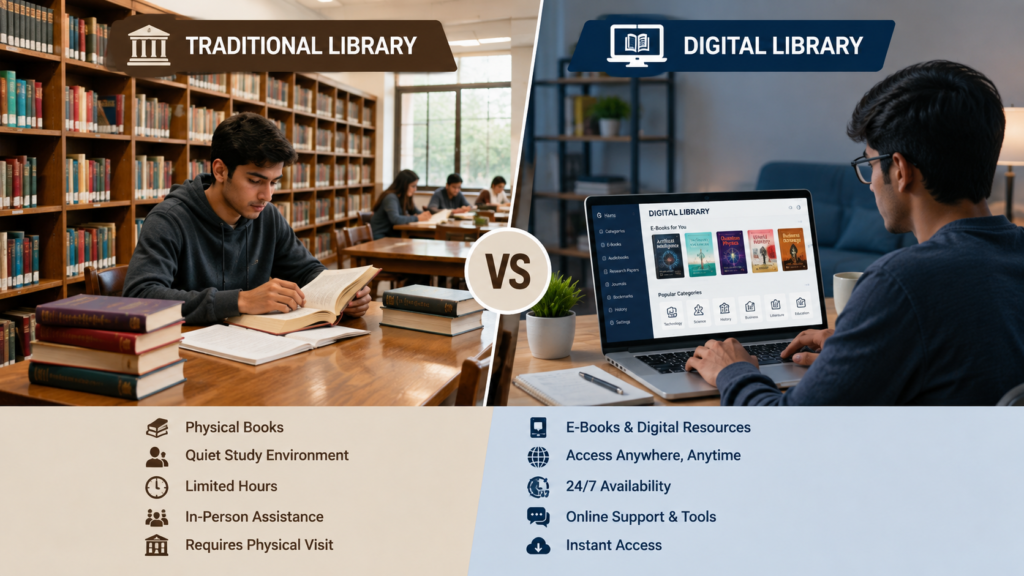
Both digital and traditional libraries play an important role in education, but they offer different experiences. Traditional libraries provide a quiet environment, physical books, and personal interaction with librarians, while digital libraries focus on convenience, speed, and online accessibility.
Understanding the differences between these two types of libraries helps students, teachers, researchers, and general readers choose the most suitable resource for their needs. Rather than competing with each other, digital and traditional libraries often complement one another by offering different ways to access information.
In this article, we compare digital libraries and traditional libraries in detail, exploring their features, advantages, limitations, and ideal use cases.
What Is a Traditional Library?
A traditional library is a physical place where books, journals, newspapers, magazines, maps, and other educational resources are stored. Visitors travel to the library to borrow books, read in quiet study areas, or receive assistance from librarians.
Traditional libraries are commonly found in schools, colleges, universities, and public institutions. Besides lending books, many libraries organize educational programs, reading clubs, workshops, and community events.
One of the greatest strengths of traditional libraries is the physical reading experience. Many readers enjoy holding printed books, turning pages, and studying in a peaceful environment free from many digital distractions.
What Is a Digital Library?
A digital library is an organized online collection of educational and informational resources available in electronic formats. Users can search, read, and sometimes download materials using internet-connected devices such as laptops, tablets, and smartphones.
Digital libraries often include eBooks, research papers, scholarly journals, theses, historical archives, multimedia content, and educational databases. Advanced search features allow users to locate specific information quickly through keywords, author names, subjects, or publication dates.
Unlike traditional libraries, digital libraries provide flexible access without requiring users to visit a physical location.
Accessibility
One of the most significant differences between digital and traditional libraries is accessibility.
Traditional libraries usually operate during fixed opening hours. Users must travel to the library, locate the required resources, and borrow or read them on-site. This process works well for local visitors but may be difficult for people living far away or with limited transportation.
Digital libraries remove many of these barriers by providing online access to resources. Students and researchers can often study from home, during travel, or from almost anywhere with internet access and the necessary permissions.
For learners who need flexible study schedules, digital libraries offer a major advantage.
Availability of Resources
Traditional libraries are limited by physical space. They can store only a certain number of books and printed materials. If a book is already borrowed, other users may need to wait until it is returned.
Digital libraries can host much larger collections because electronic resources do not require physical shelving. Many users can often access the same digital resource simultaneously, depending on licensing terms.
Additionally, digital libraries can expand their collections more quickly by adding new digital publications without requiring additional building space.
Search and Discovery
Finding information differs greatly between the two library systems.
In traditional libraries, users may browse shelves, consult catalogues, or ask librarians for assistance. Although this process can encourage exploration, it may also require more time.
Digital libraries provide advanced search tools that allow users to find resources within seconds. Searches can be filtered by title, author, keyword, publication year, language, subject, and document type, making research much faster.
Cost Comparison
Cost is one of the major differences between digital libraries and traditional libraries.
Traditional libraries require buildings, furniture, bookshelves, maintenance, electricity, and staff. New printed books must be purchased regularly, and damaged books often need to be replaced. These ongoing expenses make physical libraries costly to maintain.
Digital libraries also require investment in servers, software, website maintenance, cybersecurity, and digital licenses. However, once resources are added, they can often be accessed by many users simultaneously without printing additional copies. This makes digital libraries more scalable for large organizations.
For students, digital libraries may reduce expenses because many educational resources are available through public-domain collections or institutional subscriptions.
Learning Experience
The learning experience differs depending on personal preferences.
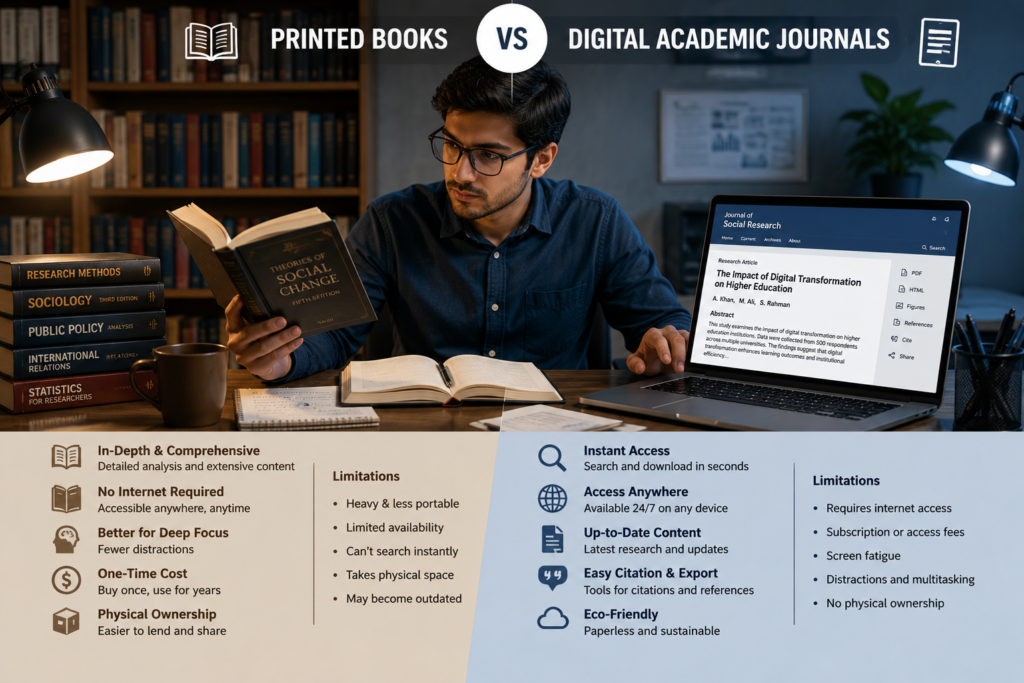
Many readers enjoy traditional libraries because they provide a quiet atmosphere with fewer distractions. Reading printed books can improve concentration and reduce screen fatigue for some people. Libraries also offer study spaces where students can work individually or in groups.
Digital libraries provide a different experience. Users can search instantly, highlight text, bookmark pages, and switch between multiple resources without carrying heavy books. They also support multimedia learning by including videos, audio materials, and interactive educational content.
Neither method is universally better; many learners benefit from using both depending on the situation.
Research Efficiency
Researchers often need access to large numbers of academic publications.
Traditional libraries provide carefully organized collections, special archives, and professional librarian support. However, finding information manually can take time.
Digital libraries greatly improve research efficiency through advanced search tools, keyword searches, citation support, and subject filters. Researchers can often compare multiple scholarly articles within minutes, helping them complete literature reviews more effectively.
For academic research, digital libraries have become indispensable because they provide quick access to current publications from around the world.
Benefits for Students
Students benefit from both types of libraries.
Traditional Libraries
- Quiet study environment.
- Access to printed textbooks.
- Face-to-face assistance from librarians.
- Encourages focused reading.
Digital Libraries
- Study anytime and anywhere.
- Quick search capabilities.
- Access to updated research.
- Convenient for online learning.
- Supports mobile learning.
Combining both resources gives students the greatest flexibility and learning opportunities.
Benefits for Teachers
Teachers also benefit from both systems.
Traditional libraries provide printed teaching materials, curriculum references, and educational collections that support classroom instruction.
Digital libraries help teachers discover updated lesson plans, research papers, multimedia content, and educational resources that enhance classroom learning and online teaching.
Environmental Impact
Traditional libraries depend on printed books, which require paper, ink, transportation, and storage.
Digital libraries reduce the need for printed copies and make electronic distribution possible. While digital technology also consumes electricity and electronic devices require manufacturing, digital collections can reduce paper usage for many educational materials.
Sustainable education increasingly combines digital resources with responsible use of printed materials.
Advantages of Traditional Libraries
- Comfortable reading environment.
- Physical interaction with books.
- Professional librarian assistance.
- Community learning spaces.
- Less dependence on technology.
- Excellent for extended reading sessions.
Advantages of Digital Libraries
- Available 24/7.
- Accessible from multiple devices.
- Fast search features.
- Large collections.
- Frequently updated resources.
- Supports distance education.
- Convenient for research.
- Easy resource organization.
Which Library Is Better?
The answer depends on individual needs.
If someone enjoys reading printed books in a peaceful environment, traditional libraries remain an excellent choice.
If someone values convenience, flexibility, and quick access to information, digital libraries provide significant advantages.
Rather than replacing each other, both systems complement one another. Many universities successfully combine physical libraries with digital collections to provide students with the best possible learning experience.
Conclusion
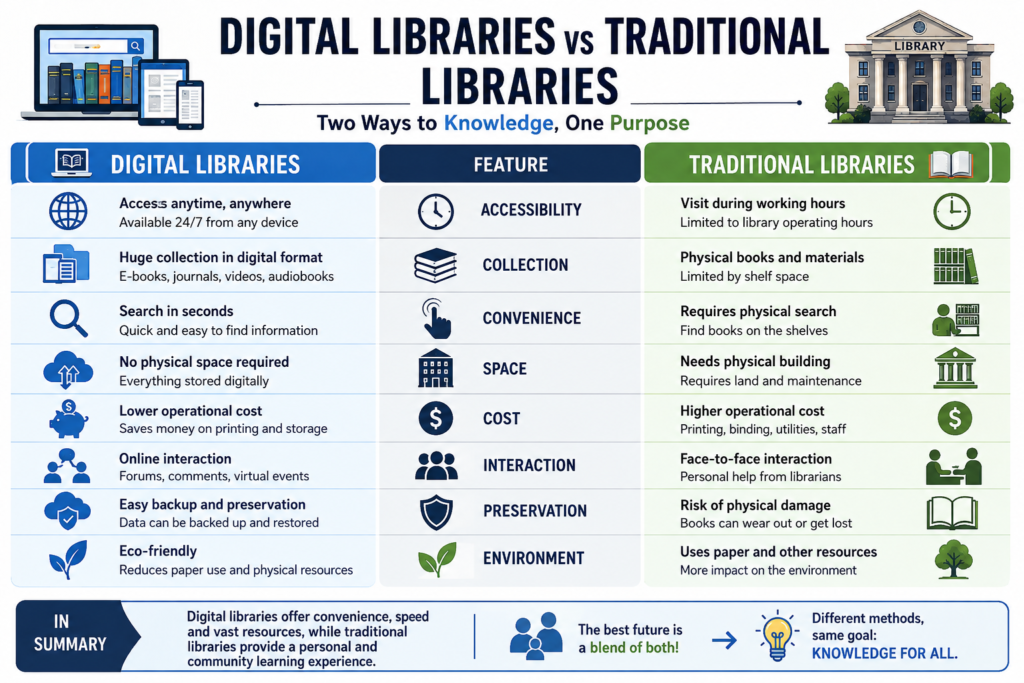
Digital libraries and traditional libraries each play an important role in education, research, and lifelong learning. Traditional libraries offer the experience of reading physical books in dedicated learning spaces, while digital libraries provide instant access to vast collections of educational resources from almost anywhere.
Modern education benefits most when both systems work together. Students can enjoy the focused atmosphere of a traditional library while also taking advantage of the speed and accessibility of digital libraries for research and online learning.
As technology continues to evolve, digital libraries will become even more advanced. At the same time, traditional libraries will remain valuable cultural and educational institutions that preserve printed knowledge and foster community learning.
The future of learning is not about choosing one over the other—it is about using the strengths of both to create a richer and more effective educational experience.
Frequently Asked Questions (FAQs)
1. What is the main difference between a digital library and a traditional library?
A traditional library stores physical books and resources in a building, while a digital library provides electronic access to books, journals, and educational materials through the internet.
2. Which library is better for students?
Both are useful. Traditional libraries offer quiet study spaces, while digital libraries provide flexibility and quick access to information.
3. Are digital libraries replacing traditional libraries?
No. Digital libraries complement traditional libraries rather than completely replacing them.
4. Can researchers use both types of libraries?
Yes. Researchers often combine printed resources from traditional libraries with digital journals and online databases.
5. Do digital libraries save time?
Yes. Advanced search tools help users find information much faster than manual searching.
6. Why are traditional libraries still important?
They preserve physical collections, provide study spaces, and offer personal assistance from librarians.